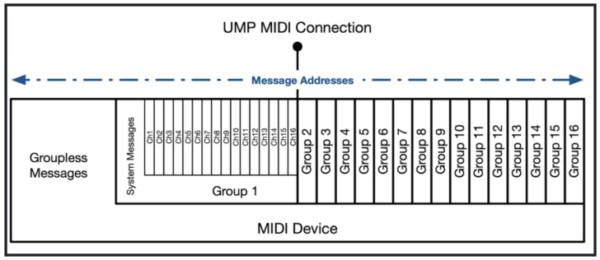
Are you are looking for some light reading? Over 350 pages of new MIDI 2.0 specifications have just been published. The documents detail an updated core spec and a brand-new spec for the MIDI 2.0 SMF Clip File.
After three years of intensive prototyping and many virtual and face to face meetings, The Association of Musical Electronics Industry (AMEI) and The MIDI Association have published 4 significantly updated MIDI 2.0 core specifications and a brand new specification for the MIDI 2.0 SMF Clip File.
It might not mean a lot to most of us, but the MIDI Association says that these new specifications are the result of many years of volunteer work by its own members and those of the AMEI, and consist of over 350 pages of detailed specifications.
These core specifications define the architectural foundations for MIDI 2.0 and define minimum requirements for devices to claim MIDI 2.0 compatibility and to apply to use the MIDI Association’s MIDI 2.0 logo.
Anyone who is interested can download the documents for free from the MIDI Association website. There are also plans to open a MIDI Association Github and fill it with tools and source code that will be available under a permissive MIT licence to all developers.
AMEI and The MIDI Association have provided the specifications for free download, but you have to register first:
As many of you know, MIDI 2.0 has been in the works for several years now, and the latest developments follows public demos of MIDI 2.0 were shown off at the recent April 2023 NAMM show:
Roland and Synthogy teamed up to demonstrate MIDI 2.0 High Resolution Velocity using an Apple computer and the publicly available version of Logic.
There were working prototypes of both Microsoft and Linux MIDI 2.0 drivers.
And Korg, Bome Box and Analog Devices were all showing prototype products that implemented MIDI 2.0.
Does your computer have the juice to handle 1000 oscillators? Mille Drone Synthesizer features 1000 Oscillators, 200 filters and more, but may make your Mac weep.
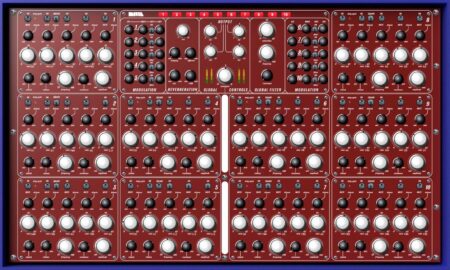
Developer Giorgio Sancristoforo – creator of unique software synths like Bento, Berna and Gleetchlab – has introduced Mille, a standalone drone synthesizer for MacOS, featuring 1000 oscillators, 200 filters and 200 LFOs.
Thanks to its architecture, Mille can create dense and evolving drones that sound huge. Mille is designed for stereo or quadraphonic surround sound, meaning 500 or 250 oscillators per channel, creating what Sancristoforo describes as a ‘giant immersive wall of sound’.
You can use the sections to create different drones that you activate and deactivate with the trigs/gates, making it possible to create a performance that can evolve over time. You can think of the sections as part of one giant drone, or you can think of them as independent drones that you can turn on and off at will. Using very slow envelopes (up to 2 minutes) enables you create smooth transition from one drone to another.
Other features include an 8-track recorder. You can export single tracks, stereo or quadraphonic files, according to your requirements.
Mille is available now for €19.50. A free demo version is also available.
Giorgio Sancristoforo says “I STRONGLY suggest you try the software before buying it to see if your computer has the necessary processing power.” An M1 processor or greater is recommended.
Synth pioneer Tom Oberheim has announced that the Oberheim OB-X8 Desktop synthesizer module is now available.
The OB-X8 desktop version condenses the sonic power of the Oberheim OB-X, OB-Xa and OB-8 into a compact desktop module. It features an identical sound engine to the keyboard version, with an all-analog signal path with discrete VCOs, VCAs, and filters.
And like the keyboard version, it features a knob-per-function interface, designed to give you immediate access to virtually all of the synth’s parameters. The Arpeggiator and Keyboard Split & Double functionality are maintained from the keyboard version.
Features:
8-voice polyphonic analog synth brings the full suite of OB-X8’s sonic possibilities to a portable desktop module
3 all-analog synths in one: the Oberheim OB-X, OB-Xa, and OB-8
2 discrete OB-X/SEM-lineage VCOs per voice and discrete SEM-lineage VCFs deliver vintage Oberheim tone and power
Genuine Dave Curtis-designed filters for classic OB-Xa and OB-8 character
Additional SEM modes for highpass, bandpass, and notch functions
Vintage knob dials in voice-to-voice variability
Carefully modeled envelope responses for each model; components as well as interactions between components analyzed for 1:1 realism
Bi-timbral capability allows 2 presets to be played simultaneously
Up to 8-voice unison stacking
Programmable per-voice pan for a wide stereo spread
Variable triangle wave cross modulation
Pitch and Mod levers for note bending, vibrato, and arpeggiator access
Includes 400+ presets from the original 3 models as well as new ones
Over 600 user presets
OLED display shows program information and accesses advanced features
MIDI and USB allow for compatibility with any setup