New Smart Gloves ‘could allow stroke patients to relearn how to play the piano’
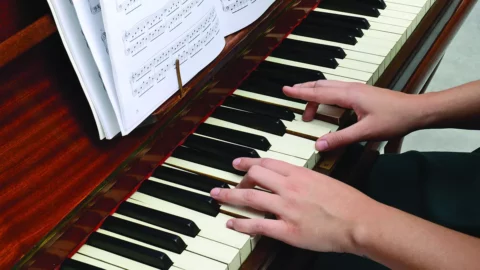

A new pair of Smart Gloves could be used to help stroke patients who are suffering from limb weakness to relearn how to play the piano, research has indicated.

Machine learning mitts can assist hand movements – Scientists have developed an exoskeleton glove or robo-glove that features machine learning algorithms, fingertip sensors and moving components known as actuators, which mimic hand movements. The theory is that it can ‘teach’ the wearer how to play the piano again by guiding them on where they’re going right and wrong.
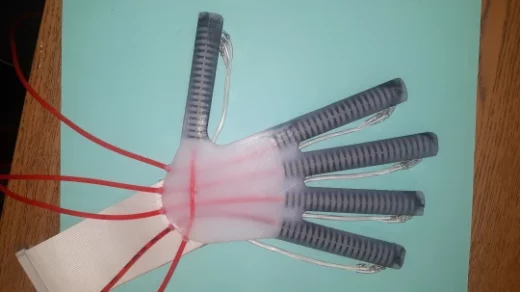
Dr Erik Engeberg, a professor at Florida Atlantic University’s department of ocean and mechanical engineering, is quoted as saying: “We found that the glove can learn to distinguish between correct and incorrect piano play.

“This means it could be a valuable tool for personalised rehabilitation of people who wish to relearn to play music.”

The study, which has been published in Frontiers in Robotics and AI, indicates that the gloves are capable of detecting where a player went wrong during their performance, so that they know where they need to improve.

“While wearing the glove, human users have control over the movement of each finger to a significant extent,” says Dr Erik Engeberg.

“The glove is designed to assist and enhance their natural hand movements, allowing them to control the flexion and extension of their fingers.

“The glove supplies hand guidance, providing support and amplifying dexterity.”

Having provided a proof of concept, the researchers say that more work is now needed to make the gloves more accurate and adaptable. But they hope that in future, stroke patients and other people with disabilities could use these gloves to regain arm function, but the glove can easily be adapted to help relearn other daily tasks.
D16 introduces Lush-2 Multilayer Polyphonic Synthesizer


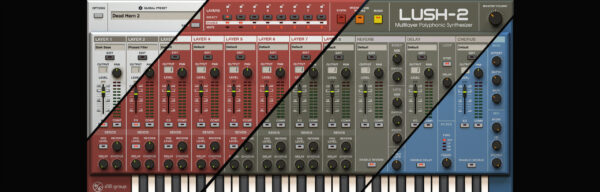
D16 Group has released Lush-2, a major update to the multilayer polyphonic synthesizer for Mac and Windows.

Lush-2 supports up to 8 layers, making it possible to create deep, complex patches. Each layer can be freely assigned to any MIDI channel or keyboard zone, and its audio output can be routed to any of the 11 available stereo busses.

Layers can either be used to create a single massive sound (where all layers respond to a single MIDI channel and a single keyboard zone) or to create several discrete timbres simultaneously (where each layer sounds on a different MIDI channel).

Features:

  • Multi-core support for better performance.
  • Multilayer architecture with 8 independent Layers (per-layer properties):
    • Up to 32 voices of polyphony.
    • MIDI channel.
    • Keyboard zone.
    • Audio output.
    • Synthesis:
      • Oscillators (Saw, PWM, Noise), with Supersaw and HardSync options.
      • Sub Oscillator (5 waveforms).
      • Self-oscillating, high-quality, multimode filter.
      • Passive high-pass filter.
      • Up to 8 voice unison with Tune, Cutoff and Panorama spread.
      • 2 LFOs with optional tempo synchronization and re-triggering modes (Trig, Gate, Arpe, None).
    • 2 envelopes with re-triggering modes (Trig, Gate, LFO1, LFO2).
      • Insert effects (selectable algorithms) – 2 slots per layer:
      • Chorus
      • String Ensemble.
      • Phaser.
      • Flanger.
      • Distortion.
      • Vowel filter.
      • Decimator.
      • Tremolo.
    • Modulation Matrix (modulation sources):
      • Note velocity.
      • Pitch bend.
      • Modulation wheel.
      • Expression pedal.
      • Sustain pedal.
      • Keyboard’s aftertouch.
      • Note pitch.
      • Arpeggiator’s output.
    • Arpeggiator:
    • Step sequencer (Gate and Tie per step).
    • 6 Run modes (Up, Down, Up and Down, Down and Up, Random, Manual).
    • Chord mode (Gater).
    • 3 Hold modes (Normal, Toggle, Trigger).
    • Shuffer
    • Tempo multiplier (Full notes, Dotted notes, Triplets).
  • Mixer:
    • Parametric EQs (1 per channel strip).
    • Compressors (1 per channel strip).
    • Up to 11 freely-assignable stereo output busses per instance.
    • Send FX’s (Reverb, Chorus, Delay with tempo sync).
  • Presets:
    • Over 1600 factory presets.
    • 6 preset categories (whole synth, single layer, Arpeggiator, Reverb, Delay, Chorus).
    • Tag-based preset browser.
  • Screen fit features
    • Several GUI sizes.
    • HiDPI / Retina screens scaling support.
    • 4 color themes to choose from.
  • MIDI-learn functionality.

Lush-2 is available now with introductory price €89 (regular €169). A demo version is also available.

Klevgrand Tomofon Updates adds MPE Support and More


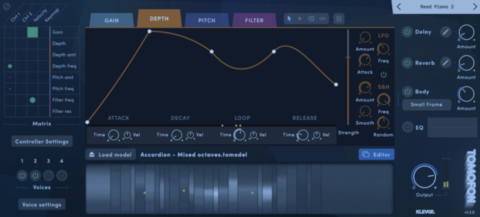
Klevgrand has announced that Tomofon – its ‘mothership’ synth – has been updated with MPE support, body resonance, multiple filter options, custom tuning and much more.

What they say about Tomofon 1.2:

“Tomofon v1.2 introduces MPE support (MIDI Polyphonic Expression), a feature that has gained even more attention in the past weeks with the release of Ableton Push 3. Thanks to the new Tomofon MPE mode, users can utilize pitch bend and controllers in a polyphonic manner, unlocking greater expressive possibilities.

Another new added feature is the ability to assign a “Body” to each patch. This feature enhances the realism of acoustic models by simulating the natural characteristics of various resonant spaces. Users can choose from a diverse selection of bodies, ranging from large boxes to metallic materials.

In response to user feedback, Klevgrand has also expanded the filter capabilities of Tomofon. In addition to the existing low-pass filter, users can now switch to high-pass and band-pass filters with two different slope options (12 dB/oct or 24 dB/oct).

When it comes to importing files, Tomofon v1.2 now also supports the import of .tun files, allowing users to utilize custom tunings in their compositions. This feature caters to musicians exploring alternative musical scales and tuning systems.

Furthermore, Klevgrand has also made several convenient updates to improve the user experience of Tomofon. Among other improvements, the audio model editor now featuring a zoom and scroll function, making it easier to work with audio models containing numerous waves.”

 Find out details on the Klevgrand website.