Korg Gadget VR, a Virtual Reality Music Studio for Mega Quest headsets


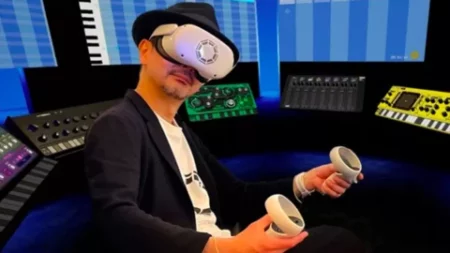
Korg today introduced Gadget VR, a virtual reality application that they describe as ‘the DAW of the future’.

Korg Gadget VR promises ‘a future music production studio in VR space’. It’s based on KORG Gadget, a software virtual studio that’s been available for years on multiple platforms, including iOS, Mac and Nintendo Switch.

With Gadget VR, you can control music ‘gadgets’ that are arranged in 360°, as if they were surrounding you. To use it, you need is a compatible VR headset, which currently is limited to Meta Quest 2 / Pro.

Korg Gadget VR currently offers a scaled-down version of the original Gadget, with a selection of ‘gadgets’ redesigned for VR.
The company notes:

“We have carefully selected six gadget instruments from KORG Gadget. In order to make them more like physical instruments, the design used in the other versions has been expanded so that all of the knobs and sliders are displayed on the panels. The sophisticated parameter structure remains unchanged, allowing for the speedy creation of all kinds of sounds. You can enjoy not only immediate sounds, but also realistic visuals with attention to detail at the same time.”

The gadgets include:

  • London – a drum sound module Gadget designed specifically for dance music.
  • Miami – a Monophonic Wobble Synthesizer, designed for creating modern electronic bass sounds.
  • Kiev – a software synth that features vector synthesis, using four oscillators that generate organic, spacey sounds.
  • Chiang Mai – a polyphonic synthesizer Gadget that features VPM (Variable Phase Modulation) synthesis.
  • Kingston – this polyphonic synthesizer Gadget is optimized for 8-bit or “chip tune” sounds.
  • Warszawa – this synthesizer features a wavetable oscillator with a powerful filter and two modulation units,.

Korg Gadget VR Audio Demos:

Korg Gadget VR is available now for $29.99
 

ELZ_1 play ZTRINGS Physical Modeling Strings Synth (Sneak Preview)


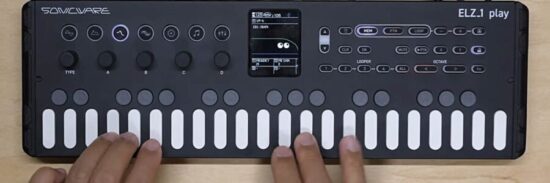
Sonicware shared this preview of ZTRINGS – a new physical modeling synth engine for the upcoming ELZ-1 play.

The ELZ-1 play is currently a limited edition ‘passion project’ of ELZ-1 developer Dr. Yu Endo. The original ELZ-1  went out of production because of the global semiconductor shortage. The ELZ-1 play is described as a sort of mkII version of the original, but also ‘a more novel and experimental synth.’

The ZTRINGS engine does not yet have a screen UI, but the engine has been selected for implementation on the ELZ_1p play.

ELZ_1 Play Features:

  • 14 synth engines + 26 effects
  • New 4-track looper for one-touch record/playback/overdub.
  • Velocity-enabled keyboard, stereo speakers built into the side panel, USB audio & MIDI.

Sonicware has not announced plans at this time to put the ELZ-1 play into production.

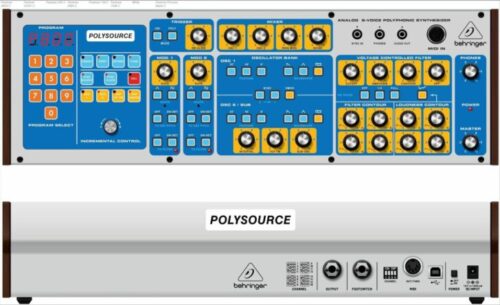
Behringer promises it’s Polysource to be a $400 Polyphonic take on the Moog Source


Behringer today teased a new polyphonic synth design, inspired by the Moog Source, the Polysource.

Details are to come from the company, but it appears to be another of their Euro-format synth module that are closely modeled on a vintage synthesizer.

While many of the Behringer’s products are designed to be straightforward knockoffs, the Behringer Polysource is much more interesting. It copies the look, the branding and the synth voice of the original Moog Source, but it also remixes these elements significantly – and in interesting ways.

The front panel of the Behringer Polysource is immediately recognizable as a copy of the Moog Source. But on closer look, the panel has been redesigned significantly, and adds physical controls. Where the original was limited to a single data entry knob, the Polysource interface is positively knobby, by comparison.

Like Behringer’s other Euro-format synth copies, the Polysource offers limited patchability. In this case, the Polysource offers a single Sync In patch point.

What the company shared about the Behringer Polysource:

“Marc, one of our mad product designers, asked me to show his PolySource draft to you, which is inspired by the Moog Source.

He stands right behind me and said he won’t leave the office until I have posted it, as he wants to read your feedback over the weekend.

Marc is actually a pretty cool guy who was deeply involved in the PRO-800. Before I press the send button he said “tell the folks we could make this bad boy also with 8 analog voices, full patch memory and for the same price as the PRO-800.”

Behringer did not announced any timetable for the Polysource, but based on previous previews, it’s likely to be a year or more before it ships.

Would you be interested in a $400 polyphonic take on the Moog Source? Leave a comment and share your thoughts!