How Synthesizers Worked in the Victorian Age

This is how synthesizers worked in the victorian age

In the video, David Pantalony, Curator at Ingenium: Canada’s Museums of Science and Innovation, demonstrates a 19th century vowel synthesizer.

The instrument is a Hermann von Helmholtz synthesizer, invented in the 1860’s and built by Rudolph Koenig. The Helmholtz synthesizer was designed to explore how additive synthesis can be used to create complex sounds from simple ones, and how sine waves can be combined to create different timbres, vowel sounds and more.

Helmholtz’s synthesizer generates sounds using a series of tuning forks, each pitched to different frequencies, made to vibrate using electromagnets. A keyboard is used to control the volume of each pitch, letting you play the pitches individually, or combine them as overtones of the fundamental pitch to do additive synthesis.

While this is clearly a synthesizer, it was designed primarily as a scientific instrument, rather than a musical one.

In-depth Guide to the SSL 1660 The Matrix Algorithmic Composer Module


Synthesist John L Rice shared this complete guide to the latest Synthetic Sound Labs module, The Matrix Algorithmic Composer model 1660.

The Matrix is a deterministic algorithmic sequencer, inspired by the rare Triadex Muse from 1969.

The SSL module was designed by Doug Slocum and programed by Harold Screven, and is based on the Triadex Muse, which was created around 1969 by Edward Fredkin and Marvin Minsky at the Massachusetts Institute of Technology (M.I.T.). The Triadex Muse was designed to be a part of a generative music and visualization system, and was one of the earliest digital music sequencers.

Topics covered:

0:00 – Beginning/Introduction Reel

1:48 – Brief Layout Overview

3:12 – Interval Controls and Binary Basics

5:33 – Normal vs Rest

6:10 – Scale Quantizer

6:45 – The C3 and C6 Difference

8:00 – Distraction and Audio Out Processing

9:00 – Back To Rests Plus Resets

10:41 – Partial Review Before Moving On

13:56 – Theme Controls and Shift Register Basics

17:42 – The Linear Feed Back Shift Register

20:42 – LFSR Pattern Watching

22:15 – Patch Example 1 – Clock Dividers and Quantizers

24:31 – Patch Example 2 – Audio Out as Modulation Source

27:51 – Patch Example 3 – External Shift Register and Quantizers

31:53 – End

The Matrix is available now for $425.


Behringer’s Oberheim Two-Voice Knockoff is Now Ready for Production


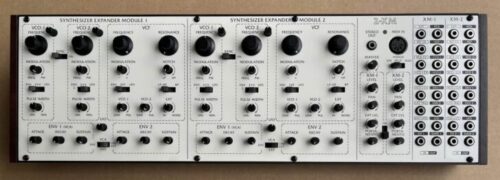
Behringer today teased that the 2-XM, a Euro format knockoff of the classic Oberheim Two Voice synthesizer, is now ready for production.

The company introduced the 2-XM in 2022 and, at the time, suggested that they thought that they could manufacture it with a $299 retail price.

The original Oberheim Two Voice keyboard synthesizer was introduced in 1975. It is a duophonic synthesizer, made up of two independent modular synth voices, and features a built-in 8-stage sequencer. Tom Oberheim released a limited-edition reissue of the original Two Voice in 2021, but demand was so high that it sold out in a day.

Like the original, the Behringer 2-XM offers two Synthesizer Expander Modules (SEM) – complete modular synth voices – along with an I/O and control section. It shrinks the design down to Eurorack format, though, and dispenses with the step sequencer.

Behringer is not saying anything about pricing or a release date for the 2-XM at this time.

Are you interested in a Oberheim Two Voice knockoff?  Share your thoughts in the comments!