Electronic Music Pioneer Patrick Gleeson Has Died At 91
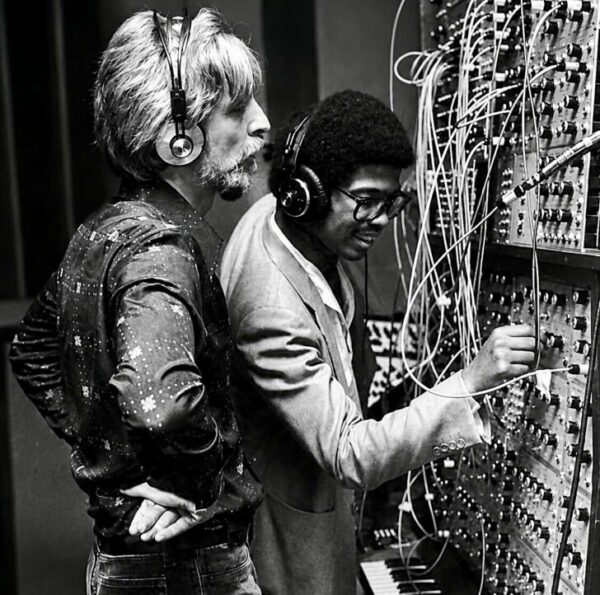

Patrick Gleeson, a synthesist, composer, producer and engineer who helped pioneer the use of synthesizers in jazz, experimental music and film, died July 19, 2026, at the age of 91.

Born November 9, 1934, Gleeson moved to San Francisco in the 1960s, where he began exploring electronic music at the San Francisco Tape Music Center. He experimented with early Buchla electronic instruments before becoming inspired by Wendy Carlos’ Switched-On Bach, and acquired a Moog III modular synthesizer.

Gleeson co-founded Different Fur Recording Studio in San Francisco with John Vieira in 1968. The studio became an important center for electronic and experimental music, hosting artists including Herbie Hancock, Devo, Brian Eno and David Byrne.

Gleeson helped pioneer the use of synthesizers in live jazz performance, and Hancock later credited him with introducing him to synthesizers. He collaborated with Hancock on the albums Crossings (1972) and Sextant (1973) and toured as part of Hancock’s band.

Gleeson also maintained a wide-ranging career as a producer, engineer, performer and composer. He produced or performed on more than 100 albums, working with artists including David Byrne, Brian Eno, Devo, Freddie Hubbard and others. He served as producer and engineer on Devo’s 1978 debut, Q: Are We Not Men? A: We Are Devo!, and contributed to Byrne and Eno’s My Life in the Bush of Ghosts.

As a solo artist, Gleeson released Beyond the Sun – An Electronic Portrait of Holst’s The Planets in 1976, an electronic interpretation that earned a Grammy nomination for Best Engineered Classical Recording.

Wendy Carlos wrote the line notes for the album, saying:

“Our eight-year wait for someone else to explore electronic music realisation with what we judge to be appropriate technical standards and musical taste has ended. One hears the ears of a gifted musician at work, in a field where one must exercise unprecedented discipline and self-control.”

Later work included electronic interpretations of Star Wars and Vivaldi’s The Four Seasons, jazz recordings and more. Gleeson also contributed synthesizer work and compositions to film and television, most notably on Apocalypse Now.

Gleeson remained active into his ’80s, performing live at events like Moogfest in 2019 and Synthplex in 2022.

Here’s the video for Gleeson’s The Leap, recorded live with Michael Shrieve and Sam Morrison:

via Drew Schlesinger, Michael Shrieve, BMF
 

New App That Converts Your Voice Into Drum Loops, DubBox


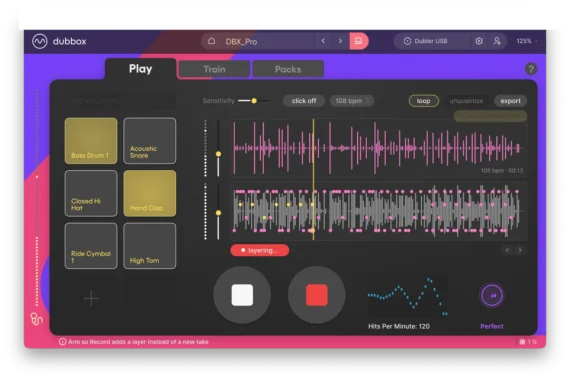
Vochlea has announced the release of DubBox, a new app that applies the same concept to drum programming by converting vocal percussion into drum loops.

Aimed at producers and beatmakers that work out rhythmic ideas vocally, DubBox can transform spontaneous beatboxing into sample-based drum patterns.

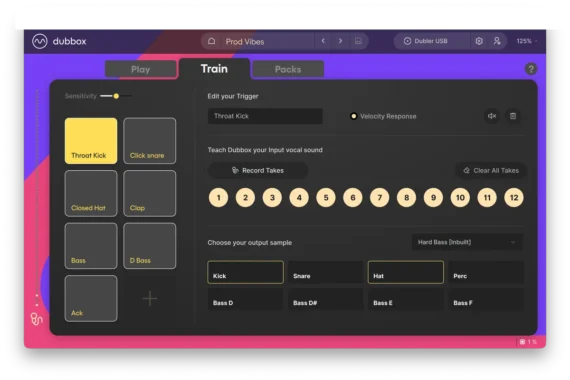
This is achieved by training the software on the user’s vocal sounds, which are then used to trigger drum samples in real time with velocity sensitivity, which can then be recorded, quantized and exported as audio or MIDI.

DubBox can learn up to eight vocal sounds per project, each of which can be mapped to samples from its built-in library or imported sounds.

Stocked with 10 packs, the app’s sample library covers everything from classic 808s to futuristic sound design and industrial percussion. Each sample has individual controls for gain, pitch, tone, drive and filter, and can be assigned to choke groups.

Once samples are configured, the user can record to a click or freely with up to 20 takes of overdubbing, and DubBox will detect the BPM of a performance before stretching and quantizing the results accordingly, while preserving the feel of the original take. When quantizing voice recordings, DubBox’s Voice Warping function time-stretches the entire take to the grid rather than re-triggering individual hits on each beat.

When you’re happy with the results, you can export your input vocal, the sample track or a mix of both, or export a MIDI file to drop into your DAW.

“Everything we build starts from the same belief: the voice is the most immediate instrument there is,” said Vochlea CEO George Wright in a press release.

“DubBox is a new instrument for a new player, the beatmaker whose beat is already in their mouth. Beatbox in, finished drum loop out.”

Priced at $39/€39/£34, Vochlea DubBox is available now for macOS and Windows.

New Reverb Effect, REVERSIDE, For macOS & Windows


DEVPROAUDIO has released REVERSIDE 1.0.0, a new reverb for macOS and Windows in VST3, CLAP, and AudioUnit v2 formats.

REVERSIDE is a versatile dual-engine, fully algorithmic reverb. It gives separate control over the early reflections and the reverb tail, allowing users to shape the sense of space, depth, stereo width, tone, and decay in far more detail than a typical one-block reverb.

Sonically, it can deliver everything from natural rooms and halls to silky-smooth long tail decays and larger, more stylized, cinematic, and experimental spaces.

Features:

  • Versatile dual-engine fully algorithmic reverb with separate, highly tunable Early and Late Reflections engines.
  • Deep control over space, tone, stereo image, timing, and decay.
  • 3D positioning for placing a virtual source and listener inside a simulated acoustic space.
  • Useful for building a coherent shared space for multiple instruments in a mix.
  • Physically inspired room shaping plus familiar musical reverb controls.
  • Material/ER and Decay filter follow/match modes for linking tonal behavior across the engines.
  • 14 unique diffusion models.
  • Dedicated mini diffusers on both engines for extra density and texture.
  • Separate stereo controls for the Early and Late engines, with a special WIDE mode for the Late Reflections tail.
  • ER-to-LR send control with selectable pickup point in the Early Reflections chain.
  • Stereo shaping, filters, EQ, pitch-preserving modulation, and flexible pre-delay.
  • Automatic modes for reflection count and reverb time, derived from the geometry of the virtual space.
  • 3D processing can be switched separately for the direct path, Early Reflections, and Late Reflections, with selectable quality modes.
  • Extended tail envelope mode for creating non-exponential decay profiles, especially useful for hall simulations.
  • Two ways to control ER/LR and Dry/Wet mixing: balance-style workflow or absolute gain in dB, with automatic conversion between both views.
  • Absolute and relative room-size modes for shaping dimensions in different ways.
  • Can move from reverb into resonant, echo-like delay effects.
  • Unique reverb density control that simulates scattering through irregular, split bounces.
  • 100+ internal LFOs for animating many aspects of the algorithm while preserving harmonic detail in the tail.
  • Rich visual feedback with an interactive Position Display, dedicated Reflections and Reverb displays, and angle views for directional reflection patterns.

REVERSIDE 1.0.0 is available now for macOS and Windows for $135 USD.