Organizers of Superbooth, the world’s biggest trade fair and festival for electronic musical instruments, have announced the dates for next year’s event.
SUPERBOOTH27 will be held May 6-8, 2027 at the FEZ Berlin. Organizers say that Superbooth 2026 attracted 9,600 visitors, 320 exhibitors, and performances from over 50 artists.
Information on ticket pre-order sales and other details related to next year’s SuperBooth is expected to be announced later this year.
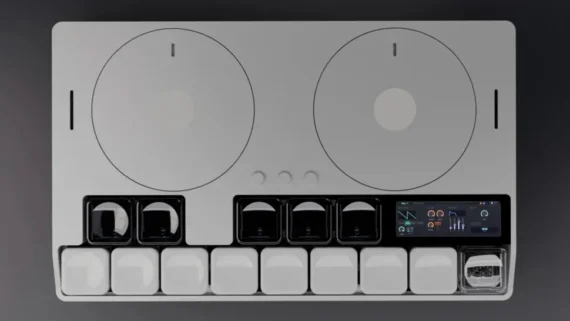
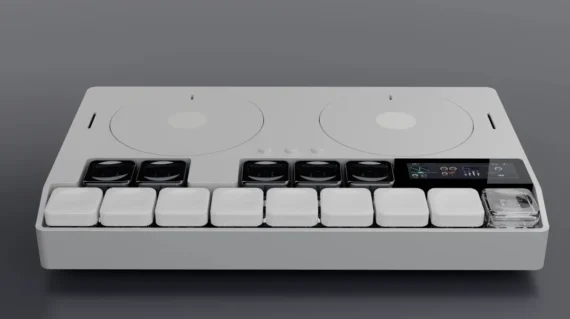
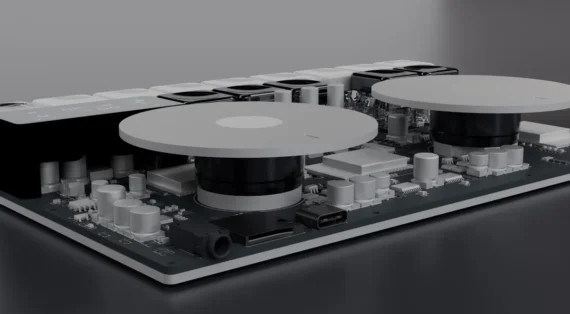
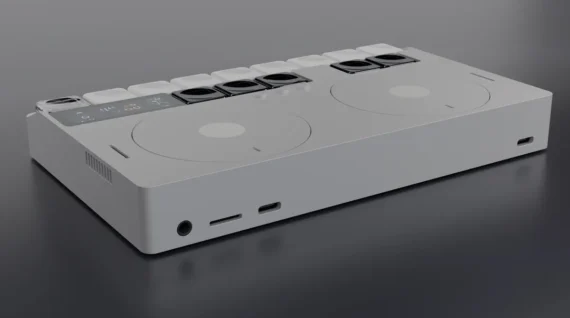
Hong Kong-based synth outfit Mach Devices has unveiled the MD-7, a stylish, innovative and open-source mini-synth controlled via motorized discs.
The MD-7’s two discs can not only be used to navigate menus, dial in parameters and scrub through sequences – as demonstrated in the Instagram video embedded below – but also provide haptic feedback that the company promises will allow users to “stop looking at the screen and start feeling the patch”. (This will be helpful, as the screen is fairly compact.)
What this means in practice is that the discs don’t merely sense rotation but also communicate information to the user through the varying response of their FOC motors. The synth will adjust the resistance of the discs’ rotation depending on the parameter that’s being tweaked, and can simulate mechanical detents that represent stepped values or even create “virtual walls” when the end of a parameter’s range is reached.
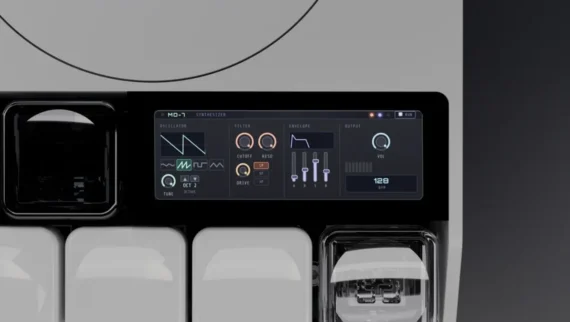
MD-7 is also equipped with a backlit keyboard comprised of 13 button keys, three smaller buttons and the aforementioned 1.65″ IPS display. In the product images, the display squeezes oscillator, filter and envelope controls for the MD-7’s synth engine into its limited real estate, which admittedly looks a little crowded. (Mach Devices notes that the UI shown is in development and subject to change.)
Speaking of the synth engine, no specifics have been provided, but the display shows a basic subtractive architecture with four oscillator waveforms, a resonant multimode filter and a standard ADSR envelope. The promo video also shows a drum looper and 16-step sequencer, its playback being controlled DJ-style by the motor discs, which is an interesting touch.
Aside from the haptic discs, the most intriguing aspect of MD-7 is its open-source software platform: Mach Devices says that the instrument’s firmware, including its DSP engine, modulation system and sequencer, will all be publicly available on GitHub, meaning that owners can customize its operation and build their own features, workflows and even new sound engines.
As for connectivity, MD-7 features dual USB-C ports – one for power, and the other for MIDI and audio output and mic input from compatible USB microphones. There’s also a 3.5mm headphone output and a microSD card slot for storage.