The Music Thing Modular Workshop Computer, a multi-function module for Eurorack systems that can be instantly changed with hot-swappable program cards, is available as a DIY kit.
The computer was originally found in the Music Thing Workshop System, a compact modular that also includes a powerful analog toolkit. Now the Computer section is available as an 8HP Eurorack module.
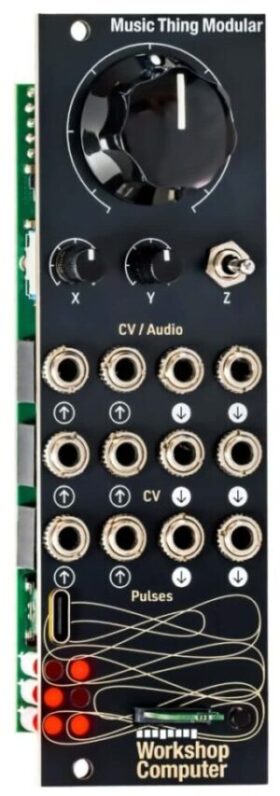
The module has three pairs of inputs and outputs: Audio/CV, Pulses; and Precision CV for pitch.
There are also three knobs for controlling the computer and one 3-way toggle switch (ON-OFF-MOMENTARY).
The Workshop Computer loads programs stored on hot-swappable custom-made program cards. The Computer comes with seven program cards:
Reverb+ is an old-school stereo reverb with some useful utilities, including sequencing and MIDI.
Turing Machine is a random looping sequencer with two channels and multiple scales.
Simple MIDI turns the module into a USB-MIDI interface to send and receive MIDI.
It also comes with 4 x blank program cards which you can write with a downloaded file.
An overview video via DivKid:
Features:
Programmable Music Computer module with hot-swappable PGM cards.
Includes Reverb, Simple MIDI, Turing Machine and a blank card to add a program of your choice.
Growing library of PGM cards created by the development community.
Module Interface: 2 x Audio & CV in/out, 2 x precision CV in/out, 2 x pulse in/out
3 x knob controls (1 x large, 2 x small)
1 x 3-way switch (ON-OFF-MOMENTARY)
6 x LED indicators to visualise program functions
The Music Thing Modular Workshop Computer is available as now as a DIY kit for £112.50 (Excl. VAT).
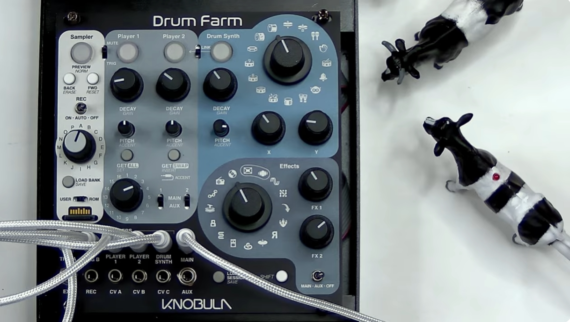
Knobula has introduced Drum Farm, a performance-focused Eurorack drum module that brings synthesis, sampling and effects together into a single, hands-on instrument.
Drum Farm features 16 drum models, 16 effects, and a 16-slot sample buffer. They say it’s built for fast, iterative sound design.
It offers a wide palette of percussion sounds, from physically-modeled drums and spectral cymbals to analogue-style voices, with subtle variation on every trigger.
The integrated sampler can capture everything you create, letting you build layered, evolving sounds or assemble custom kits on the fly.
All parameters are CV and trigger assignable, enabling fully generative patches or tight performance control. You can store 32 banks of sessions to microSD, including all samples and settings for fast recall.
Drum Farm is expected to be available in June 2026, priced at £449 GBP (including VAT).
Ahead of Superbooth 2026, SYNTH-WERK has announced a reissue of the SW 735 MK2 BODE FREQUENCY SHIFTER, a rare design by the late Harald Bode.
The Bode Frequency Shifter was iconically used by Kraftwerk, and was also licensed for production by Moog.
The Bode Frequency Shifter complements modern pitch shifters by affecting sound in a very different way, creating inharmonic overtones that change the timbre, often resulting in metallic sounds.
It can be played via a keyboard (1 volt/octave), producing an wide variety of bell, chime, carillon, wood block, marimba, steel drum and other sounds, maintaining the chosen timbres over the entire playing range.
It can also be used as an effect. Interesting percussion effects can be produced with sequencer derived control voltages for the detuning and slaving of the sequencer clock through an envelope follower from the percussion tone source. Another interesting effect is the ”drumwhip“, which is produced by adding the output of an envelope follower (receiving the drum tone bursts) to the control voltage input of the frequency shifter.
“I remember my father telling me that he had completed building his new Bode Frequency Shifter Mark II. This was the unit he built for himself, for his own studio,” says Peer Bode. “Soon after, Florian Schneider of Kraftwerk came to visit my father at his home and studio. The Bode family were all big fans and collectors of Kraftwerk music. My father was happy for Florian’s visit. He was not planning to sell and part with his new Frequency Shifter. It was a nice visit. He told me, a happy Florian Schneider left with the Bode Frequency Shifter Mark II under his arm.”
Peer Bode
Here’s what SYNTH-WERK shared about the technical details:
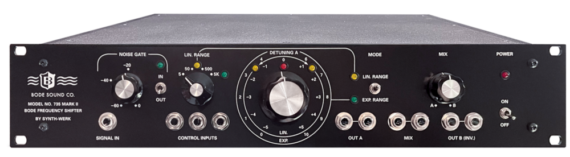
“The model 735 Mark II is a one input/three output signal processor with three control voltage inputs. The signal input may receive any program material including that of a synthesizer V.C.O.
At the output jacks, OUT A the input signal appears detuned to one side, and at OUT B to the other side. At the MIX output jacks, a mixture of the OUT A and OUT B signals is obtained, which in the center position of the MIX control is that of a ring modulator.
The controls of this frequency shifter include a threshold control for the squelch circuit (NOISE GATE), which can silence the carrier in absence of a program signal or below a preset program threshold level. A range switch (below the heading LIN RANGE) facilitates the selection of the tuning ranges, which cover the ranges from +5 Hz to -5 Hz detuning through +5 kHz to -5 kHz detuning in the linear mode (selected by the MODE switch).
With the MODE switch in the EXP position and the RANGE switch set to 5 k, the instrument is keyboard compatible and the frequency shift changes by one octave for every volt of control voltage change.
When operating the instrument without an external control voltage, the main tuning knob provides an internal control voltage range from -5 volts to +5 volts DC. Which in the linear mode provides the frequency shifts selected by the RANGE switch, and which in the exponential mode provides frequency shifts in a total of 10 one octave increments. When operating the instrument with an external control voltage, the internal and external voltages are added and jointly affect the frequency shift.
When operating with a keyboard controller (EXP mode), the desired timbres (bells, chimes etc.) are pre-selected with the main tuning knob. When operating in the linear mode, good drum detuning effects can be achieved in the 500 Hz and 5 kHz tuning ranges. In this mode, the amount of detuning may be controlled manually with the main tuning knob or remotely, for instance by a control voltage pedaI.”
SYNTH-WERK plans an initial run to be available in May 2026, priced at €2,900 Euro plus tax.