Expressive E Introduces Next Generation Osmose CE MIDI Controllers


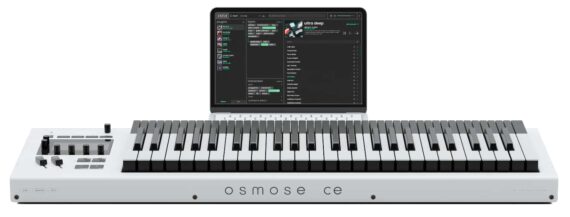
Ahead of Superbooth 2026, Expressive E today introduces the Osmose CE, a MIDI controllers based on the same expressive, MPE-enabled keybed as the French manufacturer’s Osmose synth. Available in 49- and 61-key versions, Osmose CE is priced at $999 and $1,199 respectively.

Released in 2023, the original Osmose put MPE-level expression into a traditional piano-style form factor, its full-size black and white keys offering three-dimensional control over its internal EaganMatrix synth engine, with per-note pitch bend, polyphonic aftertouch and specialized keybed gestures opening up new performative possibilities.

Osmose CE is based on exactly the same expressive keybed as Osmose, but ditches its EaganMatrix synth engine. In its place, Expressive E has developed Ctrl-e, a free companion plugin that gives users access to a library of expressive sounds that have been mapped and optimized specifically for the Osmose keybed.

This circumvents the issues with MPE configuration and routing that many users faced when using the original Osmose as a MIDI controller, providing players with a collection of more than 900 presets designed to respond intuitively to Osmose’s MPE control straight out of the box, with no setup headaches involved.

Custom-built to respond to Osmose CE’s seven expressive gestures (Tap, Press, Pitch Bend, Vibrato, Shake, Strum, and Note-Off), Ctrl-e’s presets can be browsed directly from the hardware when used with supported DAWs, and eight pre-mapped macros are available per preset. The sounds also take advantage of Osmose’s performance tools, like the MPE Arpeggiator and Press Glide, which allows for a dynamic portamento that reacts to the pressure placed on two notes on the keyboard.

As well as drawing on Expressive E’s own software instruments, Ctrl-e integrates multiple sound engines from a number of third-party developers, including Synapse Audio, AAS, Kilohearts, GForce, Dawesome and Vital. Collectively, these cover a variety of synthesis types, including wavetable, physical modelling and analogue modelling.

Outside of Ctrl-e, Osmose CE can function as a traditional MIDI controller, a fully-fledged MPE controller, or anything in between, and it’s equipped with dedicated DAW controls for transport, track and device navigation, and mixer control, which are currently compatible with Ableton Live, Cubase, Bitwig and Logic Pro.

On the hardware front, Osmose CE is decked out in a slick white aluminum, and weighs a tad more than the synth version at 10kg. You get 5-pin DIN MIDI In, Out and Thru, along with a USB-C port and two assignable pedal inputs.
Features:

  • Keybed – 49- or 61-key expressive keybed with per-note control
  • Gestural Control – Tap, Press, Pitch Bend, Vibrato, Shake, Strum, Expressive Note-Off
  • Software Ecosystem – Ctrl-e included
  • Preset Ecosystem – 900+ expressive presets
  • Performance Tools – MPE Arpeggiator, Press Glide
  • Configurations – MPE Controller • Traditional MIDI Controller • DAW Controller
  • Macro Control – 8 pre-mapped macros per preset via Ctrl-e
  • DAW Integration – Live 12+ • Cubase 15+ • Bitwig 5+ • Logic Pro 12+
  • Interface – 7 knobs/encoders • 9 buttons • 4.3″ color LCD • pitch and modulation sliders
  • MIDI / Connectivity – DIN MIDI In • DIN MIDI Out/Thru • USB-C • 2 assignable pedal inputs
  • Power – USB-C Power Delivery • 5V / 3.0A
  • Build – White aluminum top • Black base

Here’s a deep dive into how the Osmose CE works:

The Osmose CE is available now, with the following pricing:

  • Osmose CE 49: €999 / $999
  • Osmose CE 61: €1,199 / $1,199


AnalogFX Introduces Larynx Semi-Modular Keyboard Synthesizer


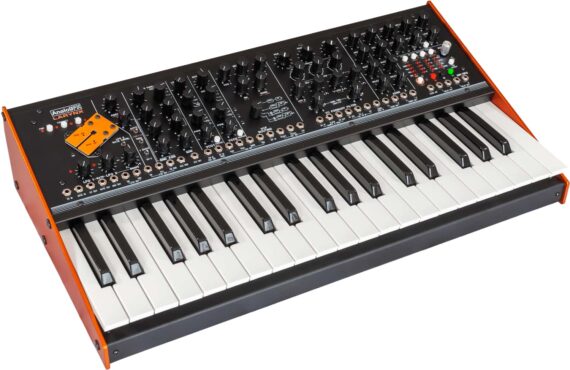
Ahead of Superbooth 2026, AnalogFX has introduced the Larynx, a new semi-modular monosynth keyboard, based on the ‘DNA’ of their SER-2020 modular system.

The Layrnx features a unique vocal sound architecture, a premium 37-key keybed, Eurorack compatibility and deep analog modulation options.

An example of the Layrinx synth voice in action:

Features:

  • Sound Design
    • 2 VCOs + Sub Oscillator
    • Ring Modulator & Noise
    • 3 VCFs
    • 2 ADSR + 2 LFO
    • Sample & Hold
    • Auto Glide
  • Performance & Connectivity
    • 37-key keybed with aftertouch
    • Touch’n’Bend performance control
    • Real-time modulation across the entire signal path
    • Arpeggiator & Sequencer
    • Stereo delay
    • MIDI + USB MIDI
    • MPE support
    • Expression / hold pedal
    • Headphone + line out
  • Eurorack Compatible
    • CV inputs and outputs

Here’s a hands-on demo of the SER-2020 synth voice:

The AnalogFX Larynx is available now to pre-order for €929.00 Euro (normally €1,032.23).


Synth-Werk Reissues ‘Kraftwerk’ Bode Frequency Shifter


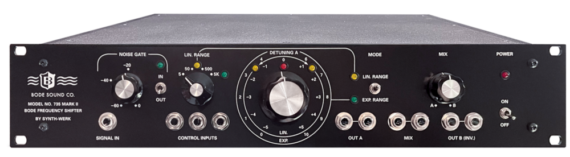
Ahead of Superbooth 2026, SYNTH-WERK has announced a reissue of the SW 735 MK2 BODE FREQUENCY SHIFTER, a rare design by the late Harald Bode.

The Bode Frequency Shifter was iconically used by Kraftwerk, and was also licensed for production by Moog.

The Bode Frequency Shifter complements modern pitch shifters by affecting sound in a very different way, creating inharmonic overtones that change the timbre, often resulting in metallic sounds.

It can be played via a keyboard (1 volt/octave), producing an wide variety of bell, chime, carillon, wood block, marimba, steel drum and other sounds, maintaining the chosen timbres over the entire playing range.

It can also be used as an effect. Interesting percussion effects can be produced with sequencer derived control voltages for the detuning and slaving of the sequencer clock through an envelope follower from the percussion tone source. Another interesting effect is the ”drumwhip“, which is produced by adding the output of an envelope follower (receiving the drum tone bursts) to the control voltage input of the frequency shifter.

“I remember my father telling me that he had completed building his new Bode Frequency Shifter Mark II. This was the unit he built for himself, for his own studio,” says Peer Bode. “Soon after, Florian Schneider of Kraftwerk came to visit my father at his home and studio. The Bode family were all big fans and collectors of Kraftwerk music. My father was happy for Florian’s visit. He was not planning to sell and part with his new Frequency Shifter. It was a nice visit. He told me, a happy Florian Schneider left with the Bode Frequency Shifter Mark II under his arm.”

Peer Bode


Here’s what SYNTH-WERK shared about the technical details:

“The model 735 Mark II is a one input/three output signal processor with three control voltage inputs. The signal input may receive any program material including that of a synthesizer V.C.O.

At the output jacks, OUT A the input signal appears detuned to one side, and at OUT B to the other side. At the MIX output jacks, a mixture of the OUT A and OUT B signals is obtained, which in the center position of the MIX control is that of a ring modulator.

The controls of this frequency shifter include a threshold control for the squelch circuit (NOISE GATE), which can silence the carrier in absence of a program signal or below a preset program threshold level. A range switch (below the heading LIN RANGE) facilitates the selection of the tuning ranges, which cover the ranges from +5 Hz to -5 Hz detuning through +5 kHz to -5 kHz detuning in the linear mode (selected by the MODE switch).

With the MODE switch in the EXP position and the RANGE switch set to 5 k, the instrument is keyboard compatible and the frequency shift changes by one octave for every volt of control voltage change.

When operating the instrument without an external control voltage, the main tuning knob provides an internal control voltage range from -5 volts to +5 volts DC. Which in the linear mode provides the frequency shifts selected by the RANGE switch, and which in the exponential mode provides frequency shifts in a total of 10 one octave increments. When operating the instrument with an external control voltage, the internal and external voltages are added and jointly affect the frequency shift.

When operating with a keyboard controller (EXP mode), the desired timbres (bells, chimes etc.) are pre-selected with the main tuning knob. When operating in the linear mode, good drum detuning effects can be achieved in the 500 Hz and 5 kHz tuning ranges. In this mode, the amount of detuning may be controlled manually with the main tuning knob or remotely, for instance by a control voltage pedaI.”

SYNTH-WERK plans an initial run to be available in May 2026, priced at €2,900 Euro plus tax.