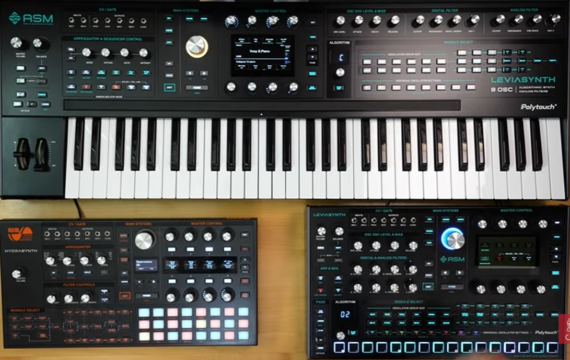
Host Ziv Eliraz – in his latest loopop video – takes an in-depth look at the new ASM Leviasynth, a 16-voice hybrid digital/analog synthesizer from the creators of the Hydrasynth.
“Its interface and effects resemble Hydrasynth in many ways, but the oscillator structure and workflow is totally different and new,” he notes. “It’s got 8 oscillators, 13 envelopes and an analog filter per voice, a new sequencer, and plenty of other updates throughout.”
As ever, Eliraz offers an overview, plenty of audio demos and his thoughts on the pros and cons.
Topics covered:
0:00 Intro
1:50 Keys vs DT
3:25 vs Hydra
3:45 Osc & algos
4:55 Filters
5:25 Interface
5:50 Group edit
6:40 Others
7:45 Similarities
9:20 Build & I/O
9:55 Oscillators
11:50 Osc/env levels
13:40 Feedback
14:00 Osc layers
14:25 Wavetable?
14:45 Osc mod types
21:20 Bias controls
22:10 Algo morph
23:15 Custom algos
24:30 Digital filter
25:20 Analog filter
26:40 VCA levels
27:00 FX
27:35 Modulation
28:10 Voice params
28:35 Osc stereo
30:40 Arp
32:15 Sequencer
33:55 Init &random
34:35 Pros & cons
37:40 Presets!
Watch the review, and share your thoughts on the ASM Leviasynth in the comments!
Ahead of the 2026 NAMM Show, being held Jan 22–24 in Anaheim, California, Ashun Sound Machines (ASM) has introduced the Leviasynth, a new 16-voice, 8-oscillator digital / analog hybrid synthesizer.
The Leviasynth combines many of the features that have made its Hydrasynth a hit – including rugged build, the Polytouch polyphonic aftertouch keybed and ribbon controller – with a new hybrid synth engine that combines the best of analog and digital worlds.
The Leviasynth takes the Hydrasynth aesthetic and attitude and looks like it’s expanding on everything that was beloved about that latter-day legend.
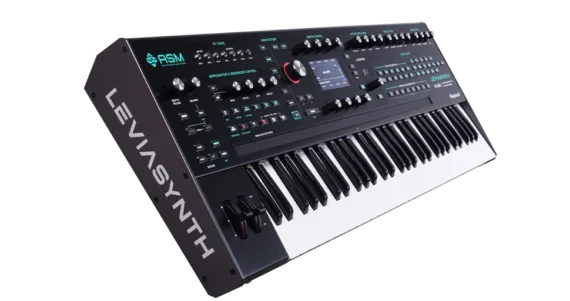
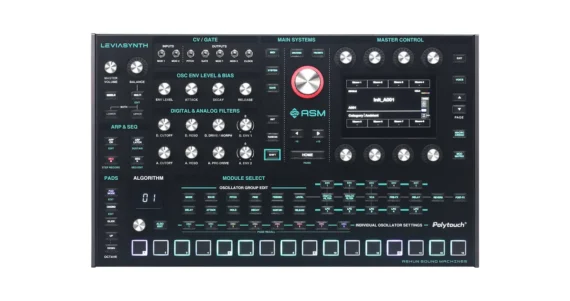
Available in both keyboard and rackable desktop versions, the Leviasynth’s 8 oscillators can be manually organised into customized groups. Reffered to, as ‘algorithms’, this approach can significantly affect the sonic results in terms of how the oscillators affect each other. It’s classic FM synthesis in principle, then, but ultra-modern in attitude.
Couple that with the new idea of ‘algorithmic morph’ (an idea that has seemingly taken its cues from Audio Cookbook’s creative Hydramorph software) and a ‘nearly unlimited’ number of configurations for these individual oscillators are opened-up. 144 preset algorithms are ready to go, all of which offer one additional algorithm that can also be customized per-patch.
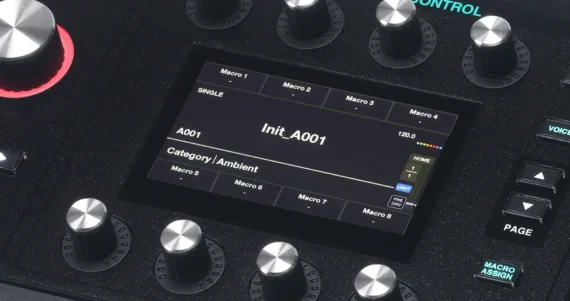
All of this programming can be done natively, using an easy-to-navigate user interface, viewable via a snazzy multi-colour touch screen.
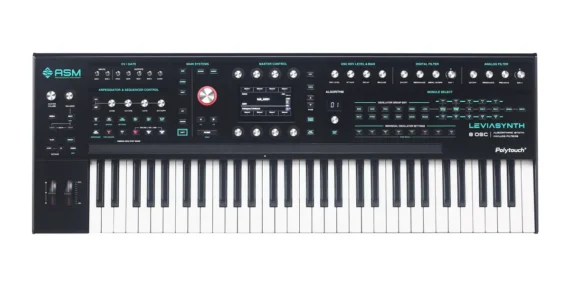
The keyboard version comes with a 61-note Polytouch polyphonic aftertouch keybed, with a lengthy 4-octave ribbon controller prompting users to sink into full intuitive control of the Leviasynth’s reactive aural results.
The Leviasynth is also MPE-compatible, and indications are that it has embraced the format in a much more well-rounded way than its rather limited predecessor. The portable desktop version, in contrast, features 16 Polytouch pads.
Back to the tech, and over 300 waveforms can be assigned to each oscillator, each of which have 7 independent oscillator modes to maximise the diversity of the timbral output. There’s also 5 LFOs and 5 envelopes, as well as the effects package previously found within Hydrasynth.
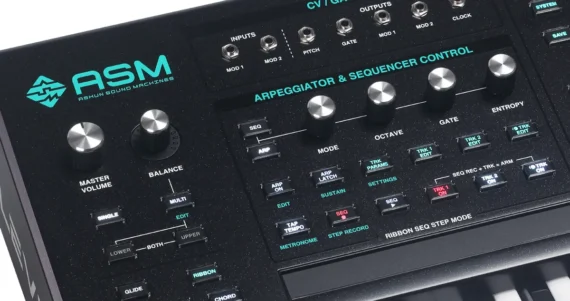
Leviasynth also offers a three-track sequencer and an eight-mode arpeggiator with Ratchet, Probability, and Entropy controls, designed to work independently or together. Other performance features include deep hands-on controls, expressive Envelope Bias touch response, illuminated wheels, and a four-octave ribbon controller.
You can switch between Single or Multi modes to allow all 16 voices to be active per-patch, or to split the voices into two parts of 8 voices each, respectively. The additional ASM Patch Manager software for Mac and PC is on hand for more intricate control.
The Leviasynth’s front control panel builds on Hydrasynth’s design philosophy and presents an easily-linked and self-explanatory overview of the routing in play.
Here’s what they have to say about the Leviasynth:
“With its 4-pole analog filter with pre-drive, create everything from thundering bass to shimmering pads.
At the heart of Leviasynth is an advanced algorithmic sound engine featuring eight oscillators per voice and seven distinct synthesis types, freely configurable across more than 140 algorithms, including user “custom” algorithms. Two independent layers can be stacked or split, while voices may be paired into true binaural stereo sets with independent modulation of carriers and modulators for wide, animated soundscapes.
The signal path fuses digital precision with analog character. A flexible digital filter section, offering 18 models with morphing and drive, feeds a custom analog pre-drive stage into a Q-compensated four-pole analog low-pass filter, delivering depth, weight, and searing warmth.
Modulation and expression form the lifeblood of Leviasynth. Thirteen envelopes, five LFOs, a deep modulation matrix, per-voice modulation offsets, and expansive Macro control keep the sound in continuous motion. Through real-time algorithm morphing, Leviasynth transforms its voices organically, drifting between textures and opening doors to distant sonic depths.”
Leviasynth Video Demos:
Leviasynth Audio Demos:
The ASM Leviasynth is available now to preorder, priced at $2499/€3299 for the keyboard version and $1799/€2399 for the desktop model.
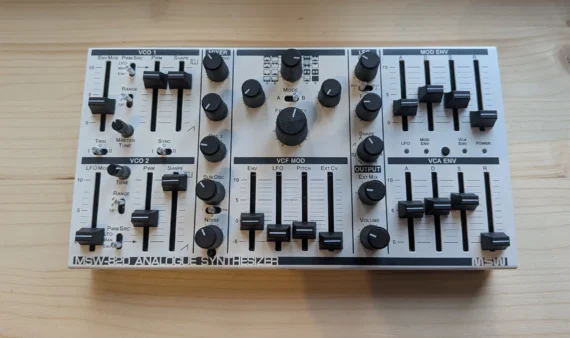
Michigan Synth Works has introduced the MSW-820, a 2-oscillator based analog monophonic synthesizer.
The MSW-820 Analogue Synthesizer features an advanced 16-mode voltage controlled filter, 2 envelope generators, digital LFO with sync and trigger functions, digital noise source with 8 flavors, MIDI (TRS or USB).
The synth can be used in desktop format or integrated into a Eurorack system.
Specifications:
VCOs:
AS3340 Based, Pulse and Sawtooth Waveforms
ENV Modulation (OSC1) and LFO Modulation (OSC2)
Range: 16’/8’/4′, 7 Octaves
Pulse Width Modulation: 50% to Min
PWM Mode: ENV/Manual/LFO Modulation
Master and OSC2 (offset) Tune Control
Pulse/Sawtooth Mixer control per Oscillator
2 Hard Sync Modes: O2 Track Pitch or O2 Do not track pitch
2 Reset Modes: Reset O1 on gate or Reset O1 and O2 on gate
Sound Mixer:
External Input (pre filter)OSC 1 Level
OSC 2 Level
Sub Osc Level tracking OSC1 with 1, 2, and 2 PWM Octave Settings
AS3109 Base16 Modes. Low Pass, High Pass, Band Pass, Allpass (aka Phase)
Cutoff Frequency: 10Hz to 20kHz
Resonance: 0- Self Oscillation
CV Follow: 0-100%
This knob (Audio rate filter modulation from OSC1’s triangle output)
Envelope Modulation via Attenuverter (-5 to 10)
LFO Modulation via Attenuverter (-5 to 10)
Pitch Modulation via Attenuverter (-5 to 10)
External CV Modulation via Attenuverter (-5 to 10)
LFO:
Rate: 0.1 Hz to 22 Hz8 Shapes with crossfade between shapes:Sine, Square, Ramp, Tri, Saw, Expo Decay, Random, Smoothed Random
2 Reset Modes. Reset on Gate and Reset on Gate with Phase Control (via Fade knob)
Fade Control (LFO Delay with Fade in)
Bipolar Rate indicator
Envelopes:
Attack time: 1.5 ms to 2 s
Decay time: 2 ms to 10 s
Sustain Level: 0-100%
Release Time: 2 ms to 10 s
Modulation Envelope is hardwired to Modulation bus
VCA Envelope is hardwired to VCA
VCA/Output Mixer:
VCA Control
External Input (post filter/Env)
Inputs/Outputs:
MIDI IN. TRS 3.5mm PSIMIDI (either A or B)
Clock IN to Control LFO Rate
Gate IN. 5-10V
V/Oct IN
Filter CV IN
LFO Mod IN
Audio IN
Synth/Mix OUT
USB C IN/OUT. 5V Power 200 mA. DC Adapter included. Also serves as USB MIDI
The MSW 820 Analog Synthesizer is priced at $499 and is expected to be available later in Jan 2026. Visit the Michigan Synth Works site for more information.