Cherry Audio Intros Harmonia Soft Synth for Mac + Windows
Cherry Audio debuts Harmonia, a new virtual synthesizer, for Mac and Windows, that they say is designed for creating “rich, evolving polyphonic sounds like those associated with vector and wave sequencing synthesizers of the 80s and 90s,” but with improved usability through visual patching.
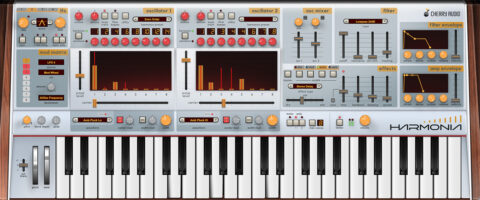
What they say about Harmonia:
“The magic behind Harmonia lies in its two sample-based oscillators. Using techniques similar to those found in additive synthesis, each Harmonia oscillator can simultaneously produce up to eight pitches, individually tuned to a harmonic series or semitones. The volume for each pitch harmonic can be fixed or dynamic, and Harmonia’s unique interpolated harmonic scanning enables dramatic sweeps and melodious sequences through a single modulatable slider.
Harmonia derives its distinctive organic sound from hundreds of sampled waveforms recorded from various synthesizers, traditional instruments and voices, colorful “lo-fi” sounds, and more. User samples can be imported, further expanding Harmonia’s tonal palette. Producers can effortlessly create unique morphed and sequencer-like tones by varying the combinations of waveform selection and harmonic presets.
Harmonia reaches new heights by providing four syncable polyphonic LFOs, an expansive stereo multimode filter, click-and-drag envelopes, and a massive mod matrix with eight slots for dozens of sources and destinations. Harmonia includes support for aftertouch, flexible MIDI mapping, and a collection of over 350 breathtaking, professionally designed presets. Harmonia also has 17 studio-quality effects such as distortion, chorus, phaser, echoes, reverbs, and more – all fully modulatable through the matrix.”
In-depth look at Harmonia’s oscillators:
Features:
- Dual sample-based interpolated scanning harmonic oscillators
- Curated sample library of 285 waveforms in 11 categories, plus support for user-imported samples
- Dual audio path: most waveform samples are stereo for natural width and organic feel with multiple-stacked harmonics
- Monophonic and polyphonic voice modes (up to 16 voices)
- Harmonic mode with six Harmonic Presets for sweeping through sample harmonics to create evolving tones or stacking multiple harmonics to create composite tones
- Semitone mode with 23 Harmonic Presets for creating sequencer-like melodies or undulating musical chords
- Create and save custom Harmonic Presets or generate random ones
- Four tempo-syncable polyphonic LFOs with ten waveforms, one-shot, retrigger, and mono or polyphonic modes
- Stereo Multimode Filter – Lowpass (24 dB/oct), Lowpass (18 dB/oct), Lowpass (12 dB/oct), Lowpass (6 dB/oct), Highpass (12 dB/oct slope), Bandpass (12 dB/oct slope), Notch
- Massive but easy-to-use Modulation Matrix with eight slots and simple click-to-assign functionality: 19 sources and 80 destinations, including Harmonia’s integrated effects
- Click-and-drag Filter and Amp ADSR envelopes
- 17 Studio-quality integrated effects:
- Distortion – Tube, Grunge, Fuzz, Sample Crush, Tone & Level
- Mod – Chorus, Flanger, Phaser, Rotary Speaker
- Echo – Stereo Delay, Ping Pong Delay, Tape Delay
- Reverb – Spring, Plate, Room, Hall, Galactic
- User-selectable Bend Depth, Octave Shift, and note Glide
- Over 350 professionally designed presets in 16 categories
- Standalone virtual instrument and plug-in versions
- Complete MIDI control and DAW automation for all controls, with easy-to-use MIDI Learn and mapping
- Cherry Audio’s popular Focus zoom-in feature, as well as standard UI zoom and resize via drag
- Complete documentation available directly online from the instrument or in downloadable PDF format
- User-adjustable oversampling control
Harmonia is now available now with an intro price of $49 (MSRP $69).