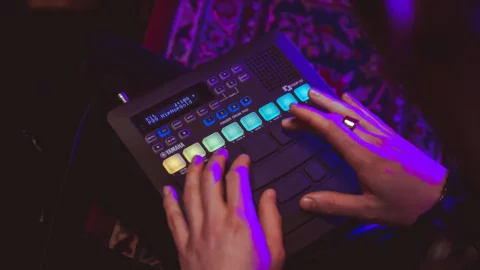
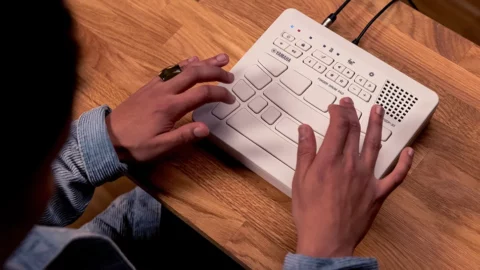
Yamaha has announced 2 new finger drumming pads in the shape of the FGDP-50 and FGDP-30.
Both FGDP finger drum pad designed to capitalise on the increasing popularity of tabletop beat performing, each model features a core setup of 18 pads, with the FGDP-50 also offering a further eight RGB-lighted pads, a display, flash drive support for playback/recording and note repeat.
The layout is to be conducive to three-finger drumming, with the thumb triggering the kick, the index finger firing the snare and the middle finger powering the hi-hat. The pads are velocity-sensitive, and pushing down on one mutes the sound (useful for creating cymbal choke effects, for example).
As regards to sounds, Yamaha has reconfigured the ones from its DTX modules for the new pads. These are said to have been optimised for playing with fingers rather than sticks, with special focus put on how they respond to different velocities.
The sound libraries are well-stocked: there are 1,500 voices and 48 preset kits inside the FGDP-50, and 1,212 voices and 39 preset kits in the FGDP-30.
Both FGDP pads can operate completely standalone thanks to their built-in 2.5w speakers and rechargeable lithium-ion batteries. Besides, you can also use them as MIDI controllers via the USB port, which also outputs audio and enables playback from another device so that you can jam along.
Yamaha FGDP-50 and FGDP-30 priced at MSRP: $387.60 and $258.40 respectively. Find out more on the Yamaha website.
Conductive Labs co-founder Darryl McGee let us know that – after a 2 year absence, due to the chip shortage – the NDLR is back and “better than ever” – and making its official debut at Knobcon 2023, being held September 8-10, 2023 at the Hyatt Regency Schaumburg, Chicago.
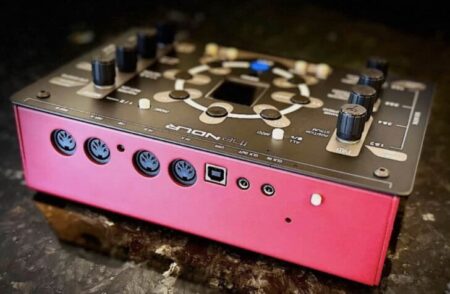
The NDLR (‘noodler’) is an ‘ultra-arpegiator’, designed for people that want to play or perform with a lot of synths. The NDLR fits between your sequencer or keyboard and your synths and sound modules. It translates what you play into up to four parts – a drone note, bass line, pad notes, and a motif sequence – and can control up to eight synths at once.
Here’s McGee introducing the NDLR five years ago at Knobcon 2017:
The NDLR v2 features a soft power button, is now powder coated with a beautiful red base, and has been redesigned internally for a more readily available (and faster) microcontroller.
Otherwise, the new model has the same feature set as the original, which had gained many additional features since its introduction, plus a couple of new features to coincide with this launch.
Here’s Loopop‘s in-depth demo of the original NDLR:
The NDLR v2 is available to pre-order for $379. It will also be available at retailers later this month.
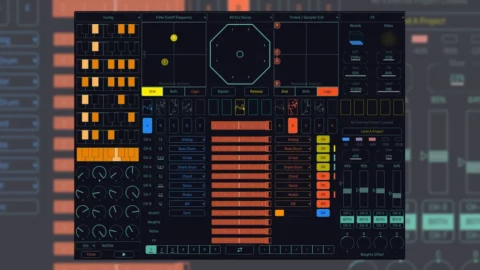
Cong Burn has announced an update to its sequencer, sampler, synthesizer and groovebox app Strokes to v3.12, adding a new performance mode which enables you smoothly interpolate, transition and morph between sounds, sequences, patterns and even project files.
Performance mode enables the user to transition between sounds, sequences, patterns and even different projects. Instead of simply jumping from one pattern (and one set of sounds, samples and parameters) to the next, Strokes enables us interpolate two patterns using a kind of meta-crossfader that smoothly blends a number of different parameters together simultaneously, rather than blending two audio signals. It’s a neat function that we haven’t seen in many other tools of this kind.
The plugin’s samplers have also been re-engineered to offer five sub-samplers, meaning different samples can now be used within each pattern that’s sequenced. Strokes’ effects capabilities have also been bolstered, with the addition of a bus saturator and glue compressor joining the onboard reverb and delay.
Strokes is available now as a VST3/AU plugin for Mac and PC and costs £35. It is also available for iOS as a standalone app or AUv3 plugin for £19.99. Cross-platform bundle for £45