Cherry Audio introduces ‘The Best Instrument For Fat Sounds’, PS-3300 Virtual Instrument
Cherry Audio has certainly had what you might call ‘a busy spell’, recreating many synth legends like the Yamaha CS-80 (in its GX-80) and Jupiter-6 (with its Mercury-6) over the last year alone.
Cherry Audio today introduced PS-330, a new virtual instrument, based on the Korg PS-3300 semi-modular analog polyphonic synthesizer from 1977, of which only 50 hardware units were ever made.
This 1977 synth was apparently once described as “the best synthesizer for fat sounds” by Bob Moog. Not the greatest PR exercise in that his own Minimoog was supposed to be that very synth, but either way, that is some endorsement.
Cherry Audio managed this recreation thanks to the Electronic Music Education and Preservation Project (EMEAPP) which allowed it full access to its own vintage PS-3300.
The organisation role is to “share the history, artists, sounds, equipment, and technology of electronic and rock music, keeping it relevant and accessible for future generations,” and as such it owns a number of iconic machines.
Cherry Audio’s PS-3300 has 360 presets (by sound designers James Terris, INHALT, and Drew Schlesinger) plus a legacy set of sounds from the original PS-3300 owner’s manual.
We should finally add that Cherry Audio’s PS-3300 is not the first Korg PS-3300 emulation of the year. Full Bucket Audio announced a similar 3300 clone, the FB-3300, a few years ago.
Here’s what Cherry Audio say about it:
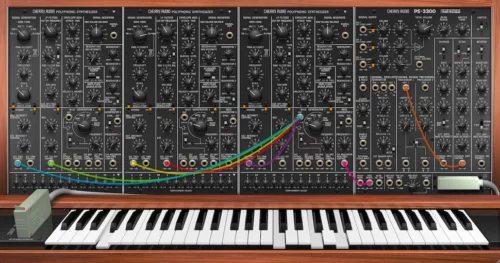
PS-3300’s unique architecture set it apart from the handful of polysynths available at the time. It had three independent “signal generator” panels, each essentially a complete polyphonic synthesizer. Each of these synth panels included 12 independently tunable divide-down oscillator banks as well as independent discrete VCFs, envelope generators, and VCAs for every note. This enabled all 48 keys of the external keyboard to be simultaneously played with independent articulation.
Dual LFOs and triple voltage-controllable resonators for each generator further shaped its signature tone. A dedicated master panel featured a mixer with VCAs for each of the three voice panels, sample & hold, an additional envelope generator, and two control voltage processors. It also delivered extensive modulation possibilities through an astounding 67 front-panel input/output jacks.
Taken as a whole, the PS-3300 was so powerful and revolutionary that even Bob Moog was impressed, stating that it was, “the best synthesizer for fat sounds.”
The PS-3300 virtual instrument replicates the functionality, layout, and sonic characteristics of each of the three PSU-3301 signal generator panels, including the six-waveform oscillators; two modulation generators (LFOs); dynamic lowpass filters, envelopes, and amps; its distinguishing triple-peak resonators; independent per-note “temperament” tuning knobs; and patchable jacks (with virtual cables) for signal routing.
The voice panels have been expanded, though, with additional faculties, including PS- or MS-style filter selection, tempo sync, copy/paste between panels, and temperament tuning presets.
The master signal mixer replicates the PSU-3302 sample & hold, a general envelope generator, and jacks for advanced sound-shaping and control. Cherry Audio has expanded the panel with continuously variable CV control of level, per-channel panning, bend range, and studio-quality integrated effects for chorus, delay, and reverb.
Features:
- Virtual analog emulation of the semi-modular analog polyphonic synthesizer released by Korg in 1977
- Three independent “signal generator” panels, each with an oscillator, lowpass filter, three-peak resonators, envelope with velocity, amp, two mod generator LFOs, and per-note tuning:
- 3X VCOs with six waveforms: triangle, saw, rectangle (square), two preset pulse waves (with different widths), and PWM (variable-width pulse)
- 3X resonant VCF 12 dB/oct lowpass filters with the option to select between the standard “clean” PS filter or the “crunchier” MS-style filter
- 3X modulatable “triple resonators”: 12 dB/oct bandpass filters to produce vowel and phasing tones
- 3X discreet ADSR-type envelope modulators with velocity control, and amplitude modulation
- 3X two syncable “mod generators” (LFOs) with output jacks: one with triangle, saw, ramp, rectangle, pink noise, and white noise, and the other with triangle waveform
- 3X temperament section with individual tuning knobs for the 12 chromatic notes, and temperament presets for Equal Tempered, Mean Tone System, Hepatonal System, and Just Intonation
- Copy/paste settings from one signal generator panel to another
- Polyphonic mode with up to 24 voices of polyphony and three monophonic modes: last, low, and high note priority
- Semi-modular synthesizer with virtual jack and cable system, featuring unlimited mults per jack and customizable (color, transparency, animation) cables
- Master signal mixer panel with sample & hold, general envelope generator, and two control voltage (CV) processors
- Individual channel panning
- User-selectable bend range and master tune
- Studio-quality integrated effects: chorus, echo with sync, and three types of reverb (spring, plate, and Galactic)
- Over 360 professionally designed presets in a dozen categories. These include a bonus Legacy collection of basic presets based on the patch sheets in the original PS-3300 Owner’s Manual, a 3100-based Glissando patch, and a 432 Hz Equal Temperament patch, all to get your started in your own sound design adventures.
- Standalone virtual instrument and plug-in versions
- Complete MIDI control and DAW automation for all controls, with easy-to-use MIDI Learn and mapping
- Focus zoom-in feature, as well as standard UI zoom and resize via drag
- Complete documentation available directly online from the instrument or in downloadable PDF format
- User-adjustable oversampling control
Cherry Audio PS-3300 is available now for $49 (normally $69)