Music Expo San Francisco 2024 Scheduled On 9th November


Organizers of Music Expo, a conference series for music makers, have announced Music Expo San Francisco 2024, presented by Focusrite Group and in association with Sound On Sound magazine.

The event returns with its first in-person event in five years, at Music City San Francisco on Saturday, November 9th.

Music Expo San Francisco 2024 will offer attendees up-close access to some of the world’s top DJs, producers, artists, engineers, songwriters, music industry tastemakers and leading technology brands. Past events have welcomed more than 5,000 attendees, more than 250 presenters, and more than 300 hours of educational content and networking.

Music San Francisco 2024 will be exploring three major themes including Music & AI, Spatial Audio & Virtual Reality, and Artistry and Connection.

“Music Expo is back, stronger than ever,” says event founder Loïc Maestracci. “It’s not just an event; it’s a celebration of the Bay Area music community that is more vibrant than ever; it’s a testament to the power of music to connect, inspire, and propel us forward.”

“Having participated in many Music Expo events in the past, I was thrilled to hear it was coming back, in person, revamped and ready to serve the Bay Area music-making community, said Hannah Bliss, Vice President of Marketing at Focusrite Group. “For the Focusrite Group content creation brands; Focusrite, Novation, ADAM Audio, Sequential, and Oberheim, it was a no-brainer decision to support Music Expo and we are proud to be the presenting sponsor. We’re looking forward to sharing some of our best-selling audio recording, production and music creation products with Music Expo attendees. We will have product specialists on hand to answer questions, and plenty of new products to share.”

Super early bird tickets for the one-day event are available now for $39 (50% off General Admission) and limited VIP tickets are available for $149. Full program details to be announced.
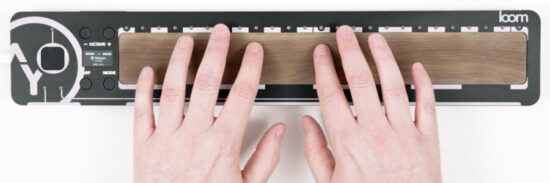
Aodyo Instruments Loom Adds 4 New Playing Modes: Fader, Keygrid, Martenot & Controlpad


Aodyo Instruments has announced four new playing modes for its new Loom MPE MIDI Controller.

The Loom is a multidimensional MPE MIDI Controller, designed to let each finger to control pitch (X axis), timbre (Y), and dynamics (Z) independently. In addition, a dynamic sensing system analyzes when your fingers land to determine impact force.


When it was originally introduced, the Loom featured four playing modes:

  • MIDI Keyboard, offering access to a two or three-octave range. You can play notes, bend them, nuance individual attacks, and add expression by sliding along the keys.
  • MIDI Ribbon, allowing for smooth sliding across its surface. Optionally, it can make sure you land on the right note, making it easier to play with others, without losing the free-form nature of the ribbon.
  • MIDI Strum mode lets you choose a chord with one hand and strum virtual strings with the other.
  • MIDI Drumkit mode is designed to provide you with an efficient layout for finger-drumming. It can sense the way your finger hits the surface, as well as the position of your hit.

The video demonstrates four new playing modes for the Loom: Fader, Keygrid, Martenot, & Control Pad. See the video for examples of each of the new modes in action.

Production of the Aodyo Instruments Loom is being funded via a Kickstarter project, and it is available to project backers starting at €259, which is 35% off the planned retail price.*Note: Crowdfunded projects can involve risk. View the project website for more information.


Synchron World Percussion features 29 Instruments From Around The World


Vienna Symphonic Library has introduced Synchron World Percussion, a new collection of virtual percussions instruments from West Africa, the Middle East, and Brazil.

All drums and percussion instruments were recorded in the large hall of Synchron Stage Vienna and are designed to blend seamlessly with VSL’s other sampled instruments captured on this scoring stage.

Features:

  • 29 authentic instruments
  • 3 regions: West Africa, the Middle East, Brazil
  • Over 500 vivid MIDI loops
  • Extra mixer preset “Ensemble” included
  • 3 close microphone options
  • Exceptional level of realism and sonic excellence

Synchron World Percussion features instruments from around the world:

  • West Africa:
    • Djembes A goblet drum with a deep bass, round open strokes and sharp slap sounds. Played with the hands, standing with a stand or sitting between the legs.
    • Sabar Drums An elongate drum with a somewhat muffled sound. However, hits with the stick can sound very sharp. Played with a thin stick in the left hand, and with the free right hand.
    • Talking Drums An hourglass-shaped drum whose skin tension can be controlled with the arm, allowing the player to change its pitch while playing. It is wedged under the player’s arm and played with both hands. One hand holds a mallet whose head is angled by 90°, while the other hand remains free.
    • Doum Doums The doum doum, also called dundun or dunun, is a larger cylindrical drum with a medium to low pitch. It is played with thick mallets, often in a set of three drums.
    • Shekere The shekere is a dried gourd covered in a net of pearls with a shaker-like sound. The most common playing technique is hitting the net with one’s hands.
    • Caxixi A filled shaker instrument with a woven basket-like body and a hard, flat base. The sound is softer or harder depending on whether the filling hits with the side or with the base.
    • Bell straps Little bells (crotal bells) mounted on a ribbon. The sound is similar to that of jingle bells. The ribbons can be strapped to the leg but also hung on cymbals and hi-hat.
    • Cabalonga A nutshell shaker with a noisy, but warm wooden sound. Played by shaking, combing, pressing.
  • Middle East:
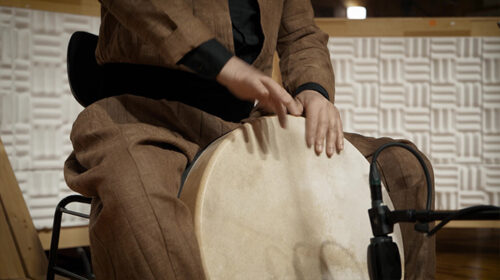
    • Daf A frame drum with metal rings, offering a large spectrum of sounds from bass to slaps and shakes. It is held in both hands and played with both hands simultaneously, also shaken.
    • Daira The daira is written differently according to region; like the bigger daf, it is a frame drum with metal rings. It is held in both hands and played with both hands simultaneously, also shaken.
    • Daf Bass A large frame drum with low bass and without metal rings. It is held in both hands and also played with both hands at the same time. As the instrument is quite heavy, it may also be wedged between the legs and played with both hands.
    • Pandariq A frame drum with detachable jingles developed by the company Schlagwerk. It is held and played with both hands simultaneously. As the instrument is quite heavy, the alternative is to wedge it between the legs and play with both hands.
    • Riq The riq, also written riqq, is a small frame drum with jingles in the frame, making it sound similar to a tambourine. The instrument is held with both hands and played on the skin and the jingles.
    • Darabuka There are many different spellings of this goblet drum with a wide sound range from bass over open tones to sharp slaps. The darabuka is placed in the lap and played with both hands.
    • Tombak Like the darabuka, the tombak is a goblet drum with a wide sound range from bass to open tones to sharp slaps, but with a darker sound. It is placed in the lap and played with both hands.
    • Dohol The dohol, also called davul, is a large drum with a bassy timbre, but also able to produce bright sounds. The double-sided barrel drum is carried in front of the body with a shoulder or neck strap. The right hand holds a bent (so as not to pierce the skin) stick for the bass strokes. The left hand uses a thin, flexible stick for the high strokes.
    • Naghare The naghare is a cylindrical drum whose sound lies between frame drum and tom. The drum is played sitting, wedged between left leg and left arm, with both hands.
    • Tas The tas is a kettle drum with a bassy sound. The instrument is played with rubber mallets, lending it a smacking attack. The skin is struck from above with two rubber mallets.
  • Brazil:
    • Pandeiro A little to medium-sized frame drum with jingles in the frame, similar to a tambourine. The instrument is held in one hand and played with the other, often with so-called “floating-hand” movements.
    • Surdos Surdos are large cylindrical drums with a saturated, bassy sound. They are carried in front of the body with a sling. One hand plays with a samba mallet, while the free other hand not only plays audible strokes, but also is used to damp the skin.
    • Tamborim The tamborim is a small frame drum. As opposed to the tambuorine, it has no jingles. The sound is high, noisy, and short, i.e., without resonance. It is mostly played with a plastic whip called “baqueta” while the holding hand executes a turning motion.
    • Cuíca A friction drum with a squeaking to buzzing sound. A stick mounted on the skin of the drum is rubbed with a damp piece of cloth. Pitch can be controlled with the amount of pressure.
    • Snare A flat cylindrical drum with stiff wires (snares) crossing its resonance skin on the underside. It is played mostly with drumsticks, but also with rods, brushes, hands, or soft mallets.
    • Repinique The repinique is a cylindrical drum, in build and function between the highest surdo (terceiro) and the snare drum. As the skin is stretched very tightly, its sound is similar to that of a snare drum played with detached snares. Depending on style, the instrument is either played with two drumsticks or with one drumstick and one hand.
    • Chocalho The chocalho is a stick rattle made of metal with numerous tin lamellas, and sounds like a loud metal shaker. Chocalhos are shaken out of the wrist joint at the height of the head.
    • Shaker A closed rattle with a bright, noisy sound. Shake it!
    • Agogo Bells Two metal bells joined together by a hoop, with a bright, bell-like, assertive sound. The bells are held in one hand and played with a stick in the other. They can be played open or muted.
    • Timbau The timbau, also called timba or timbal, is a conical, elongate hand drum with a wide range of sounds. The drum can be carried in front of the body with a shoulder belt or put on a stand, and is played with both hands.
    • Reco-reco Originally wooden, but nowadays mainly made of metal, the reco-reco is a scraping instrument with a tinny, noisy sound. Similar to the guiro, sound is produced by rapid up and down movements with a stick on a grooved surface.


Synchron World Percussion is available now with an introductory price of $194 for the Standard Library (regular $257), and $294 for the Full Library (regular $399). The difference between the Standard Library and the Full Library is the number of available microphone positions.