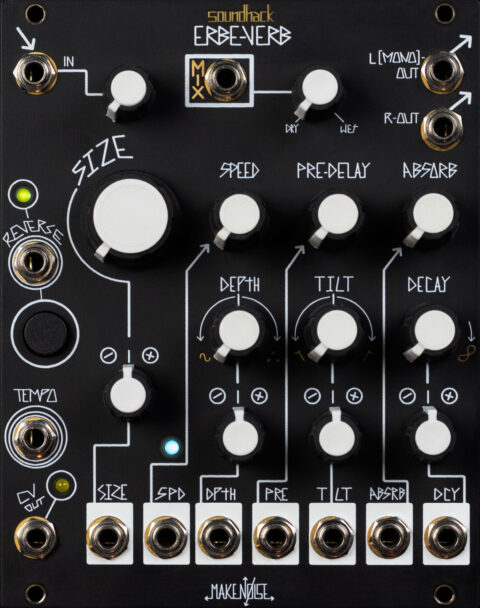
Make Noise has announced that it’s retiring its Erbe-Verb Eurorack effects module, once the current run is sold.
“To celebrate its legacy,” they say, “we have produced one last run of Erbe- Verbs in Black & Gold faceplates.
Features:
Mono In, Stereo (or Mono) Out, all analog Dry signal path
Size ranges from “coffin” to “the heavens”
Continuously variable Decay settings all the way to infinite feedback
Wide ranging Pre-Delay settings from 7ms – 500ms
Manual or voltage controlled REVERSE reverb
Control over Absorption, Internal Modulation Depth and Speed allows for programming smooth resonances, chorused Doppler effects, shimmer, ghost choirs and more
TILT shapes the tone of the reverb, dramatically emphasizing low or high frequency content
Pre-Delay, Reverse and Internal Modulation all able to be synchronized to external clock via TEMPO input
CV Out completes the conversation between Erbe-Verb and rest of system!
Utilizes High performance DSP hardware with 24bit, 48kHz codec, 32 bit floating point processing and reasonable power consumption
The Make Noise Erbe-Verb has a street price of $489.
At Superbooth 2024, composer & synthesist Anthony Marinelli interviewed Geert Bevin, Software Engineering Lead and Product Designer at Moog Music.
This discussion is really about the state of what’s possible with synthesizers and expressive performance, which will be of interest to anyone passionate about synths.
Bevin is one of the most important developers working in the musical instrument space. He’s been involved in developing firmware for instruments like the Roger Linn LinnStrument and the Eigenharp; leading development for Moog’s software synthesizers; and is the author of the original MPE specification.
The interview is free-flowing and covers a lot of territory, but is ultimately is a fantastic conversation about two people with deep knowledge of synthesis and instruments.
Whether your into hardware or software synths, bookmark this interview and check it out when you have 48 minutes to watch it. At its core, the discussion is really about the state of what’s possible with synthesizers and expressive performance, which will be of interest to anyone passionate about synths.
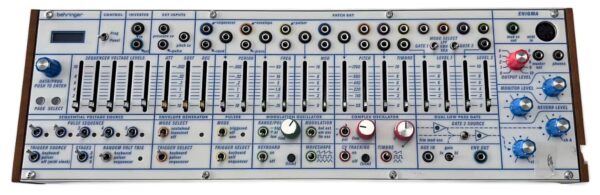
Today, Behringer shared another preview of their upcoming Enigma synthesizer (Buchla Music Easel Copy), designed to be an inexpensive, unofficial copy of the classic Buchla 208 Stored Program Sound Source.
Details are still to come, but they say “We’re excited to share our latest Enigma prototype as we get closer to the final product. It’s a very complex design, particularly with the addition of total patch memory. “
The Buchla 208 is the voice of the classic Buchla Music Easel from 1972. The Music Easel pairs the 208 with the 218 Touch Keyboard in a suitcase-style case. Modern reissues of the 208 are available from Buchla USA.
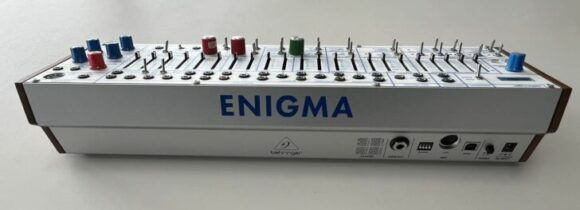
The Behringer Enigma is not a straight clone of the original 208. It follows the format of Behringer’s other Euro-format synths, scaling the original design down to Eurorack-compatible format, trades the program card connector of the original for patch storage, and adds DIN & USB MIDI control.
The image that they shared is of a Behringer Enigma prototype, so no time frame for availability has been announced. Behringer expects to price the Enigma at $399.