Akai Professional has announced that MPC Stems is now available for all MPC standalone hardware.
This feature enables stem separation directly on MPC hardware fully standalone, allowing producers to separate bass, drums, vocals, and other musical elements without the need for a computer.
This expansion builds on the March 2024 announcement of stem separation for MPC users via the desktop app, now enabling users to create stems directly on their MPC controllers in standalone mode.
Ski Beatz Demonstrates How He Uses Stems In His Production Workflow:
MPC Stems for Standalone is compatible with the following MPC hardware: MPC Live series, MPC One, MPC One +, MPC X, MPC XSE, MPC Key 61, and MPC Key 37. Supported by the new 2.15 Software/Firmware update, this feature ensures seamless integration and enhances the user experience on all compatible MPC devices. MPC Stems is available now for $9.99. All previous licenses purchased for MPC Stem Desktop will include “Stems Standalone.”
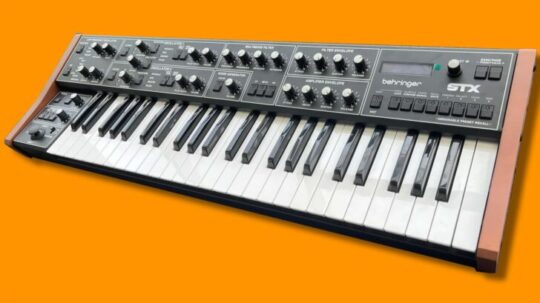
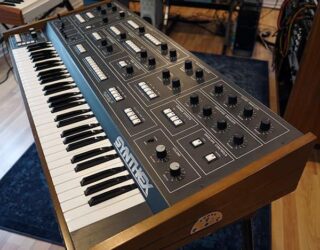
Today, Behringer shared a preview of its upcoming copy of the Elka Synthex, an 8-voice DCO polysynth design from 1981.
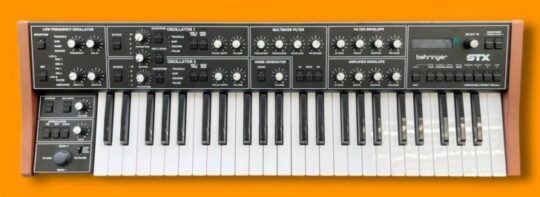
The Behringer STX appears to be a fairly straight copy of the Synthex’s design, but reduced to fit into Behringer’s 4-octave Deepmind 12 form factor.
What the company say about it:
The original Elka Synthex was used notably by Jean-Michel Jarre
“The Elka Synthex, a synthesizer from the early 1980s, is cherished for its rich, warm sound and unique character. Musicians like Jean-Michel Jarre and Duran Duran have used it to create iconic tracks, solidifying its place in music history.
Designed by Mario Maggi and produced by the Italian company Elka, the Synthex has a storied past.
At Behringer, we’re working to revive the Elka Synthex with a dedicated team of top-notch R&D engineers in Italy, where the original was created. Using original DCO oscillators and advanced Field Programmable Gate Arrays (FPGAs), we’re able to replicate the original circuitry and signal paths, capturing the essence of its distinctive sound.
Our goal is to make the classic sound of the Elka Synthex available to today’s musicians, combining its vintage appeal with modern technology. This passion project aims to respect the legacy of the Synthex while providing the enhancements needed for contemporary use.”
Behringer hasn’t shared any official specs yet, but based on the images that they’ve shared, it looks like the key changes are the addition of MIDI, and shrinking the synth down to fit into one of Behringer’s standard formats, losing an octave off the keyboard in the process.
Details on pricing and availability for the Behringer STX are to be announced, but the company says that “This ‘labor of love’ project will take lots of time, but it’ll be worth the wait.”
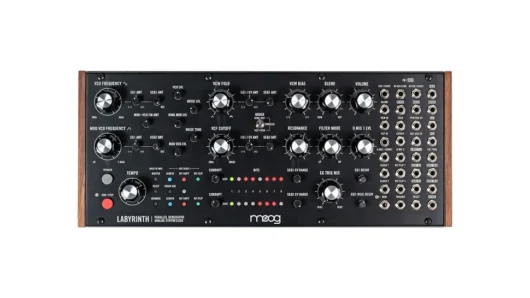
Today, Moog Music has officially introduced its Labyrinth, the latest in their line of all-in-one semi-modular analog synthesizers.
Like the Mother-32, DFAM, Subharmonicon & Spectravox, the Moog Labyrinth can be used as a standalone synth module, or integrated into larger Eurorack modular systems.
A semi-modular analogue machine, this represents a departure from past Moog instruments in that it offers a new voice architecture with unique oscillators, a different filter topology, wavefolding and parallel processing. There are also dual generative sequencers, which can be intertwined for polyrhythmic expression.
“Labyrinth is designed to be an engine of sonic exploration,” says Moog’s Rick Carl, System Architect and Lead Hardware Engineer on the new synth. “It allows users to create evolving sequences and rich timbres. It’s like having a compositional companion that navigates through a labyrinth of sound, constantly reconfiguring and surprising you with new sonic landscapes.”
Labyrinth comes in 60HP format can be used either standalone or part of a Eurorack setup. Its 32 patch points facilitate extensive modulation and routing options.
What they say about it:
“Departing from traditional Moog instruments, Labyrinth introduces a new voice architecture with unique oscillators, a different filter topology, wavefolding, and parallel processing. This innovative design also features unique dual intertwining generative sequencers to help inspire new compositional ideas.
As part of Moog’s semi-modular family, Labyrinth stands out as a unique tool for auditory exploration. Its dual generative sequencers and parallel voice architecture enable the creation of evolving soundscapes and intricate polymetric melodies. More than just an instrument, Labyrinth is an idea machine, offering limitless sonic potential that adapts to both live performances and studio sessions.
In a compact 60HP format, Labyrinth excels both as a standalone synthesizer and an integral part of larger Eurorack setups. Its flexible architecture allows musicians to add color and depth to any musical arrangement, from ambient soundscapes to dynamic rhythmic patterns. The instrument’s patch bay facilitates extensive modulation and connectivity with other modular gear, making it a versatile addition to any setup.”
Features:
Dual Generative Sequencers: Construct intertwining melodies and rhythms that mutate over time, uncovering new patterns and textures.
Parallel Voice Architecture: Features a combination of a voltage-controlled wavefolder and a state-variable filter for complex sound shaping.
Comprehensive Patch Bay: 32 patch points for extensive modulation and routing options.
Analog and MIDI Sync: Easily sync Labyrinth with other equipment using analog clock or MIDI.