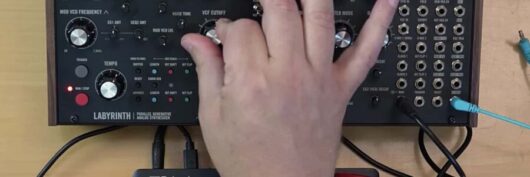
Host Ziv Eliraz – In his latest loopop video – takes an in-depth look at the Moog Labyrinth synthesizer, the fifth synthesizer in the company’s line of monophonic synths in Eurorack/standalone format.
Eliraz digs into the sequencer first, demonstrating how you can control the level of randomness and also the scale of sequences. He also demonstrates how you can do this in live performance, interactively generating new sequences and then, if you like, locking them in.
Next, he dives into the Labyrinth’s synth voice, explaining how it’s unique among Moog’s synthesizers and how its features contribute the its unique sound.
Finally, Eliraz shares his take on the pros and cons of the Moog Labyrinth. “There’s not much to compare this to,” he notes, adding that you’d spend a lot more trying to build similar functionality using individual Eurorack modules, software options wouldn’t provide the Labyrinth’s hands on control.
He also notes that the “Labyrinth sounds completely different from any other Moog.”
Topics covered:
0:00 Intro
1:40 Overview
5:20 MIDI
6:00 In the box
6:15 Sequencers
7:30 Flipping bits
8:10 Corrupt
8:45 Bit shift
9:05 CV Range
10:20 Save & recall
10:55 Qtz Scale
12:10 Chain seq
13:50 Advance
14:10 Combos
14:40 Oscillators
15:25 TZFM
16:20 Mixer & mods
17:20 Folder
18:20 Filter
19:15 Routing, blend
21:15 Envelopes
22:15 EG trig mix
22:55 IDEAS, PATCHES
23:05 Duophony – drums
25:20 Duophony – melodies
25:50 Square wave?
26:30 Pulse wave?
26:50 PWM?!
27:50 Fold tip
28:15 Tuning
28:50 Modes, scales
30:30 Looping AD env
31:10 Osc sync
32:15 Polymeters
32:35 Polyrhythms
33:15 Drone mode
33:30 Pros & cons
36:30 Sounds & sequencers
What do you think of the new Labyrinth synthesizer? Watch the video and share your thoughts in the comments!
If you’ve found that your musical performances don’t involve enough onanistic pantomime, you may want to check out the Sonica, a ‘slightly phallic’ electronic instrument.
German synthesist Hainbach – In his latest video – takes a look at the Sonica, shares his thoughts on it, and demonstrates how it can be used musically.
“This feels very, very nice to hold,” notes Hainbach. “The wood is absolutely fantastic to touch!”
Watch the video, and share your thoughts on the Sonica in the comments.
Video Summary:
“Franklin Eventoff, an American tinkerer and musician invented the force sensing resistor in 1977. This allowed for touch control of voltage, which he used to create instruments.
It found first commercial musical use in the Mattel Musical Thing, a cheap toy synth. Frustrated with the experience, Eventoff went on to create the much more refined Sonica. The Sonica is a lovingly crafted boutique instrument with an oscillator by famed Serge Tcherepnin, the creator of the Serge synthesizer. Only about 650 where made, and they are collector’s items.
The technology of the force sensing resistor proved hugely successful and lives on in cars, robotics and instruments like the AKAI MPC and the Otamatone.”
Alex Theakston of Mylar Melodies – In his latest video – takes an in-depth look at the new Moog Labyrinth synthesizer.
*Note: This is a sponsored video, so it’s part of Moog’s marketing for the Labyrinth. But, as usual, Theakston does a thorough job of introducing and demoing the new synth. If you want to get a better idea of the Labyrinth’s synth voice and how the sequencer works, the video does a good job of covering them, and then features a wide variety of musical demos.
“Labyrinth is well suited to Techno and so there is a lot of techno in the video,” notes Theakston, “but there is ambient and more in there!”
Topics:
00:00 What’s a Labyrinth?
01:46 Voice Explained
11:32 Sequencers Explained
26:32 Mavis & Laby Jam
30:50 The Techno Bells
31:34 Proper Techno
32:40 Tuff Techno
34:27 Extremely Tuff Bass
36:49 Tuff Bass Techno
38:53 Duophonic Drums
43:39 Ambient Buffersaving
46:40 TR8 & Mavis MIDI Techno
53:34 Heaven & Hell
58:17 Cosmic Family Jam
1:04:43 Post Credits Scene
Watch the video and then share your thoughts on the Moog Labyrinth in the comments!