Waldorf Wave 1 For iPad Brings Back Iconic Instrument As Mobile Instrument


Today, Waldorf introduces Microwave 1 for iPad, an emulation of the original hardware Microwave synthesizer.

The original Microwave “defined hybrid synthesis at its best”, with its combination of wavetable synthesis with analogue filters. Now Waldorf Music brings this instrument back as a standalone iOS app, as well as in the iPadOS AUv3 plug-in format.

Waldorf says that the Waldorf Microwave 1 Plugin was “painstakingly recreated from the original hardware, with all its idiosyncrasies and wonderful singularities.”

Waldorf says that this was a multi-year effort, and that they analyzed and modeled the original instruments down to the finest sonic details of every aspect of the hardware.

Microwave 1 for iPad Intro Video:

Only the first generation of the Microwave and also the Waldorf Wave were based on a custom developed integrated circuit called the Waldorf ASIC. In combination with the legendary Curtis filter chips and a very unique 68k CPU based controller software, the ASIC defined a very special flavor of wavetable sound unparalleled. The ASIC was designed with the help of Wolfgang Palm, a pioneer of wavetable synthesis.

As the original, the app runs the internal synthesis with the sampling rate of 250 kHz, regardless of the DAW sampling rate. The recreated digital waveforms have been bit-by-bit compared with the original to be 100% identical.

Even the old-school digital-to-analogue converters of the original hardware were modeled, with their non-linearities and tone shaping color which were leading into the two Curtis filter chips variants used for the revisions A and B of the original hardware. The plug-in allows further for artificially detuning and recalibrating of the analogue components.

But the Microwave 1 iPad app goes one step further: Its modern graphical user interface reveals many aspects of the synthesis engine which were hidden before in the original hardware by its minimal interface.

Users can also now edit existing wavetables and create new ones. All the original wavetables are available, with their control structures and the full original waveform catalog.

Even the more exotic feature like tuning and velocity tables have been implemented and can be edited in the UI. All the original factory single and multi-mode sounds are contained in the app in combination with new and modern sound presets. Original MIDI and Sys-Ex dump files can be imported, so you can load patches from the original hardware. Moreover, the app can be used to control the original hardware are a graphical editor.

If you an owner of a Microwave first generation, the app allows you to take your vintage hardware virtually with you wherever you like. The Microwave 1 iPad app can also be used as a standalone app as well as in the iPadOS AUv3 plug-in format.

Microwave 1 vs Original Hardware Microwave:

Microwave 1 for iPad is available now for $12.99

Korg Multi/Poly Synthesizer Features 60 Analog-Modeled Voices, Kaoss Physics, Motion Sequencing 2.0 & More


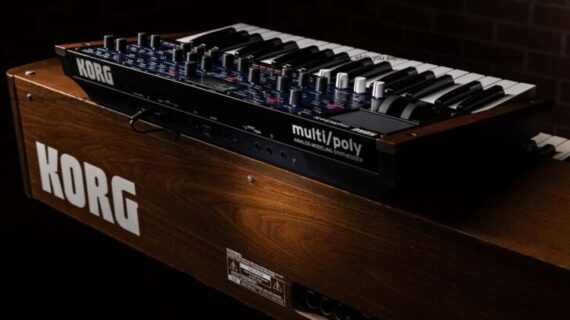
Korg has unveiled the latest in its line of compact digital synths, Multi/Poly, a multi-timbral instrument described by Korg as using ‘next generation analogue modelling’.

Today, Korg  introduces the multi/poly synthesizer, a new synthesizer in their opsix/wavestate format that offers 60-voice polyphony, three types of oscillators, Kaoss Physics, Motion Sequencing 2.0 and more.

Korg appears to have learned from the reception of its initial synths in this format, which were praised for their deep synth engines but criticized for the synth’s relatively lightweight build. The new synth more of a premium build, with thick wood end caps, and metal front and back panels.

Inspired by the classic KORG Mono/Poly, the new KORG multi/poly is an analog modeling synthesizer, and is the first instrument to use Korg’s latest analog modeling technology. While Korg reached back to the Mono/Poly for inspiration, the multi/poly is a completely new design, with capabilities that go far beyond the original. And, just as important as the vintage influence, the multi/poly builds on capabilities from other instruments in its compact synth line, like the wavestate and modwave.

What they have to say about the multi/poly synth’s capabilities:

“It’s like a polyphonic modular system in a compact, hands-on package – a limitless playground for synth players and sound designers. Create hardware mash-ups with East-coast, West-coast, and wavetable oscillators and a wide selection of newly-modeled filters. Make them come alive with models of different envelope, VCA, and portamento circuits.

Virtual voice cards produce organic timbral variation. Layer Rotate triggers new Programs with each press of a key. Plus Kaoss Physics, Motion Sequencing 2.0, massive modulation, and more.”

The multi/poly features analog modeling that goes beyond traditional virtual analog to more closely model a vintage analog synth engine. At the heart of Multi/Poly are virtual voice cards, with oscillators, filters, LFOs, amps, envelopes and portamento all designed to emulate the behaviour of analogue circuitry. The result is that each voice has a slightly different character, creating naturally rich timbres. You can dial-in in as much or as little of this variation as you like, and do individually for each sound.

Just like in an analog synth, the Virtual Voice Card also continue to ‘play’, even if you’re not hearing them. Envelopes keep evolving, so that if you play a pad with a long release time, newly played notes “catch” the envelope at its current level instead of restarting from zero. Oscillators and LFOs maintain their phase, and resonance continues to ring. Each oscillator’s pitch can also drift slightly over time, modeling the slight pitch instabilities found in analog hardware.

Envelopes are an often-overlooked factor that contributes to the unique sounds of vintage synths. The multi/poly includes envelope curvature presets for the Mono/Poly, MS-20, “Mini,” “Pro,” ARP Odyssey, and more. Also, analog VCAs don’t respond evenly to voltage, and have different thresholds for turning on and off, which in turn has a strong effect on the Amp Envelope’s character. So, the multi/poly features modeled VCA responses from the Mono/Poly, MS-20, Mini, Odyssey, and Prophet 5, as well as a linear option.

Classic analog synths had different approaches to portamento, too, and so the multi/poly has six different portamento models to choose from.

The synth also has modulation capabilities that go well beyond what an analogue instrument could achieve, with four 6-stage envelopes and five LFOs feeding into a complex mod matrix that can apply modulation processors to alter modulation routings.

Other highlights include Korg’s Motion Sequencing 2.0 technology, which offers independent sequencing of pitch, timing, parameter automation and more. There’s also a capable multi-part effects engine. Multi/Poly also features the Kaoss Physics touchpad first seen on the Modwave, which allows parameters to be modulated across an X/Y space using the movement of a virtual bouncing ball.

Possibly the most distinctive feature here is the Layer Rotate mode, which emulates the way Mono/Poly could alternate its oscillators in a round robin manner with each new note played. Here, however, rather than using individual oscillators, Multi/Poly alternates between its four timbral layers.

The synth hardware itself is similar to that of Korg’s Wavestate, Modwave and Opsix. It features a 37-note semi-weighted keyboard with velocity and release velocity sensitivity. It features MIDI I/O and USB connectivity, which can send/receive MIDI as well as make use of Korg’s Librarian app, for managing patches and uploading user wavetables.

The multi/poly also has a dedicated Editor and Librarian, for Mac & Windows, which can streamline sound design and managing your sound library.

Korg multi/poly Overview:

Korg multi/poly Audio Demos:

The Korg multi/poly synthesizer is available now and Amazon site, priced at $899.99

Elektron Digitone II Features New Synthesis Options, Double The Polyphony & More


It’s been a busy few weeks for Elektron. The Swedish hardware brand has just dropped updates for its Syntakt and Digitakt II grooveboxes, bringing new analogue sounds to the former and long-awaited Overbridge compatibility to the latter, all while playing down rumours of the imminent announcement of a leaked new instrument named Tonverk. As it transpires, Elektron did have a new instrument ready to announce all along – not Tonverk, but a new version of its synth-come-groovebox Digitone.

Today, Elektron introduces Digitone II, a major update that adds new synthesis options, double the polyphony and 16-track sequencing.

They say that Digitone II reimagines the synth as “a multi-machine, many-realm-reaching wonder, taking the evolution of Digitone synthesis and sequencing to new heights.

While FM synthesis is still at the heart of Digitone II, the update looks to expand the capabilities of the synth engine significantly. Much like Digitakt II, which arrived earlier this year, one of the most notable upgrades here is a doubling of the audio capabilities, raising the overall polyphony from eight to 16 voices. As before, Digitone II is multi-timbral and allows users to split the voice count into four independent synth sounds.

According to Elektron, Digitone II is designed so users can, “pull your sound through the prism and into a spectrum of dazzling tones and timbres.”

Elektron Digitone II Overview:

Elektron Digitone II Synth Machines:

To that end, Digitone II introduces a system of ‘machines’, which effectively allow the user to mix and match a variety of synth engine and filter modules, each with its own characteristics and parameters.

On the synthesis front, Digitone II has four machines to choose from. FM Tone is the original Digitone’s four-operator FM engine. FM Drum is a new machine specifically designed for synthesizing percussive sounds, similar to the engines found in Elektron’s Syntakt and Model:Cycles grooveboxes. Wavetone is a two-oscillator synth engine that allows users to morph between waveshapes and adds phase distortion into the synthesis mix. Finally, Swarmer is a super-saw based cluster oscillator with detune and noise modulation controls.

The new filter modes are similar to those found in Digitakt II. These include a Legacy LP/HP based on the original Digitone design, a new morphable multimode filter, a 24db lowpass filter, parametric EQ and a pair of comb filter modes.

There are also improvements on the effects front, with new sample rate and bit reduction effects, along with overdrive that can be placed pre- or post-filter. Digitone II also gains a master compressor.

Other enhancements from Digitakt II are also present and correct here, including upgraded modulation that now includes three LFOs per synth track and easy routing of external velocity, aftertouch, pitch and mod wheel sources.

On the sequencer side, the original’s 64-step sequencer is doubled to 128 steps, and adds the Euclidean generator present on Digitakt II and Syntakt. Digtone II also adds a variety of other workflow improvements, including improved preset management and song mode.

We have not seen any info yet from Elektron on whether or not any of Digitone II’s new features are coming to the Digitone mk1 via firmware updates.

Elektron Digitone II Key Features:

  • Digitone II is a multitimbral polyphonic synth, framed in a modular workflow. Its 16 tracks can be used for any of its synth machines or for MIDI, with 16 voices available across those selectable synth machines. On top of this, there’s also an abundance of filters, an expanded Elektron Sequencer, a powerful note editor, and more.
  • Machine by machine – There are four synth machines to play with, each with their own character and options.
    • Wavetone, a fresh take on the classic 2-oscillator synthesizer. Morph between oscillator shapes, add phase distortion and oscillator modulation, or define with precision the flavor of your noise.
    • Swarmer is a “super saw-in-origin cluster”, offering lots of waveform control across the swarm. Pick your shape, combine detune and noise modulation controls, and reach complex textures.
    • FM Tone is the original Digitone FM synthesis engine.
    • FM Drum is tailored to creating FM percussion sounds, but is capable of being used melodically, also.
  • Modularity & modulation – The Digitone II’s flexible workflow, featuring swappable synth machines and a variety of filter options, offers deep options for shaping your sounds.
    • Digitone II’s augmented filters show how much depth is possible. Experiment with Comb- and Comb+, or try out Multi-mode, EQ, Lowpass 4, and Legacy LP/HP.
    • The base width filter is also more flexible than ever – place it before the other filter or at the end of the audio track chain.
    • ‘There’s also a dedicated amp envelope for each voice: ADSR for increased control and clarity, or AHD, for maximizing percussive sounds.
    • It also features three LFOs/voice, and their many destinations give you deep control over your sounds.
  • FX – Digitone II offers more sound-refining effects options, including lush delay and reverb, shimmering or dissonant chorus, brutal bit reduction, sample rate reduction, and overdrive that can be placed before or after the filter. Use the master compressor via the mixer page, opening up sidechaining and other parameters, as well as the master overdrive, for even more distortion control.
  • The Sequencer – The Digitone II sequencer offers 128 steps with Parameter Locks. Euclidean sequencer mode lets you combine two pulse generators to create mathematically-driven but musical sequences. Per-step conditions, settable probabilities, and retrig mean that you can create sequences that take much longer than 128 steps to repeat, or that go all the way into generative sequencing territory.

Digitone II is available to order now, priced at $999/€1049/£899. Find out more at the Elektron site.

*Note: The Elektron site currently says that the Digitone II is “Out of stock”.