Minimal Audio Unveils Current 2.0, The Next Edition of its All-in-one Synth, Sampler, Multi-effects Plugin and Content Platform


Last year, Minimal Audio announced the release of Current, a hybrid of synth, sampler and multi-effects plugin that also offered access to a cloud-based content platform.

Today, Minimal unveils Current 2.0, an updated version of the instrument that features a new and improved Ul, modulation matrix and frequency shifter effect. If you’re not familiar with Current, check out our news story to find out more; here’s what’s new in Current 2.0.

Current has been updated with a new Play View that gives music-makers a dedicated space to quickly and easily experiment with preset sounds by assigning various parameters to a dual XY pad. The plugin ships with 400 new presets, along with an expanded factory content library that features more than 800 samples and 170 additional wavetables.

The plugin also benefits from a new mixer panel that enables the user mute, solo and adjust the levels of each sound engine, along with a pop-up modulation matrix that provides access to additional modulation controls.
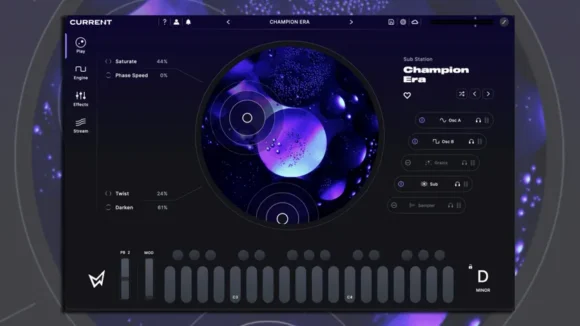
Though most of the updates to Current focus on its interface and workflow, the plugin’s new Wave Shifter effect brings together a frequency shifter with integrated FM, AM and ring modulation to produce glitchy, experimental textures, and the synth engine has been upgraded to support 32-voice polyphony.

The original version of Current brought together multiple sound engines, effects, and a cloud-based content platform in a single plugin; its two-oscillator wavetable synth is joined by a granular engine, a sampler, and additive sub-oscillator, all passing through a dual multimode filter and an effects section that includes a variety of the company’s effects processors. The plugin also gives users access to Stream, a cloud-based content platform that regularly delivers new presets and samples to subscribers.

Current 2.0 is priced at $199, but is available now at an introductory price of $99. Existing owners of Current can upgrade at no additional charge.

Find out more at Minimal Audio website.
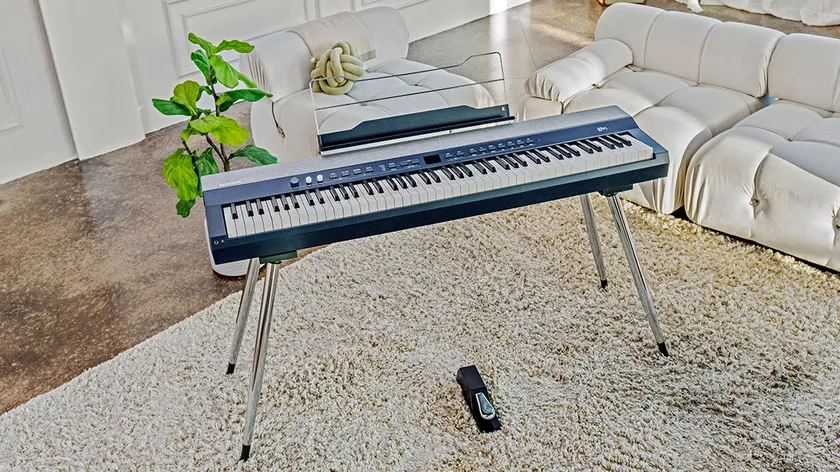
Kurzweil & Axel Hartmann Channel Mid-Century Modern Design With The KaP1 Digital Piano


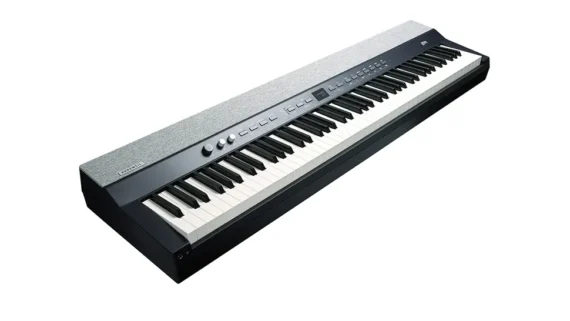
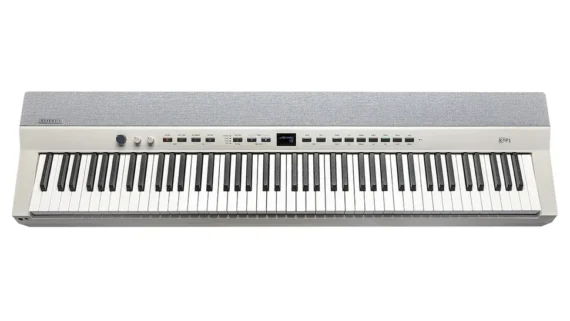
Kurzweil has released a portable digital piano with a “mid-modern aesthetic” that’s said to be “beautiful from all angles”. With a look dreamt up by renowned synth designer Axel Hartmann, the KaP1 is actually billed as a stage piano, but could easily fit with the decor of a contemporary home or vibey studio.

It’s not all about the visuals, though: thanks to the inclusion of the Kore 2.0GB sound library, the KaP1 shares its 9-foot German grand piano samples with Kurzweil’s flagship K2700 workstation and SP7 Grand. Additionally, there are string, electric piano and organ tones in here.

The H1 Ivory Hammer-Action Keyboard is designed to replicate the touch and feel of a real piano. The KaP1 also features a 4-speaker stereo sound system that’s powered by dual 15W digital amplifiers, and has Bluetooth audio and MIDI connectivity.

Other player-friendly features include splitting and layering, pre-programmed backing rhythms, a metronome and a MIDI song recorder. The stand options are a traditional looking 3-pedal rig, the ST-4, or the more hipster ST-C1, which gives you those mid-century thin metal legs.

The KaP1 is being launched into the US with Artesia Pro and will be available in blue, white and black colour options. The KaP1 is available now, with a street price of about $800, and you can find out more on the Kurzweil website.

Music For Synthesizers + MIDI-Controlled Music Box


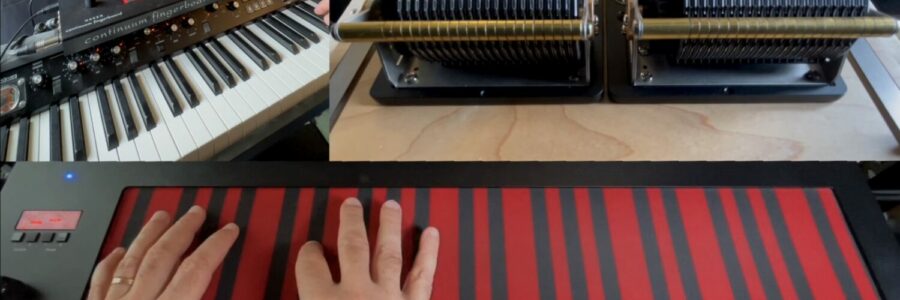
Synthesist and instrument designer Christophe Duquesne shared this video, capturing a composition for synthesizers & electronic music box.

The arrangement features:

  • The Muro Box-N40 Standard, a MIDI-controllable music box;
  • The Continuum synthesizer and Eagan Matrix module from Haken Audio; and
  • An Expressive E Osmose synthesizer.

Duquesne is part of the team behind the development of the Haken Continuum and Eagan Matrix synth engine; the developer of several software synthesizers and effects; and the founder of La Voix du Luthier, a company that makes resonators for electronic music, in the tradition of the diffuseurs of French instrument designer Maurice Martenot. He also contributed to the unique sound of the Hans Zimmer soundtrack for Dune: Part II.

What Duquesne shared about the technical details of this piece:

“The Muro Box-N40 s controlled via MIDI by a Korg SV1. The N40 is an enhanced version of the N20, the main additional feature being a chromatic scale and internal piezo microphone, both being huge improvements!

The voice is built from and analysis of the voice of Khatija Rahman and resynthesised by the Continuum. The pitch and shimmer effect on the Murobox are done by an Eagan Matrix Module. Both are done thanks to the new 10.40 features of the Eagan Matrix.

The murobox is recorded with 3 internal piezo and an IQ7 microphone. The piezo are connected to a small preamp (TubeMP from ART, but multiple others will work).

The output of the preamp goes to a Eurorack (in an Eagan Matrix Module). I then a processing chain with a notch filter cuting a frequency band aroud 280/300 Hz, and a noisegate in order to lower the motor noise. The Eagan Matrix module then adds shimmers and pitch effects.”