Google Acquires AI Music Platform, ProducerAI

Google’s ProducerAI can create customized instruments and effects in your browser.

ProducerAI is a chatbot that generates songs, album art, music videos and even music-making apps.

Just days after unveiling its latest AI model for music generation, Lyria 3, Google has acquired AI music platform ProducerAI and folded the startup into Google Labs, its experimental playground for AI-powered products.

Founded by the makers of Riffusion – one of the first text-to-music AI apps – ProducerAI is a browser-based generative AI tool that is capable of producing songs based on text prompts. Following the acquisition, ProducerAI is now equipped with Lyria 3, a “high-fidelity, professional-grade” music generation model that Google claims has a deep understanding of musicality.

ProducerAI’s output is similar to that of rivals such as Suno and Udio – as in, it can confidently cough up a convincing imitation of a chosen genre that lacks soul, flair and humanity – but the interface is a little different. Users interact with the platform via a chatbot-style interface that utilizes Google Gemini, and can develop and refine their creations through a conversational, iterative process.

ProducerAI can also generate both album art and music videos using Google’s image and video generation models, Nano Banana and Veo.

Speaking to The Verge, ProducerAI’s Seth Forsgren said that his team is “just scratching the surface of what these models are going to be able to do once we harness everything that Google brings to the table.”

“You can talk to this producer like you would a Gemini model, ask questions, and learn about a new genre,” he added. “As soon as you want to, you can start actually creating, and you can craft things with these instruments and make a song and iterate on it.”

Tracks generated with ProducerAI will be embedded with SynthID, Google’s imperceptible watermark for identifying AI-generated content. While Google has not shared any specifics on how Lyria 3 was trained, the company says that it has “sought to develop this technology responsibly” and remained “mindful of copyright and partner agreements” during the model’s training process.

From our perspective, the most interesting thing about ProducerAI is the Spaces feature, which can be used to create musical mini-apps in the browser based on natural language prompts, allowing you to design customized instruments and effects without writing a single line of code.
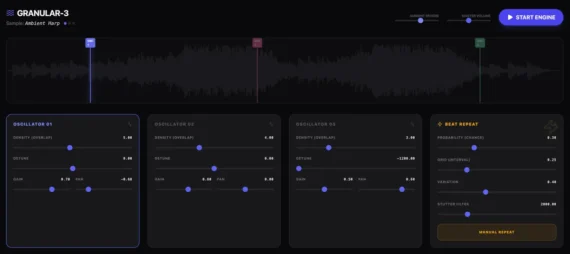
Examples provided by Google include a cute mini keyboard you can play with your computer keyboard and a sophisticated modular audio patching environment, Node Atlas, complete with synthesis, sample playback, modulation and a comprehensive set of audio effects.

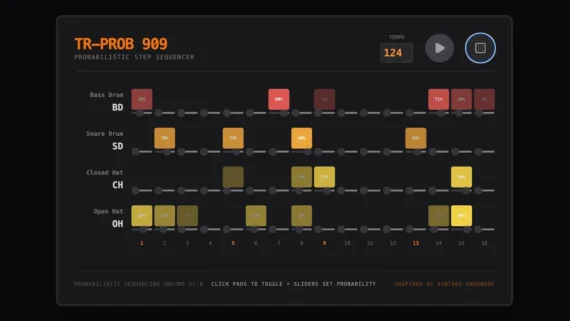
Though it’s unsurprisingly a little glitchy and unpredictable, the concept behind Spaces is a fascinating one, and it’s a lot of fun to play with – we managed to create a three-oscillator granular synth and a basic 909-style drum machine with probabilistic sequencing in the space of about ten minutes.

ProducerAI operates a credit-based system with several membership tiers, ranging from $8/month to $64/month – there’s also a free tier that gives you a limited number of credits.
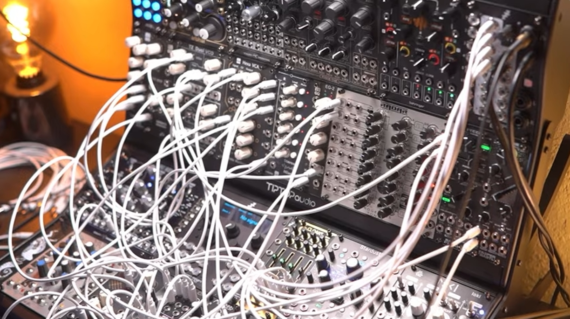
 

Infinite Machinery Eurorack Modules


S1gns Of L1fe Modular – latest video – takes a look at the Infinite Machinery line of Eurorack modules, exploring how they work in a musical context.

Infinite Machinery offers a variety of pre-built and DIY Eurorack modules, along with parts for synth DIYers.


Video Summary:

“In this video, I explore a selection of Infinite Machinery Eurorack modules in real musical context, focusing on stable FM, expressive filtering, and patch-efficient utilities that support creative flow. You’ll hear practical patch ideas and see how these modules translate into dependable, musical results you can apply to your own system.”


Composer & Synthesist Éliane Radigue Has Demised At The Age Of 94


French composer and synthesist Éliane Radigue has demised at the age of 94.

“Time, silence and space are the main factors constituting my music.”

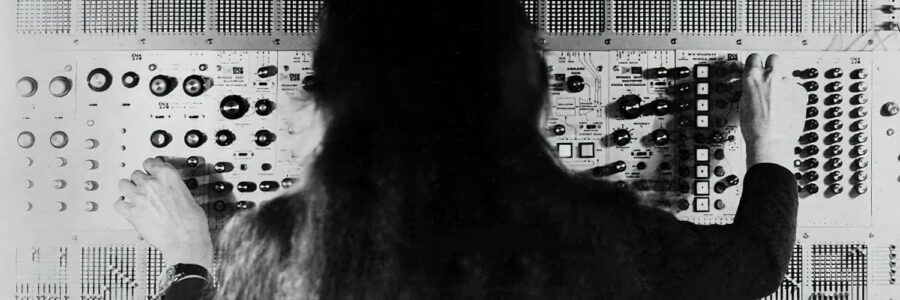
Radigue was best known as a pioneer of drone music and a proponent of the ARP 2500 modular synthesizer. But her career stretched from the early days of musique concrète to modular music in ’70s, to her more recent collaborative acoustic compositions.

Éliane Radigue (January 24, 1932 – February 23, 2026) studied with Pierre Schaeffer and Pierre Henry, pioneers of musique concrète, in the mid 1950s. Schaeffer and Henry focused on the practice of using audio tape to treat sound as something you could physically work with to create music.

While Radigue quickly moved on from the tradition of musique concrète, an appreciation that any sound could be music remained with her throughout her career.

In the early ’70s, Radigue was inspired by the generation of American composers that were treating electronics and synthesizers as a new palette for making music, including Terry Riley, Laurie Spiegel and Morton Subotnick. She soon found the ARP 2500, and it became her instrument of focus for the next 25 years. She named it ‘Jules’.

Radigue’s electronic music explores slowly evolving soundscapes, and – while it comes from a different tradition – doesn’t sound that far off from the ambient electronic music that began to emerge in the ’70s.

Here’s Radigue’s Trilogie de la Mort, which premiered in 1988. It features sounds of the ARP 2500:

The meditative drones of the piece evolve, almost imperceptibly, shifting you gradually from one soundscape to another. At times, you hear pairs of oscillators, vibrating against each other. At other times, you hear soothing harmonies and shifting harmonics. Next, you may find yourself immersed in filtered noise.

One of her late electronic works, L’Île re-sonante, combines sounds of the ARP 2500 and Serge modular synthesizers with looped audio.

The work is said to be inspired by Radigue seeing her reflection in the still waters of a lake, and gives the effect of haunting vocals emerging from a still drone, and then fading away until they are imperceptible one more.

Starting around 2000, Radigue shifted her focus to acoustic instruments. While her medium changed, the music of her later era still has the same quiet, slowly shifting quality of her electronic works.

Here is Occam XXV, part of a monumental series of collaborations with acoustic musicians. It is performed by organist Frédéric Blondy at Union Chapel, on an organ built in 1877:

Brian Eno‘s definition of ambient music seems to fit these pieces – accommodating many levels of listening attention, without enforcing one over the other.

A video portrait of Éliane Radigue – in French, with subtitles – from 2006. The video captures her at work with her ARP 2500, and offers rare insight into her compositional techniques. She also discusses how she conceives of her work as a ‘musical bath’ for her listeners:

“In an era often seemingly obsessed with velocity and spectacle,” notes composer and sound designer Robin Rimbaud (Scanner), “she taught us the radical power of slowness, of patience, and attention stretched to the threshold of perception.”