Sound Semiconductor Introduces New Mixer Chip For Synthesizers



Sound Semiconductor, a chipmaker focused on development of high performing analog integrated circuits for use in synthesizers and other applications, has introduced the SSI2190 ProCircuit 6-into-1 Voltage Controlled Mixer.

Sound Semiconductor is the ‘spiritual successor’ to pioneering synth chip maker Solid State Music (SSM), which, along with Curtis Electromusic Specialties, manufactured integrated circuits that helped make the first generation of affordable analog polysynths and other electronic instruments possible.

The SSI2190 Voltage Controlled Mixer, like the company’s other analog chip solutions, is designed to be a flexible building block for making synthesizers and other audio gear. It’s based on an original Operational Transconductance Amplifier (OTA) design and offers current-mode linear control of each channel.

Differential voltage inputs provide design flexibility, and a high-compliance current output makes summing from multiple sources, including other SSI2190’s, easy.

In addition to basic use cases – like mixing of multiple audio inputs into a single output – the SSI2190 can be used for more complex use cases, such as voltage controlled equalizers, pole mixing, phase correction, and mixing of control voltages.

Offered in a 28-lead SSOP package, only a handful of external components are necessary.

“I’m really excited about the potential of this new chip”, said co-designer Neil Johnson, adding, “it’s the first new mixer IC in decades, and I can’t stop thinking up new applications for it!”

The SSI2190 Voltage Controlled Mixer is available now, priced at $1.93 at 1000 pieces, with stock available for immediate delivery or sampling to qualified OEM’s.

New ‘Switched On’ Album From Alex Wurman, The Classical Synthesizer


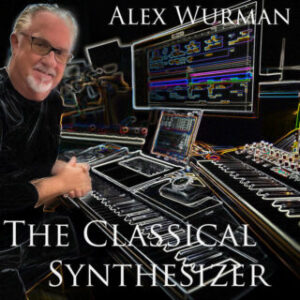
Composer and synthesist Alex Wurman has released a new album, The Classical Synthesizer, that’s a rare treat for fans of the ‘switched on’ category of electronic realizations of classical music.

Wurman is best known for his soundtracks for films like Anchorman, March of the Penguins & Talladega Nights & the TV Series Patriot.

But he’s also the son of composer Hans Wurman, who released a series of ‘switched on’ or ‘classitronica’ type albums in the late ’60s and early ’70s. The Classical Synthesizer is a tribute to his father and his father’s synth work.

The Classical Synthesizer features fairly ‘straight’ electronic realizations of classical works. While the arrangements are in the tradition of composer/synthesists like Wendy Carlos, Tomita & Hans Wurman, they’re less focused on the novelty of synth sounds than the original generation of ‘switched on’ albums, and more focused on bringing electronic sounds into the classical tradition.

Points of comparison are the music of the Will Gregory Moog Ensemble and Craig Leon’s Bach To Moog. So you won’t hear any synthesized whistling, but more of an emphasis on subtle orchestration and expressive performance.


What Alex Wurman has to say about the new album:

“This album has been a long time in the making, mostly because it’s a tribute album to my father, Hans Wurman. His pioneering of the Moog Modular System synthesizer (serial number two), left an indelible mark on my musical career. The sound of his albums, and the study of classical music permeated my style as a film composer (March of the Penguins, Anchorman), and as artist in general.

This album was created with vintage synthesizers only. No samples. I read and played every line of music on the orchestral scores one at a time, paying close attention to dynamics and the original intent of the composer. This required inventive solutions to performance parameters to achieve the detail. On occasion, my dear friend Katherine Liner singing beautifully, and my real acoustic piano gave extra depth to the sound. This was a practice also used by my father.

Creating this album was certainly a labor of love, and the experience of making it was extremely pleasurable. I hope you enjoy!”

You can preview Alex Wurman’s The Classical Synthesizer below. It’s available via Bandcamp:

Pete Townshend Donates Synth Collection To His Alma Mater For New Studio


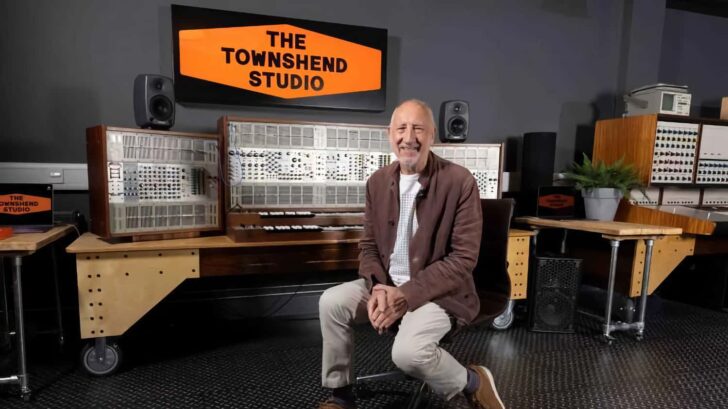
The University of West London has announced the opening of The Townshend Studio, a new electronic music studio that features the amazing synth collection of rock legend Pete Townshend.

While Townshend is best known as the primary songwriter of The Who, he’s also a pioneer in the use of synthesizers in popular music.

In 1971 – a year where the charts were dominated by the likes of The Osmonds, and a year before Stevie Wonder’s released the first album of his TONTO era – The Who released Who’s Next. The album featured Baba O’Riley and Won’t Get Fooled Again, tracks which used synths and electronics to create effects inspired by the music of American minimalists, notably Terry Riley.

The Townshend Studio was unveiled on Thursday 10 October at the University’s Ealing site. The new studio arose from Townshend looking for a home for his synthesizers, to leave a legacy for the next generation.

The collection includes some of the most influential instruments in the development of electronic music, along with some modern ‘dream synths’.

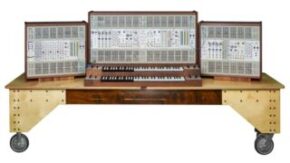
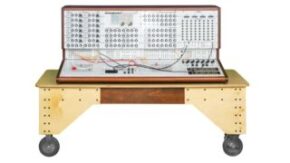
These include the ARP Model 2500 used on ‘Quadrophenia’; the rare Yamaha GX-1, one of only 10 made; a Moog System 35; an EMS Synthi 100; an Analogue Solutions Colossus; a Roland Jupiter-8; a Yamaha CS-80; a Yamaha GX-1 and more.

You can find out more about the studio and its collection at the University site.