Wave Alchemy Magic7 Plugin Emulates A $4,000 Bricasti M7 Reverb


Black Friday is upon us, as developers scramble to get you on their mailing lists with the tempting offer of free music-making software. Not a bad deal – as long as you’re okay with an increasingly inflated inbox.

The latest developer to offer up a free plugin in exchange for your email address is Wave Alchemy, who has lovingly recreated the lauded (and eye-wateringly expensive) Bricasti M7 reverb in plugin form, delivering an impressive emulation that you can access entirely free of charge.

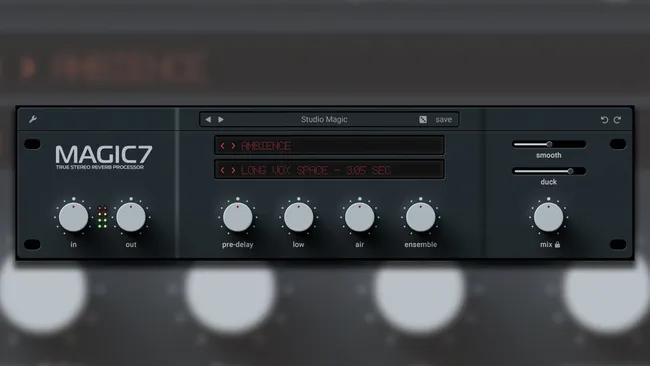
Magic7 takes its inspiration from the Bricasti Design Model 7, a $4,000 rackmount reverb that sounds fantastic, but likely sits well outside of the price range of most bedroom producers. Fortunately for us, Wave Alchemy has recreated each of the M7’s 234 presets, from spacious cathedrals to snappy room tones and everything in between.

Magic7 features 11 reverb types, covering Ambience, Chambers, Halls, Plates, Rooms, Spaces and Nonlinear, and the plugin is kitted out with a tempo-synced pre-delay control, along with two adjustable EQ bands. There’s also two types of modulation on offer: Flux introduces stereo spatialization for a subtle sense of movement, while Ensemble applies a richer and more dramatic chorus effect.

In addition, Magic7’s Smooth control will help to tame wayward transients to keep your reverb tails sounding lush, while the Duck slider will stop those tails from interfering with dry elements of your mix.

Magic7 is available now for free to download at the Wave Alchemy website.

Polyend Synth Offers 8 Types Of Synthesis, Plus Sequencing, Polyphonic Aftertouch and More


Today, Polyend introduces Synth, a $499 multi-engine, multi-timbral polyphonic synthesizer and sequencer.

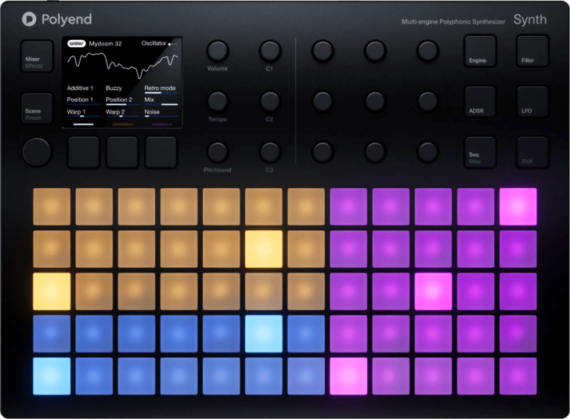
The Polyend Synth features 8 distinct synth engines, and lets you use three different synth engines at once, so you can combine Granular, Physical Modeling, FM, Wavetable, Virtual Analog, or Phase Distortion. Other features include sequencers, arpeggiators, a ‘smart grid’ with polyphonic aftertouch, customizable macro knobs, three effects and more.
Polyend Unusual Promo Video:

‘No talking and Play’ Demo:

Features:

  • Play three synths at once.
  • 8 distinct synth engines – Polyend Synth combines various synthesizing methods, such as Granular, Physical Modeling, FM, Wavetable, Virtual Analog, or Phase Distortion.
  • Sequencers and Arpeggiators – Independently assign a sequencer or arpeggiator to each synth and control swing, groove, octave range, gate length, and more. Transposable sequences automatically adapt to the chosen scale.
  • Smart Grid – allows for single-button chords and note followers that “will always be in tune”.
  • Polyphonic Aftertouch – responds to your finger’s pressure independently on each pad. Every synth has up to five values that can be controlled with pressure.
  • Combo Knobs – Combo knobs are customizable macros that can control one, two, or all three synths simultaneously.
  • Three brand new effect engines – These customizable effects (delay, reverb, modulator) can be independently routed for each synth or effect engine.
  • Scenes – Scenes combine synth engines, their parameters, patches, effects sends, macros, arps, sequences, and all other settings into a quickly accessible file.
  • Full Control – The 3×3 knob matrix and dedicated parameter buttons provide all the controls needed to create advanced patches without menu diving.
  • Responsive Visual Interface – Gain a deeper understanding of how parameters change. Every knob turn updates the interface with graphs, whether you change the LFO shape, filter, envelope, or oscillator.
  • Expandable and Customizable – With SD and USB-accessible storage, sharing and customizing patches, effects, and Scenes is simple. Expand the engines by loading your Wavetables or Grain files.

The Polyend Synth is available now for $499/ €499.

Roland Future Design Lab Launch Tone Explorer New AI ‘Technology Preview’ Project – You Can Try It Now


Roland’s new AI ‘technology preview’ claims it can “freshen ideas, remove writer’s block, and discover the undiscovered”, and you can try it right now.

Roland – With its Roland Cloud software – has spent much of the past decade building up a vast library of sounds for electronic music makers to draw upon, from emulations of vintage synthesizers to sampled acoustic instruments, modern soundscape machines and beyond. It’s a bountiful, expansive collection – and it can be a lot to get your head around.

With its new ‘technology preview’ – launched by Roland’s Future Design Lab R&D group – the company appears to be addressing this, aiming to help musicians overcome the decision paralysis that can come from being presented with so many potential sounds.

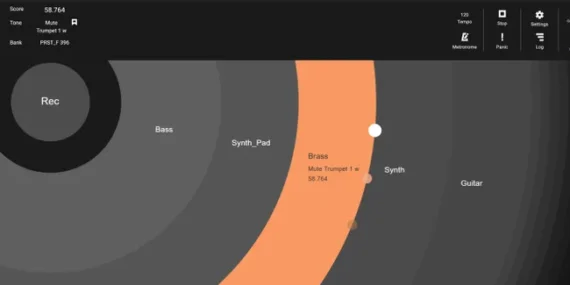
This help comes in the form of Tone Explorer, a new AI-assisted tool designed to match potential instrument sounds to your MIDI ideas. It does this by analysing a musical phrase with the help of neural networks, before presenting the user with a number of potential sounds that it suggests could suit it, ranked using a scoring system.

“The model is built by performing metric learning with a neural network consisting of both MIDI and tone data,” Roland explains. “It then analyses and calculates the ‘distance’ between phrases and tones to extract compatibility indicators. Tones are given a ‘score’ as a guide to compatibility, and then Tone Explorer provides graphical views of the tone choices for deeper exploration.”
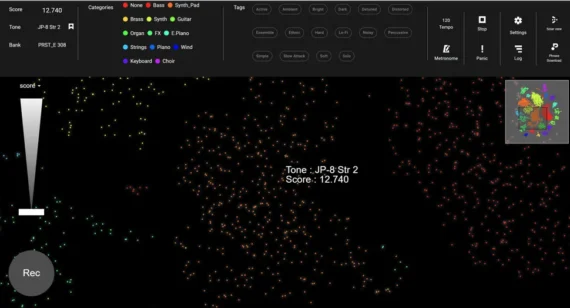
By doing so, rather than presenting the user a definitive answer of the sound it thinks you should be using, Tone Explorer instead presents a narrowed down selection of presets for you to audition. Or, as its promo website puts it: “Leveraging the intelligence of machine learning, Tone Explorer helps you freshen ideas, remove writer’s block, and discover the undiscovered.”

The Tone Explorer technology has been developed by Roland Future Design Lab alongside Japanese AI specialists Qosmo.

Roland Cloud Ultimate subscribers can try Tone Explorer now. The technology itself runs within a web browser, and requires the use of the latest version of Google Chrome. It works in conjunction with the Zenology synth at the heart of Roland’s Zen-Core instruments, along with Galaxias which is the ‘super instrument’ Roland Cloud uses as a shared UI for its multitude of virtual vintage synth recreations.

Roland is keen to stress that Tone Explorer is currently only a ‘technology preview’ – functional for users to experiment with, but still an unfinished work in progress. It hopes that user feedback will aid with further development of the project.

“When Roland and Universal Music Group established The Principles for Music Creation with AI, hearing from musicians as we consider and develop AI applications was made fundamental,” says Paul McCabe, leader of Roland Future Design Lab. “With the Tone Explorer technology preview, we are honouring this as we seek input from innovative music creators on everything from initial concept to execution. If we move forward with Tone Explorer development in the future, it will be based directly on the feedback we receive over the coming weeks.”
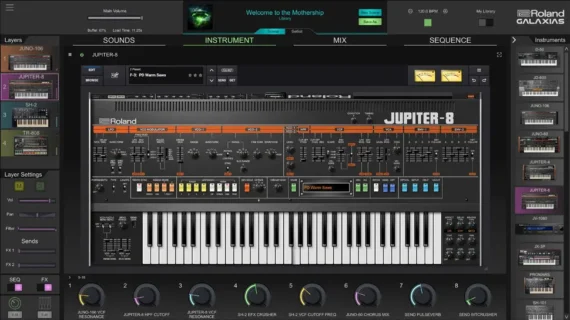
On the subject of Galaxias, the ‘super instrument’ recently received an update of its own, bringing it to version 1.3. Highlights of that update include better plugin compatibility, now offering VST3 and AUv2 compatibility in Mac and Windows DAWs. It also brought improvements to the synth’s LFOs, along with CPU optimisation that promises improved speed and performance.

Galaxias houses an impressive 23,000 sounds lifted from Roland’s back catalogue of synths, drum machines and effects.

Find out more about Tone Explorer at the official site.