Behringer Wave Now Shipping From Factory With $599 Price
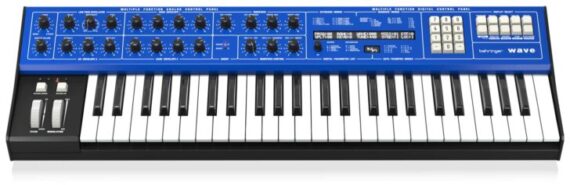
Today, Behringer announces that its Wave synthesizer, a knockoff of the classic PPG Wave synth, is now shipping from its factory.
The Behringer Wave copies the PPG Wave 2.2, a pioneering digital/analog hybrid synthesizer from the ’80s, beloved by artists such as Depeche Mode and David Bowie. Like the original, the Behringer Wave combines wavetable oscillators – which offer a much wider range of waveforms than traditional analog oscillators – with analog VCFs and VCAs.
Wave was first announced all the way back in 2020, but the brand seems to have ditched the original name of BBG Wave in favour of an only slightly less barefaced ripoff, Behringer Wave. Side note: Wave is not to be confused with Waves, a Eurorack module released by Behringer just a few weeks ago.
Wave is a wavetable synthesizer that shares many similarities with the PPG Wave 2.2 and 2.3, while adding some modern bells and whistles. It’s an 8-voice synth equipped with 16 digital oscillators, each of which can draw from a selection of 30 factory wavetables, themselves containing 64 waveforms, alongside 64 slots for importing your own via Behringer’s SynthTribe app.
Wave is a multitimbral instrument, allowing up to eight different sounds to be layered or split across the keyboard. It’s also capable of both 8-bit and 12-bit wavetable synthesis, so you can recreate the vintage charm of the OG Wave if you so wish. Wave’s oscillators run through a 24db low-pass analogue filter, and can be sequenced using a polyphonic sequencer and multimode arpeggiator. A single LFO is joined by two ADSR envelopes – one more than the original PPG Wave.
As for the hardware, Wave features 49-key, velocity-sensitive keyboard equipped with velocity aftertouch. Though the synth is smaller, its front panel looks remarkably similar to its bright blue forebear, right down to the font and keypad-style buttons on the right-hand side.
Wave is well-equipped in the I/O department, with USB, CV/gate, sync and MIDI in, out and thru joined by a stereo main output, headphone output and eight mono outputs (one for each voice). Expression and sustain pedal inputs are also on board.
The original PPG Wave was a key element of the Tangerine Dream sound in the ’80s, and you’ll hear echoes of this in the audio demos in Behringer’s intro video:
Features:
- Wavetable generators and analog VCF and VCA designs based on the PPG* Wave 2.2 and 2.3 from the ’80s
- Digital wavetable synthesis with 8 or 16-bit resolution
- Aanalog signal path based on original VCF and VCA designs
- 8 voices configurable in modes such as splits, layers, and unison
- 30 classic factory wavetables and 64 user-defined wavetables, each comprising 64 waveforms, along with 32 user-defined transients
- Import of user wavetables and transients through SynthTribe
- 200 user presets with storable sequence
- Authentic and advanced oscillator modes for versatile sound design
- Manual wavetable control for precise navigation through selected table waves with optional crossfading
- Two ADSR envelopes for shaping the filter, amplifier, or wavetable position
- Additional AD envelope for oscillator pitch modulation or wavetable position control
- LFO for creating vibrato, tremolo, or cyclic wavetable sweeps
- Built-in polyphonic sequencer optimized for both performance and studio applications
- Dual arpeggiator with play modes including up, down, up-down, and random
- 49 full-size keys featuring velocity, aftertouch and polyphonic portamento for expressive playability
- Stereo width control for dynamic voice placement within the stereo field
- Individual audio outputs for all 8 voices to enable external processing per voice
- CV/Gate and Sync In/Out connectivity for integration with external gear
- Expression and sustain pedal support
- MIDI implementation for full integration and flexibility
Wave Hands-One Demo:
Behringer Wave is priced at $599, and the company says it is now shipping.
*Note: It typically takes a month or so for new Behringer synths to be available at its ‘super partners’ after it starts shipping.
Find out more on Behringer website.