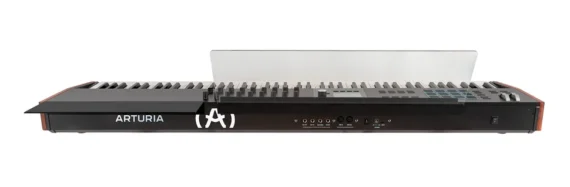
Arturia Releases KeyLab 88 mk3 MIDI Controller Keyboard With Fully-Weighted Hammer-Action Keybed
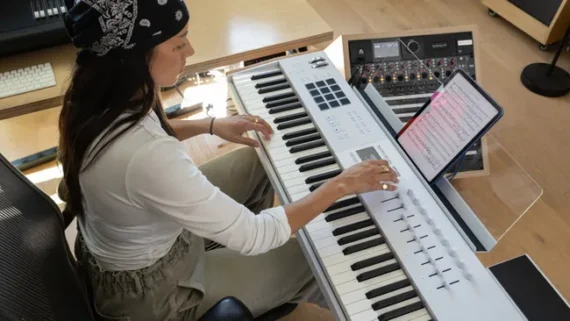

Last year, French manufacturer Arturia released the third iteration of its MIDI controller keyboard, KeyLab, in 49- and 61-key versions, bolstering the range with a new keybed, redesigned interface and touch-sensitive controls.

The French manufacturer’s flagship MIDI keyboard gets an 88-key model with an “authentic piano feel” thanks to its Fatar TP/110 keybed.

Today, Arturia has unveiled an 88-key version of the KeyLab mk3 that boasts similar upgrades, along with a “premium” Fatar TP/110 hammer-action keybed with weighted keys and channel aftertouch that you won’t find on the 49- and 61-key models.

Like its smaller siblings, the KeyLab 88 mk3 is equipped with 9 potentiometers and faders that are touch-sensitive, so you’re able to tap a control and check its associated information on the KeyLab’s display without altering the value.

The official KeyLab 88 mk3 overview:

These are joined by 12 velocity and pressure-sensitive pads, two mode wheels and an array of dedicated DAW controls including save, undo, redo and transport controls. KeyLab 88 also features the similar full-colour 3.5″ screen as the other mk3 versions, surrounded by eight buttons and a dial for navigation.

KeyLab 88’s Scale Mode will automatically adjust notes to a chosen scale, and its new arpeggiator can be used to create generative patterns that randomize parameters such as ratchet, octave shift and division time. There’s also a Chord Play mode for playing preset or custom chords with a single key.

KeyLab 88 mk3 is equipped with pre-mapped templates for many of the major DAWs, including Ableton Live, Logic Pro and FL Studio, and arrives with a generous software bundle that includes Ableton Live Lite, Analog Lab Pro, and a number of software instruments and effects. You’ll also get a subscription to sample library Loopcloud and tuition platform Melodics.

Check out the embedded video above. Composer and pianist Belle Chen delivers a mesmerising performance at Hôtel d’Heidelbach in Paris, unleashing the creative power of KeyLab 88 mk3’s all-new Fatar TP/110 hammer-action keybed.
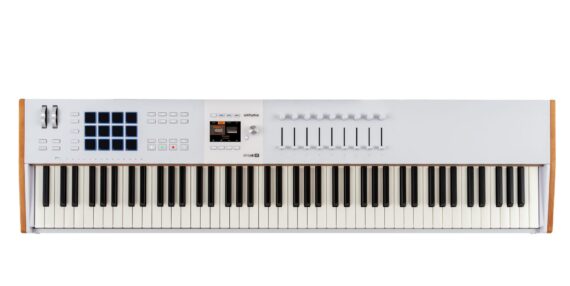
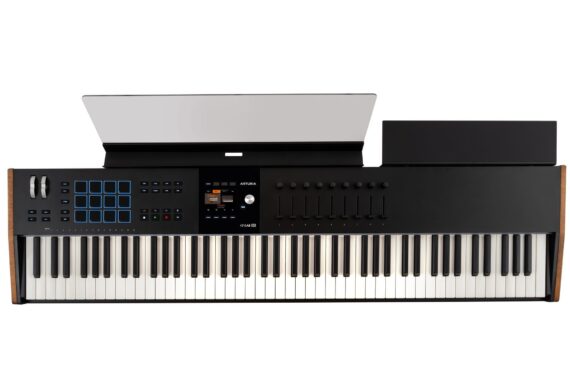
KeyLab 88 mk3 is priced at $1299 and is available in both black and white. Find out more on Arturia website.
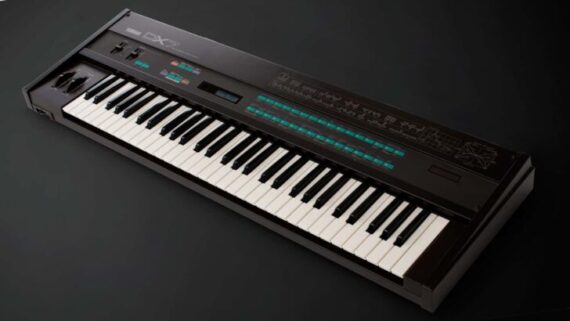
Free Yamaha DX7 Patches From Legowelt – ‘The Art Of DX7’


Dutch composer & synthesist Danny Wolfers (Legowelt) & Dim Garden have released a new album, The Art Of DX7.

Wolfers describes The Art Of DX7 album as a collection of “Synthesizer folks songs, full with nostalgia and yearning.” The album was made on a vintage Yamaha DX7.

In addition to the album, Wolfers has released a free library of the sounds that he used on the album. If you have a DX7 or a synthesizer that can read the DX7’s patches, you can download the sounds used on the album in .syx format.

You can also use them with Dexed, which can be used to preview and play the sounds, both as a standalone application and as a VST for your DAW.

You can preview The Art Of DX7 below:

The Art Of DX7 is available now via Bandcamp. The patches are available as a free download (.syx).


Noon Instruments Intros ‘Aphex Twin-inspired Sample Instrument’ Vessels


Re-amping synthesizers – playing recordings through an amplifier and then re-recording the results – is a powerful technique that can bring an illuminating dimension of organic texture and character to your synth patches.

Noon Instruments’ Vessels breathes new life into a spectacular library of synth samples through “contemporary and experimental” re-amping techniques.

Not sure, just ask Aphex Twin, who sang the technique’s praises in a 2014 interview with Pitchfork: “It’s real, it’s something in the air,” he said. “That’s the magical ingredient – when something moves through the air, it’s automatically going to sound more interesting […] It’s been in the real world and put back in the computer”.

It’s this sentiment that serves as the inspiration for British creative sound studio Noon Instruments’ latest sample instrument: Vessels. Billed as an “exploration of object resonance and sonic materiality”, Vessels is based on an extensive library of samples of both analogue and digital synths that have been re-amped using a variety of creative and unconventional studio techniques: the result is a stunning and diverse library of sounds that spans cosmic pads, soaring arps and distorted textures.

Here’s the sound demo:

Vessels’ presets are categorized into three banks: Divergent, Convergent and Relics, each characterized by a different approach in the studio. The sounds in Divergent lean towards traditional re-amping techniques, having been passed through two 180-watt cabinets and recorded with multiple microphones.

Convergent has a more experimental bent, its discordant recordings run through surface transducers attached to metallic objects, while Relics’ samples were run through tape machines and effects pedals to achieve a warm and evocative sound.

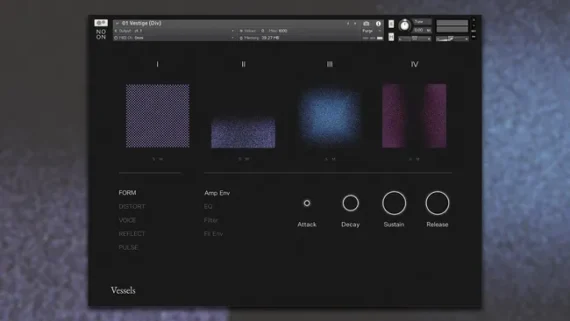
The instrument’s GUI features four squares representing the four sound layers comprising each of the instruments’ 460 presets. These can be blended, soloed or muted, before the mix is shaped via the ADSR envelope, filter and EQ.

Four additional menus reveal a variety of effects that includes multiple types of distortion, compression, delay, reverb and chorus, while two tempo-syncable LFOs can be used to modulate eight of Vessels’ key parameters.

Vessels requires Native Instruments’ Kontakt or Kontakt Player, versions 7.7.2 or later. The instrument is available now and is priced at £99. Find out more on Noon Instruments’ website .