UJAM Unveils Vox Hamana Virtual Instrument Recreates Iconic Sound Of The Polymoog 280A


UJAM has introduced a virtual instrument, Vox Humana, which features sound variations, envelope, multi-effects, presets and more.

The Vox Humana Plugin is a collaboration with the Bob Moog Foundation that recreates the sound of the Polymoog’s Vox Humana preset, a sound made famous by Gary Numan’s 1979 hit Cars.

Vox Humana features sounds directly sampled from the Polymoog 280A by musician and YouTuber Alex Ball. Once recorded, a virtual instrument was designed around the samples and based on UJAM’s proprietary Gorilla Engine.

The plugin has four timbral settings – Original, Bright, Hollow and Octaves – that offer subtle variations on the original sound. Attack and Decay sliders provide envelope control for dynamic shaping, while a trio of built-in effects that includes chorus, phaser and delay yield additional character and modulation.
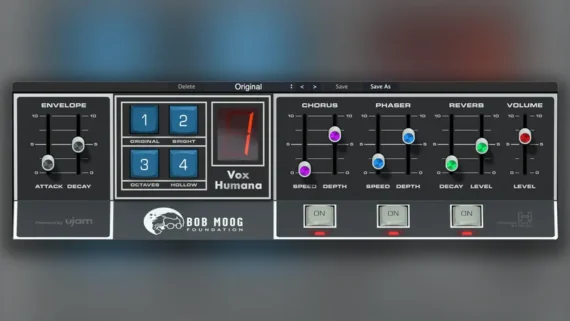
The first preset on the Polymoog 280A, Vox Humana features prominently in Gary Numan’s Cars. “The Vox Humana sound that plays the lingering high string part was the reason I bought a Polymoog,” Numan told Synth History in 2020.

“I loved that sound. The reason that first high note lingers for so long on the song is because I hit that note first when I was trying to come up with a part for the the intro and couldn’t think where else to go with it.

“So I just held it for way too long before finding the descending line that followed, and it worked, so that long held note became a key part of the song.”

Watch Alex Ball on Polymoog below:

All proceeds from the Vox Humana plugin will be donated to the Bob Moog Foundation to support its work in science education and the preservation of Bob Moog’s legacy.

Vox Humana is available for macOS and Windows in VST/VST3/AU/AAX formats, priced at £18/$19/€22. Find out more on UJAM website.

 

AI-Generated Works Are Public Domain, Court Affirms


This image of The Terminator can’t be copyrighted, since it was generated by AI.

The U.S. Court of Appeals for the District of Columbia Circuit ruled on March 18th, 2025 that works generated by AI, without human involvement, are not eligible for copyright protection under U.S. law.

Computer scientist Stephen Thaler argued that his ‘Creativity Machine’ created the painting on its own, and tried to copyright it. The US Copyright Office rejected it, and their decision was affirmed by a lower federal court.

Now, a federal appeals court has affirmed that decision, ruling that art created by artificial intelligence cannot be copyrighted, saying that at least initial human authorship is required for a copyright. The decision is based on the Copyright Act of 1976, which the court said was based on human authorship. Many provisions of the act are based on the idea of human authorship, like copyright lasting for 70 years beyond the author’s death.

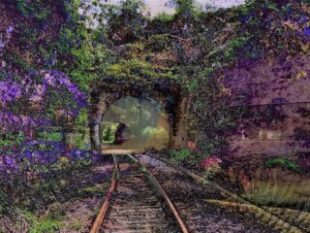
The image A Recent Entrance To Paradise is public domain, because it was generated by AI and does not have a human author.

This affirms how copyright applies to AI-generated works. Under current law, content produced entirely by AI immediately enters the public domain, allowing unrestricted commercial use. Works can be copyrighted if they are authored by a human that provides ‘meaningful input’, and AI is just used as a tool.

The decision has interesting implications for musicians:

  • AI-generated audio is public domain, meaning that it can be sampled and used to create original works.
  • Music that’s created by a musician can be copyrighted, even if they use AI-powered tools for things like effects, mixing and mastering.
  • If you use AI-powered tools to create music, without providing ‘meaningful input’ and control over the results, you can’t copyright it. What level of creative control is needed to meet this bar is still a gray area.

The ruling affirms US Copyright Office guidance from 2023 on AI-generated works.

What do you think about the use of AI tools in music-making? Share your thoughts in the comments!

Tim Exile Introduces Autechre-Inspired PTNSHIFT Generative Instrument For Native Instruments’ Reaktor & Ableton Push


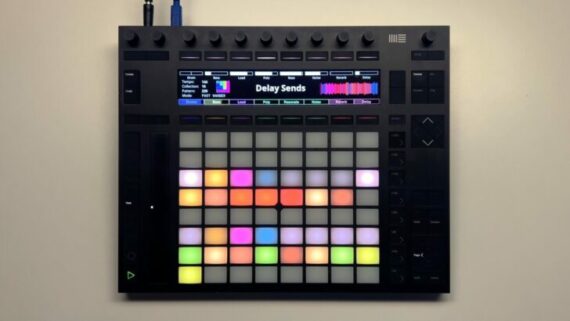
Producer Tim Exile (Timothy Charles Shaw) lets us know that he has introduced PTNSHIFT, a generative music performance instrument for Ableton Push and Native Instruments Reaktor.

He says that it’s inspired by Autechre’s generative live performances, and combines the “deep sonic universe of modular synthesis” with DJ-style interactions, like pattern-launching, mixing, blending and FX.

The official intro video:

Here’s a deep dive into PTNSHIFT:

*Note: PTNSHIFT requires a full license of Native Instruments’ Reaktor to run without restrictions.

PTNSHIFT is available now for $59 + tax and includes a Reaktor file and a MacOS and Windows companion app for capturing the Reaktor interface and displaying it on Push 2’s screen. Additionally, PTNSHIFT and Scapeshift are now available as a bundle for $99 + tax.