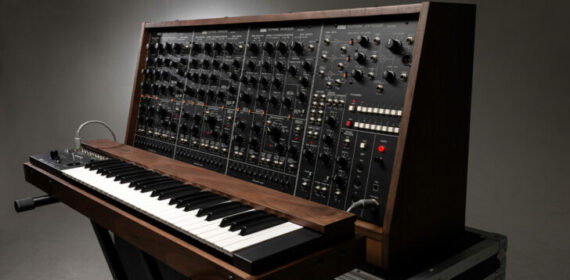
Korg shared this new interview with Fumio Mieda, creator of the original PS-3300 synthesizer, and technical supervisor for their updated take on the classic synthesizer.
The new Korg PS-3300 is a full-size reissue. Here’s what Korg has to say about it:
“While its electronics benefit from modern parts, the instrument stays remarkably faithful to the original. Every detail – from the case, panel, and knobs, to the wooden side panels – has been meticulously recreated, with manufacturing methods closely mirroring those used in the original production. Each unit is handcrafted to ensure exceptional quality and authenticity.
Due to the intricate hand-crafted nature of PS-3300, production capacity is naturally limited. The PS-3300 is therefore offered as a limited-edition instrument, ensuring it remains as rare and coveted as its predecessor.”
Features:
49 keys / 49 voice analog polyphony (the original model had 48 keys / voices)
3 Layers: The PS-3300 consists of three synthesizer units (PSU-3301) and a mixer & utility section (PSU-3302)
Three independent oscillators, plus multiple filters, envelopes and amplifiers for every note on its keyboard, for a total of 147 synth voices of raw analog power
Microtuning knob x12 on each PSU-3301 unit
New panel memory function (16 programs per bank and 16 banks = 256 slots)
Modernised for contemporary music use with the inclusion of USB / MIDI jacks, and a dedicated librarian app for easy preset management
Semi-modular
3-Band Resonator: Three frequency bands can be emphasised, a feature unique to the PS-3300 (original was a Cadmium sulfide circuit, but it was replaced with modern components for safety and to comply with regulations)
Keyboard unit (PS-3010) included
The new Korg PS-3000 expands on the original in several ways:
Programmable memory—previously available on the PS-3200 but absent from the original PS-3300. With 16 banks of 16 slots each (256 program slots total), saving and recalling custom sounds is now easy, making both studio work and live performance more intuitive.
Connectivity has been upgraded to meet modern production needs. The PS-3300 features a USB-B port and MIDI IN/OUT/THRU connectors for seamless integration with computers and external gear.
The PS-3010 module, once an optional add-on, now comes included. The keyboard has been expanded from 48 keys (F to E) to 49 keys (C to C) for improved playability. Plus, the original 60-pin cable has been replaced with a more user-friendly 8-pin connection, simplifying setup without compromising functionality.
The PS-3300’s dedicated librarian software is designed to let users manage programs and tunings.
Audio Demo:
Korg has not announced official pricing and availability information for the PS-3300. If you’re interested, you can register to get updates at the Korg US and Korg UK sites.
Apple Music has shared a new interview with pioneering ambient electronic composer and artist Brian Eno by Zane Lowe.
Brian Eno has sprung a surprise new album on the world. Aurum is a new full-length ambient record released exclusively on Apple Music to make use of the tech giant’s Spatial Audio technology.
It’s his first album since 2022’s ForeverAndEverNoMore and as it’s released via Apple.
Lowe joins Eno in his studio and discuss the album, Eno’s new book What Art Does – generative art, the importance of art in our lives, as well as his thoughts about artificial intelligence.
The interview also reveals the sheer scale of Eno’s musical archive – it spans around 10,500 tracks, which he estimates “equates to a listening time of 44 days, 8 hours, 38 minutes, and 28 seconds.”
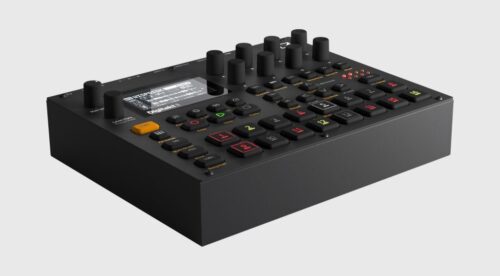
Today, Elektron unleashed a ‘Double OS delight’, with free firmware updates for the Digitakt II and Digitone II.
Firmware for both devices has been updated to firmware 1.10, with some cross-pollination between the two, plus some ‘tasty new additions’.
What’s new with Digitakt and Digitone firmware 1.10:
Digitakt II:
Comb+ Filter – Digitone II’s Comb+ filter is now also available on Digitakt II. It gives you another super versatile shade of feedback to add to your filter options, bringing additional metallic-sounding, resonant qualities to explore.
Mono Sampling – Much requested and back again! Mono sampling returns to the Digitakt setup, alongside the existing Stereo sampling approach, giving you more choice when it comes to capturing sound.
Routable distortion and base-width filter – Choose whether you want your overdrive distortion and your base-width filter to be placed before or after your various filter alternatives, with your decision opening up different sonic avenues to your track.
Keytrack Modulation – Also arriving from its sibling, key tracking lets you choose from a variety of parameter destinations (and up to four of them) to be modulated depending on where you are on the keyboard. Play high notes to change the parameters in one way and low notes to modulate in another way.
Digitone II:
Chord Mode – Rejoice in unison! Chord Mode arrives on Digitone II. And this version has even more melodic flexibility than ever. Your one-finger harmonizing power can be activated in a variety of scales, types, and root notes, but that’s only the beginning of the fun available. Choose from different modes such as Chord Root, Chord Center, and Chord Spread, and add an additional bass note; all allowing you to further tweak the kind of chord that will be played. To top it all off, use Chord Memory to store whatever wild chords you can put together, enabling instant playing of up to 16 that can be saved per pattern.
Overbridge streaming – With 1.10, you can now multi-stream all of your Digitone II tracks separately to your computer. We’re still working on the rest of the Overbridge goods for Digitone II – the plugin is currently in BETA testing and will be available in the near future.
Rotate arpeggiator + more speeds – Play with the arpeggiator in new ways by rotating the offsets and forming new melodic sequences. That’s not the only way you can twist things either, with a bunch of new arpeggiator speeds to experiment with. Connect it to the new Chord Modes to really open things up.
There are also a host of new features that are arriving on both machines.
Track Swap lets you switch two tracks – with all the settings, presets and sequencer info attached – helping you organize for live shows or just keep things tidy.
With P-lock to active trigs you can quickly edit parameters on all active trigs on your page, or track.
Live record overdub allows notes to be recorded on top of existing trigs instead of overwriting them.
There’s also an option for live recording Parameter Locks to active trigs only, and new track select options.