Dog Paw Music Announces World’s First Weighted Grid Instrument
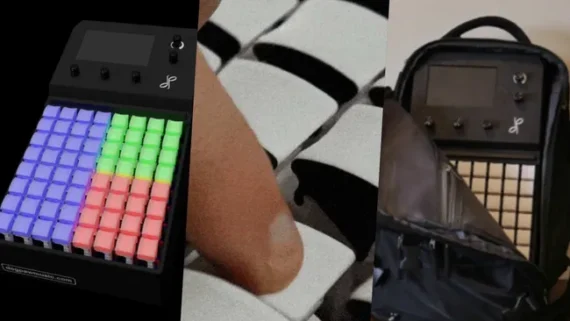
Dog Paw Music is a new company, only just establishing itself a boutique builder of tech gear aimed to fit broad niches, and its self-titled first offering is a first public foray into the crowded world of MIDI controllers. Dog Paw is a device that’s currently looking for support via Kickstarter so that the team, based in Oakland, California, can make it a reality.
And don’t let appearances be deceptive. This is not just another controller. Dog Paw merges the features of traditional grid controllers, like Ableton Push or Launchpad.
At a passing glance the Dog Paw looks like any other set of drum pads. Like the front surface of an Akai MPC, or the pads off stage right on a Roland Fantom. Hit them, trigger a sound, you know the score.
But it’s only when you take a closer look via video that Grid’s special features set it apart.
Instead of each large, square, pad being a simple ‘button’, they’re weighted in much the same way as a weighted piano keyboard giving a much more tactile approach to playing what can broadly be considered a new type of instrument, or, if you want the touch but not the sound, for adding more depth and feel to the inputs in your DAW.
For while this is a new type of controller with ‘the feel of a piano with the versatility of a grid controller,’ its makers claim it’s also an entire musical instrument all-in-one, with a built-in Raspberry Pi-based computer and audio outputs giving it synth and sample capabilities with no extra gear required.
“Dog Paw bridges the gap between traditional instruments and modern controllers,” explains Bill Bartke-Croughan, the creator of Dog Paw.
“Musicians coming from acoustic backgrounds will find an intuitive way into electronic music production, while producers and digital creators can add a new layer of expression to their workflows.”
Not only are the instrument’s pads sensitive to the degree of velocity with which its pads are struck, but also they’re also pressure and movement sensitive allowing the player to introduce vibrato and pitch bend just as you would a stringed instrument.
Press and shake for vibrato. Bend the pad left and right… Bend the pitch up and down.
And all on a device that – rather than being stuffy old piano key shaped and requiring a degree of keyboard skill (as per Roli’s multiple takes on similar heightened means of control) – looks and plays like a set of finger-friendly drum pads instead.
“Avoid the confusing finger gymnastics of traditional instruments. With our grid layout, the pattern you learn for one chord or scale will work everywhere,” its makers claim.
And rather than simply being a front end to getting digits into your DAW (it needless to say offers full MIDI and MPE compatibility) it’s audio outputs and audio sound engine mean you can also leave the laptop at home.
Dog Paw Feature Walkthrough:
Find out more about Dog Paw and help make their dream a reality here.