Interview with Behringer’s Founder/CEO Uli Behringer On His Journey, Inspirations & Story


Behringer founder and CEO Uli Behringer has appeared in a rare interview with music gear retailer Sweetwater. Mitch Gallagher and others join Uli Behringer in which he discusses his upbringing, creating Behringer, his journey along the way and sheds light on the company’s pricing strategy.

Behringer is widely known for releasing highly affordable instruments and studio gear that take influence from the design of popular products released by other manufacturers. In the past few months alone, the company has revealed inexpensive products inspired by the PPG Wave, LinnDrum, Roland CR-78 and Universal Audio 6176, among others.

In the interview Uli Behringer reveals that his decision to price the company’s products so competitively is driven by a mission to make music technology accessible to a broader range of customers. “We have not invented synthesizers, nor will we ever claim to, but hopefully people will remember us for having brought all these jewels back to life,” he says.

“Only a few people can afford those, and I think it’s important to make them accessible to people who do not have deep pockets. That’s something we feel strongly about and that’s our purpose, it’s why we exist.”

Speaking in more detail about how the company decides on its prices, Behringer says: “The way that we price our products is that we look at the cost and we add a small profit on top of it, and that’s the sales price”. Behringer then compares this to the company’s competitors, who he believes are overcharging their customers.

“We don’t go out like most of our competitors and say, ‘how much could I charge and get away with it?’ We say it doesn’t matter. We just take the cost, add a small margin, and that’s the sale price. Customers will appreciate it, and then you have a long-term or lifetime customer, and that’s what matters.”

While the interview didn’t touch on the criticisms levelled at Behringer’s imitative designs by LinnDrum designer Roger Linn, who recently questioned  the ethics of the company’s business practices, Behringer claimed that his decision to recreate vintage instruments isn’t driven by financial gain, but the desire to make historic pieces of gear – most of which are now either too expensive or too rare to purchase for many musicians – attainable for music-makers that cannot afford them.

“We made it our mission to bring these products back and give them to people like me who, at that time, couldn’t afford them,” Behringer says. “I can tell you that in many cases, we build synthesizers and there is no commercial incentive behind it. In some cases we even lose money, it doesn’t matter. But perhaps my gift to these musicians is to make these synthesizers affordable.”

Watch the video and share your thoughts in the comment.
 

Forever 89 Releases Topos, an ‘All-Terrain Tone Explorer’


Topos, a topographical effects plugin that puts saturation on the map – and there’s a free version.

Forever 89 is a creative studio and music tech company founded by Svante Stadler and Rikard Jönsson, two developers formerly of Ableton and Teenage Engineering.

Last year, the company released its first product, Visco, an innovative software drum machine with an endearingly unique interface based around a squishy 2D blob.

Now, Forever 89 has designed another imaginative product that boldly explores uncharted sonic terrain – in more ways than one. And the follow-up to that plugin has arrived.

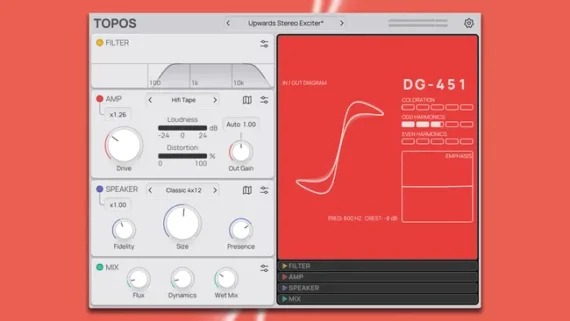
A combined saturation and speaker simulation plugin, Topos is described as an “all-terrain tone explorer” that lets you “explore the personality of classic studio gear”, thanks to a topographically styled interface that can be used to blend between multiple amp and speaker models using waypoints on a map.

Topos is built around two main sections preceded by an input filter. The Amp section features 35 saturation models based on an array of hardware that covers vintage tube amps, distortion pedals, tape machines and classic preamps. Forever 89 says that the emulations here can be deployed for everything from subtle mixing tasks to expressive sound design.

Next in the signal chain is Topos’ Speaker section, which emulates a variety of speakers and their acoustic characteristics through physical modelling; among the 41 presets are models of a number of classic guitar and bass cabinets alongside recreations of studio monitors, car stereos and even vintage phone speakers. These can be fine-tuned using a number of settings that adjust cabinet size, fidelity, presence and internal reflections, and more.

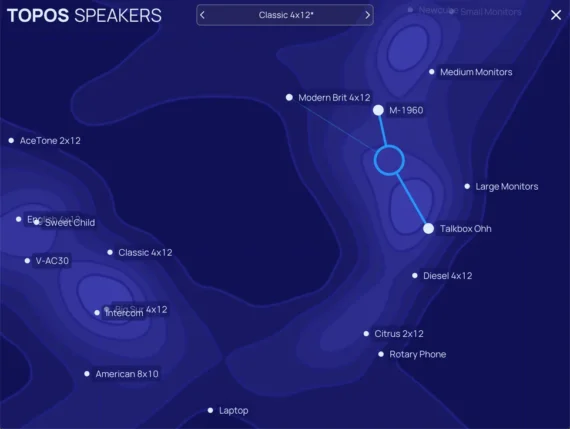
As mentioned, Both Amp and Speaker sections have their own Map View, which enables you to blend between up to three speaker or amp simulations by dragging a node across the map; as you drag, the node will attach itself to the three presets closest to it, and the thickness of the connecting lines indicates each preset’s influence on the overall tone.

Following this is Topos’ Mix section which, along with the obligatory Wet/Dry mix dial, offers controls for Flux – which introduces subtle movement to Topos’ parameters – and Dynamics, a control that restores some of the natural dynamics dampened by the plugin’s saturation. A separate panel opens up further controls for mid/side processing and Flux modulation.

Available in VST3/AU formats for macOS and Windows, Topos is currently priced at an introductory price of $/€79, but if you are short of cash, Forever 89 has generously made a stripped-back version of the plugin available for free.

Though it lacks some of its sound-sculpting controls, Topos: Play features many of the same amp and speaker models as its paid-for counterpart and is well worth downloading.

Audio Demo:

Find out more on Forever 89 website.


Sinevibes Hollow, Luminance Effects For Korg Multi-Engine Synths Get Major Updates


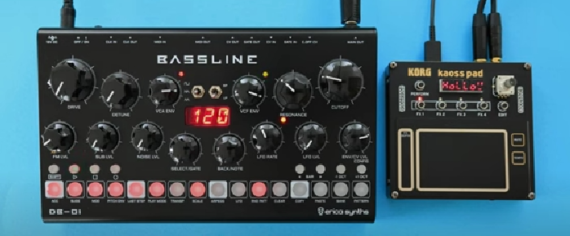
Sinevibes has released major updates for two of its effects for the Korg Multi-Engine line of synthesizers, Hollow v2 and Luminance v2, adding support for the NTS-1 mkII synth and NTS-3 kaoss pad.

Hollow is a “vast space reverb” plugin for KORG prologue, minilogue xd, NTS-1, NTS-1 mkII and NTS-3.

At its core is a feedback delay network – with as many as 64 connections – that they say creates a “lush, almost three-dimensional” reverb sound. With all settings maxed out, this engine is capable of tail times that exceed several minutes, while still having a smooth and naturally decay.

Luminance is a shimmer reverb plugin for KORG prologue, minilogue xd, NTS-1, NTS-1 mkII and NTS-3.

The plugin is based on a feedback delay network with a built-in a granular pitch shifter and chorus-style modulation. They say that Luminance “gently follows the original musical content and creates a rich background sound layer – reminiscent of a gorgeous, dreamy symphony of strings or pipe organs.”

Compatibility:

  • KORG prologue
  • KORG minilogue xd
  • KORG NTS-1
  • KORG NTS-1 mkII
  • KORG NTS-3

Hollow and Luminance are available now, priced at $19 each.