Reason Studios Launch ReCycle, Makes Recycled Classic Sample Editor Available Free
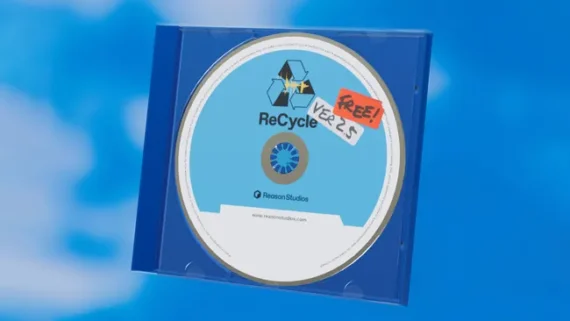

We take sample editing for granted these days; in one form or another, it’s integrated into pretty much every DAW on the market.

Back in the early ’90s, working with samples was a time-consuming task, and bringing loops of different tempos together in a single project was even tougher. Released in 1994, Propellerhead’s ReCycle was one of the first pieces of software to tackle this problem, making it possible to time-stretch samples without changing their pitch and paving the way for developers like Ableton to incorporate advanced sample manipulation tools into modern DAWs.

More than thirty years later, the company – now rebranded as Reason Studios – is re-releasing (recycling) ReCycle as a free download and launching a beat challenge competition hosted by Def Jam’s VP of A&R Don Cannon. ‘ReCycling the Beat’ invites competitors to flip a given sample in a new production – ideally using ReCycle – and submit the results before April 16 to be in with a chance of winning a year-long subscription to Reason+.

ReCycle works by automatically detecting the transients in a sample before chopping the loop into individual slices, the number of which is set using the Sensitivity slider. This allow the sample to be played back at different tempos without altering the pitch or introducing time-stretching artifacts.
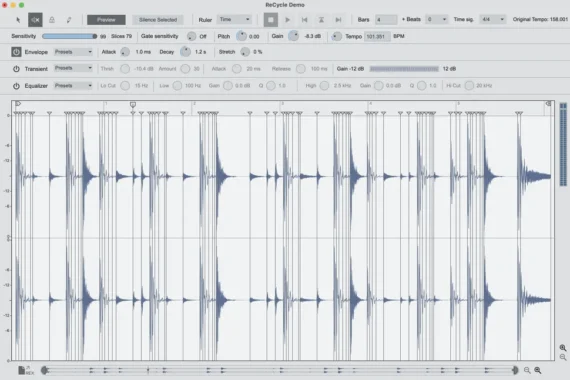
An envelope, EQ and transient shaper can be applied to each slice, while gain and pitch can be adjusted for the overall sample. ReCycle operates using its own file format, REX2, which has since become a standard for storing audio loops with slicing data and is supported by a number of software samplers and DAWs.

ReCycle remains a piece of music tech history, and it’s a decent, if somewhat limited, piece of software with an excellent transient detection algorithm that holds up against some of its contemporary counterparts three decades on.

“We’re thrilled to make ReCycle accessible to everyone. It’s a piece of music software history, and we believe it still has a lot to offer today’s creative minds,” notes Reason Studios CEO Niklas Agevik.

Find out more and download ReCycle over at Reason Studios website.
Behringer 2-XM, A Euro Format Oberheim 2-Voice Copy, Now Shipping


Three years since it was first announced, today, Behringer announces that its 2-XM, a Euro format knockoff of the classic Oberheim Two Voice synthesizer, is now shipping.

What they have to say about it:

“The original design consisted of two single-voice modules coupled together. With its 37-note keyboard, it was a considerable size but introduced a feature no other synth was capable of at the time: polyphony.

The 2-XM combines all the features of the original with all the awesome stuff that we’ve all come to love in modern synths, such as MIDI and USB implementation, stereo, as well as a ton of CV and GATE ins and outs that’ll allow you to transform and shape sounds any way you want!”

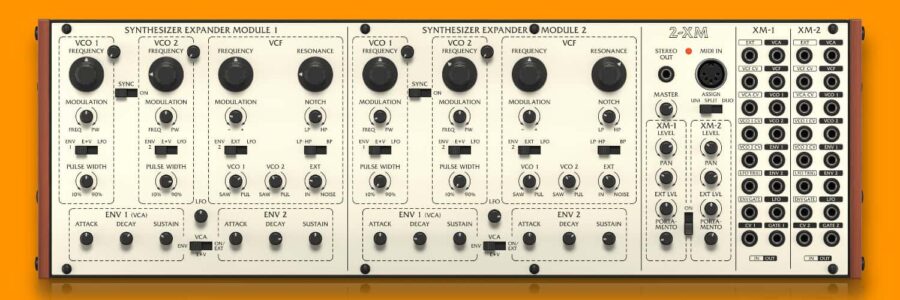
Though it lacks a keyboard and has been reimagined in a Eurorack-friendly format with some modern enhancements, Behringer’s duophonic 2-XM nonetheless recreates the design of the Two Voice faithfully. Each of its two modules is equipped with two VCOs based on original Oberheim designs, with saw and pulse waveforms, PWM and oscillator sync on offer.

These run through a VCF section based on the SEM’s legendary 12dB/oct multimode filter, which morphs between low-pass, high-pass and notch modes with a single knob. An additional band-pass mode is accessible through a switch below. Each module has a noise generator, along with two ADS envelope generators and a single sine-wave LFO on modulation duties.

On the right-hand side there is a master section with level and pan controls for each module, which let you create some interesting stereo patches, along with portamento controls and a switch to choose between 2-XM’s unison, duophonic and split modes, the latter of which splits each of its modules across a keyboard. Here you’ll also find a level control for 2-XM’s dual external audio inputs.

These can be found on the 2-XM’s 32-point patchbay, which provides plenty of scope for integrating 2-XM into a broader hardware set-up or Eurorack rig. Further I/O is provided by a 3.5mm stereo output and MIDI input on the front panel, joined by a 1/4″ stereo output, MIDI thru and USB port on the back.

Behringer 2-XM Video Intro:

Features:

  • Copies synthesizer circuitry from the ‘70s
  • Analog signal path(VCO, VCF and VCA)
  • 2 independent voices for polyphonic, split or 4 oscillator unison sounds
  • 2 variable oscillator shapes with adjustable pulse width
  • Oscillator sync
  • 2 multi-mode filters with low-pass, high-pass, band-pass and notch modes
  • 2 analog LFOs with sine waveform
  • 4 analog envelope generators for control of filters and amplifiers
  • Noise generator
  • Extensive modulation capabilities, including internal and external sources
  • 2-channel mixer section featuring level and pan controls for intense stereo sounds
  • Portamento for pitch gliding effects
  • 2 external audio inputs for processing external sound sources
  • Dedicated audio outputs plus a combined stereo output
  • CV and GATE In/Outs
  • 16-voice Poly Chain allows combining multiple synthesizers for up to 32 voice polyphony
  • Eurorack compatibler – main module can be transferred to a standard Eurorack case
  • 67 controls to give you direct and real-time access to important parameters
  • MIDI and USB implementation with MIDI channel and Voice Priority selection

The Behringer 2-XM is shipping now, with a global list price of $319 and a US list price of $399. It typically takes a month or two for their shipping synths to become available at retailers. Find out more on Behringer website.

Tiptop Buchla 264t Quad Sample And Hold Model Hands-On Demo


Tiptop Audio & Buchla have released the latest module in their series of reissues of classic 200 Series modules in Eurorack format, the Quad Sample & Hold Model 264t.

The module features four independent sample-and-hold circuits, plus a specialized logic circuit for expediently implementing polyphonic patches.

This video offers a hands-on demo of the module and its capabilities.

Topics covered:

0:00 Intro

0:45 Panel Layout

2:31 How can we Polyphony?

3:50 Quad OSC Audio Example

7:44 Sample vs Track & Hold

9:17 Offset parameter

10:03 What’s a Quantizer?

11:33 Sample Rate Reduction?

12:29 Compared to the 266t

13:56 The REAL quantizer!

16:32 Gate length

17:18 Different modes

18:26 Free lanes on the 245t

19:26 259t in ART mode

21:20 Why all this is a BIG deal

22:33 Outro blipblopping

Sample-and-holds are essentially one-cell analog memories. They are useful for “remembering” the instantaneous value of a control voltage, for generating equally spaced steps from a constant slope input, and for converting any continuously changing voltage into a series of discrete values.

The 264’s sample-and-hold circuits have two operating modes: sample and track.

  • In the sample mode, the value of the input is sampled and applied to the output whenever a pulse is received. The output remains at this value until the next pulse arrives.
  • The track mode differs in that an input is applied to the output for the duration of the pulse. The output tracks the input until the end of the pulse and remains at a constant value until the next pulse.

To use the 264t as four independent channels set the separate/common switch to separate. A single CV can be set to all four channels by setting the operate/common to common and plug CV in the the back jack on the with right side.

The Model 264t includes a polyphonic adaptor, which performs the logic necessary to implement four-voice polyphony. Facilities are incorporated for fine tuning and f.m. modulating the oscillators; light emitters display the adaptor’s operation.

The four voltage control outputs are internally routed to a quad-channel quantizer with four ART outputs for use with ART-equipped oscillators, such as the 259t Complex Oscillator. A 12-stage switch selects the key, while the knob above chooses the scale: Minor (m), Chromatic (ch), or Major (M).

For more info on the 264t, Visit the Tiptop site.