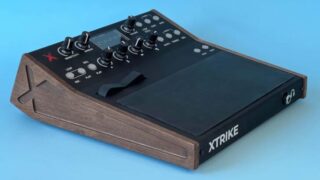
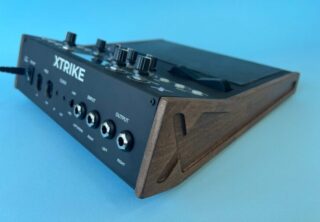
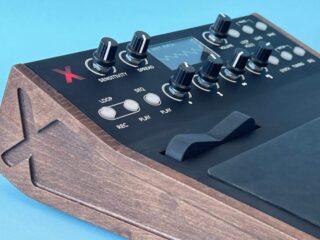
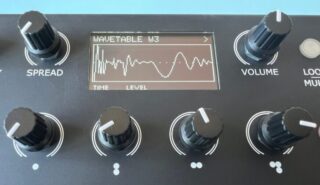
X Audio Systems has introduced XTRIKE, a stereo polyphonic, multitimbral wavetable synthesizer.
Here’s what they have to say about it:
“XTRIKE’s dual-daisy architecture combines a magnetic bender and an expressive pad, offering a tactile, soft impact-driven interface that feels like a percussive instrument while harnessing the full power of a modern synthesizer. Beyond traditional percussive sounds, XTRIKE empowers users to craft intricate, evolving soundscapes through its advanced wavetable synthesis engine and experimental toolset.”
Features:
Synthesizer – A 4-voice polyphonic, analog-controlled wavetable synthesizer with robust processing and many effects.
Tuning – An intuitive auto-tuning and micro-tuning engine for precise pitch control and cultural exploration.
Sequencer – A dynamic 16-step sequencer for crafting complex compositions directly on the instrument.
Loop/Multi – 20 seconds of stereo sampling, looping, processing, multilayering for real-time creativity.
XTRIKE is now in pre-launch phase on Indiegogo. You can sign-up with your email to get a €200 super-early-bird discount. Details on pricing and availability are to be announced.
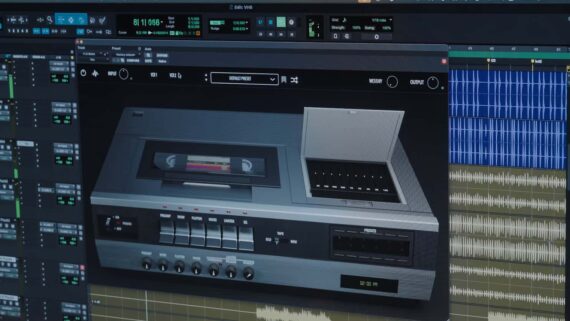
Audio Hertz VHS Home Video Flavor Box is a plugin that’s designed to recreate the the sonic fingerprint of VHS playback.
The plugin is modeled on two consumer VCRs, each with its own personality and sonic character:
1979 JVC Vidstar HR-7600U — One of the earliest home VCRs ever made. Heavy, noisy, and built like a tank. When driven, it delivers smooth distortion with a unique bass boost.
2001 Panasonic PV-V4521 — Driven hard, it produces an extremely flavorful, gritty overdrive.
The result is a plugin that brings you back to the “beautifully nostalgic, imperfect world of analog home video.”
Features:
VCR Saturation – The developers say that they pushed the inputs of consumer VCRs, to capture the unique distortion they produce when overloaded.
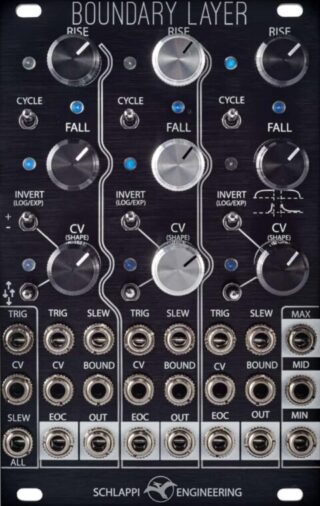
Schlappi Engineering let us know that they’ve introduced a new Euro module, Boundary Layer, that they describe as “a powerhouse of modulation, audio mayhem, and obscure modular tricks.”
Each of Boundary Layer’s channels can act individually as:
A modulation oscillator
Voltage controlled slew (including portamento)
AR/AD envelope (decay or release determined by choice of input).
All three channels are tied together by three global inputs, as well as three outputs which select the MAX, MID, and MIN of all three voltages. Using different combinations at audio rate allows for patch programmable stereo drone synth capabilities.
Features:
3 separate channels
3 global inputs
3 combined outputs MAX/MID/MIN
Oscillates from low LFO rate (a minute?) to audio rate (>10kHz with exponential feedback)
A CV input switchable between RISE/FALL/BOTH
Bound input for simultaneous control over cycling rate and amplitude
TRIG input for AD envelopes
SLEW input for AR envelopes and portamento or filtering