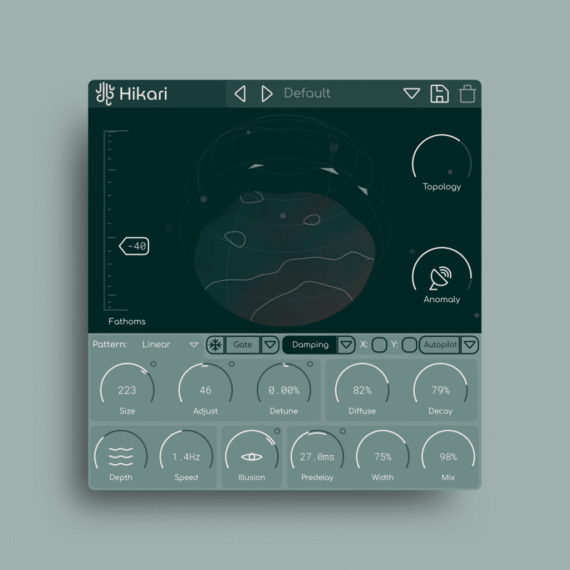
Lese Audio Technologies shared this preview for Hikari, described as ‘an ocean-themed random reverb’.
Central in Hikari’s interface is the “navigator”, which lets you move around in two dimensional space. The contours of the terrain beneath the navigator are sampled and used to subtly alter various settings in the reverb algorithms. The two dimensions of the current navigation position can be used to modulate various parameters, using the same workflow that is available in Glow.
The navigator can also enter “autopilot” mode, where the movement is automated & adjusted by various controls.
An overview of Hikari:
Hikari is available now, for Mac & Windows, priced at $55. A 25% discount is available for a limited time using code SUMMER25.
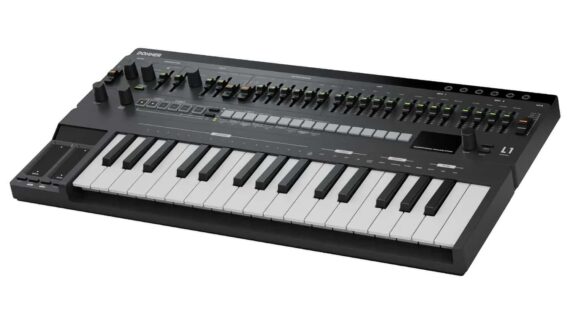
Host Ziv Eliraz – in his latest loopop video – shares an in-depth review Donner Essential L1, a modern take on the classic Roland SH-101.
While Roland offers its own digital take on the SH-101 and Behringer a hardware analog copy of the original, Donner has created a new synth design based on the SH-101’s synth voice, with expanded synthesis options, original hardware design, and a unique removable keyboard system.
Eliraz says that the Donner Essential L1 sounds good, and is close to the original, and cites the added features as pros. On the cons side, he notes that Roland’s alternatives offer more features, and the lack of presets.
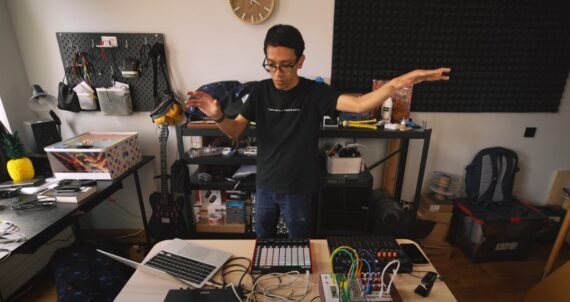
Developer Asep Bagja shared this synth jam, created with the AirBending camera-based MIDI controller.
AirBending is a macOS app that transforms hand gestures into musical expression using computer vision and MIDI technology. It tracks hand movements in real-time using Apple’s Vision framework, detecting precise hand poses and finger positions.
With dual-camera control, you can control multiple MIDI devices using up to two camera inputs, and each camera can have its own preset.
AirBending is one of the nominees in the Accessible category of the 2025 MIDI Innovation Awards, an annual event, organized by The MIDI Association, NAMM, and Music Hackspace. The awards highlight products and projects that use MIDI 1.0 and 2.0 in novel ways.
Another example of AirBending in action:
The developer says that AirBending can make music-making more accessible by eliminating the need for special instruments and devices. Unlike traditional MIDI controllers that require touching keys, knobs, or faders, AirBending transforms the surrounding space into a musical instrument using only hand gestures and built-in Mac camera, without the need for additional hardware.
This provides a new option for people that may not have access to, or may not be physically able to use traditional MIDI controllers.
You can find out more about AirBending at the developer’s site.