Bastl Instruments Launches Kastle 2 Wave Bard Ahead Of Superbooth 2025
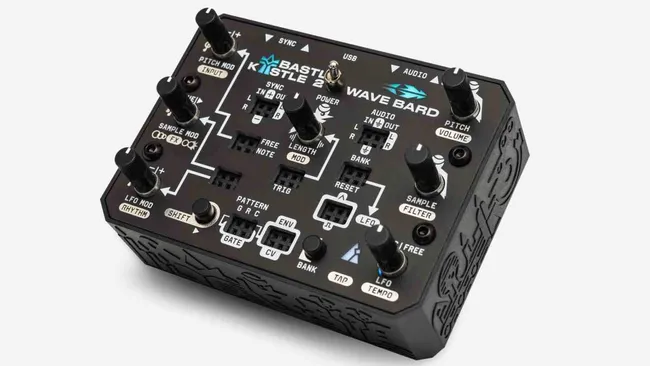

Kastle 2 Wave Bard is a “semi-autonomous” patchable sample player for discovering new rhythms and riffs.

Ahead of Superbooth 2025, scheduled for May 8-10 at the FEZ-Berlin, Bastl Instruments has launched a new ‘experimental’ compact sample player and patchable groovebox , inspired by its popular Kastle Drum synth launched in 2020.

Bastl Instruments says this compact and portable sample player is designed to “empower you to discover new rhythms and riffs through modulation and modularity”. Onboard you’ll find a CV and Gate-based pattern generator with physical controls to modulate its output creating your own bespoke beats, triggered from the in-built LFO which can sync to your other gear or run wild, controlling the show.

Bastl describe the Wave Bard as being “semi-autonomous”; being a unit that given enough freedom will essentially compose for you, with in-built inspiration coming from the onboard sound bank lovingly put together by electronic artist Oliver Torr.

Take a closer look below:

But, of course, Wave Bard really comes into its own when you make it your own. Load the unit with your own samples, apply them to the pattern generator, tweak the sound with pitch and mod knobs and remix the patterns on the fly. A sample knob allows you to switch samples while the length control will adjust decay while turning left will allow you to adjust the attack, going all the way to reversing the sample should you go so far.

There are controls to manipulate the sequencer as it plays and the effected output is under your full command with controls for the stereo delay, chorus/flanger FX and built-in resonant filter with low- and high-pass modes. There’s even a mini patchbay on board so you can manipulate the playback by physically wiring its components together into whatever order you like.

Wave Bard has room for eight samples per bank and six factory-loaded banks, with up to 32 banks available in its computer-based editor software should you need more room to breathe. And, by virtue of being battery-powered (on three AAs) in addition to that ubiquitous USB-C port, you really can use it anywhere.

Getting samples inside is accomplished via a simple web-based app – where you can also inject new scales and rhythms to try out – and there’s a generous 89 seconds of mono sample time (that’s 44 in stereo) at a high-quality 44kHz rate. Of course, if you’re after more time or simply love that lower sample-rate sound, you can downgrade and have room to spare.

The Kastle 2 Wave Bard is available now for €190. Both Kastle 2 instruments – the Wave Bard along the FX Wizard – will be presented at Superbooth 2025 at booth #0385. Find out more on the Bastl Instruments website.
 

Datamind Audio Releases Concatenator, AI-powered Audio Mosaic Tool


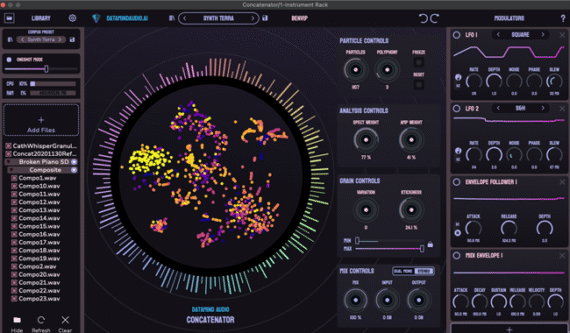
Datamind Audio released Concatenator, an AI-powered audio mosaicing tool that turns any sound into a playable instrument.

Distinctly different from sampling, Concatenator can use any microphone, instrument or audio file as real-time input to create complex and idiosyncratic sounds and textures.

Using proprietary machine learning techniques that analyze live audio input in real-time, the Concatenator plug-in re-constructs the signal using fragments of the samples you load into it. The result is a sonic potential as broad as whatever is thrown at it.

Concatenator uses a little known synthesis method called Concatenative synthesis which uses machine learning to analyze an incoming sound, and then tries to recreate it in real time, using fragments from samples that you load into it. It’s great for complex sample layering in sound design applications, but it also affords the user the chance to get really creative with it by manipulating how the algorithm selects and plays back the samples you put into it.

Datamind Audio Concatenator Features:

  • Lightning Fast Load Time – Your computer’s RAM size is the only limitation for how many samples can load into Concatenator.
  • Machine Learning control – Modulate how the audio matching algorithm “weighs-in” the spectral and amplitude components of the input signal.
  • Flexible modulation – 5 LFOs, 5 Envelope Followers, 5 Sidechain-enabled MIDI Envelopes
  • Total control – Control sample repetition with “Variation”, re-scatter the probabilities for chosen slices with “Particle Reset”, and then modulate how likely the sample is to hold once selected with “Stickiness”.
  • Dynamic Presets – Presets can be used with any sample combination, while additionally Corpus Presets store the currently loaded samples.

Datamind Audio Concatenator is available now for $149. A free one-week trial of Concatenator is also available.

For more information and demonstration videos, visit the Datamind Audio website.


Erica Synths Pikocore XL ‘A Lo-Fi Music Mangler’


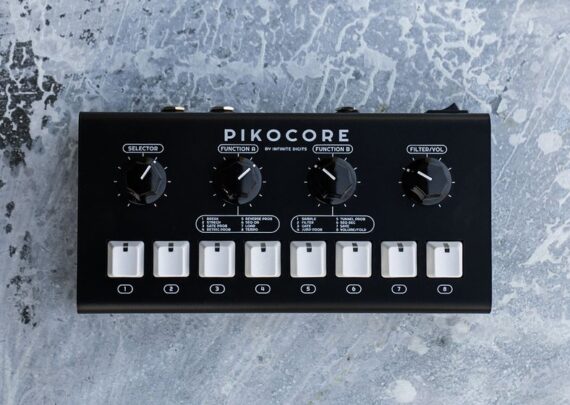
Erica Synths has introduced the Pikocore, a lo-fi music mangler developed by Zack Scholl that’s available as a DIY kit.

Here’s what they have to say about it:

“The original DIY kit comes in a miniature pocket calculator form factor, but we at Erica Synths wanted to make it more playable, so we reached out to Zack and developed Pikocore XL version that has identical functionality, but comes in Erica Synths signature hands on user interface and proper aluminum enclosure.

Infinite Digits Pikocore XL by Erica Synths is a full DIY kit that includes all components to build an instrument and put in in action straight away.”


Features:

  • A lo-fi music mangler based on the Raspberry Pi Pico.
  • Capable of holding 8 minutes of 8-bit 33 kHz monophonic samples.
  • Powered by a single alkaline AAA battery for up to 3 hours or by powered by USB-C.
  • Tempo-synced with a selectable BPM between 60 and 300, with samples mangled by beat-synced effects (stutter, retrig, gate, tunneling).
  • Loaded with real-time effects like a resonant filter, timestretching, volume, and wavefolding.
  • Sequenced with a 128-step sequencer with recording/playback
  • Saved and loaded via EEPROM for instant patch recall.
  • Able to load custom firmware, new samples, all through USB-C.
  • Sync-compatible with Pocket Operators.
  • Open-source, hackable.

The Pikocore is available now for € 160.00.