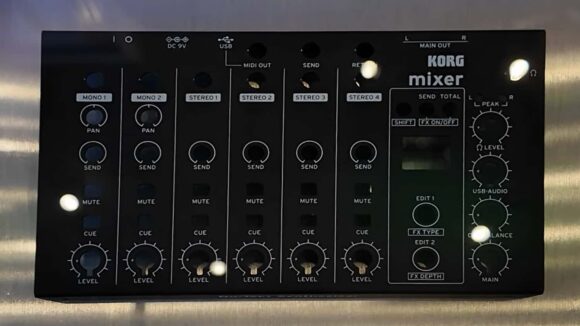
The Korg NTS-4 Mixer features two mono inputs, four stereo inputs, stereo send and return, cue monitoring, USB return level, headphone output and a two-channel USB audio interface running at 24-bit/48kHz.
There are two FX engines, one on the send which includes delays, reverbs, chorus and a range of master effects, including filters, phaser, decimator, drive, distortion, compression and limiting.
The NTS-4 does not support Korg’s ‘Logue SDK, so its effects can’t customized by the user.
Topics Covered:
00:00:00 Introduction to the Korg NTS-4
00:00:43 Kit build begins
00:01:34 Finished build and first impressions
00:02:00 Inputs, sends and mixer layout
00:04:14 Cue mix and pre-fade monitoring
00:04:42 Audio examples and send effects
00:07:11 Master effects section
00:09:22 USB power and possible noise issues
00:10:00 USB audio with phone and BandLab
00:12:23 The alternatives and conclusion
Watch the video and share your thoughts on the NTS-4 Mixer in the comments!
The Korg Intros NTS-4 Performance Mixer Kit is available now, including on Amazon for $249.99 USD.
Pittsburgh Modular founder Richard Nicol shared this teaser video for the Lifeforms SV-2, a new semi-modular analog synthesizer.
Nicol says the Lifeforms SV-2 is “perfect for complex tones or lo-fi noise’.
He adds that the soundtrack of the teaser video was recorded by multi-tracking the Lifeforms SV-2 into Ableton Live, with EQ and compression added in the mix.
Details are still to be announced.
Details for the Lifeforms SV-2 are expected to be announced Tuesday August 11, 2026.
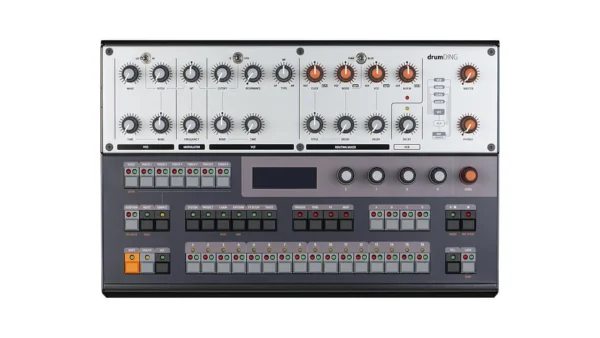
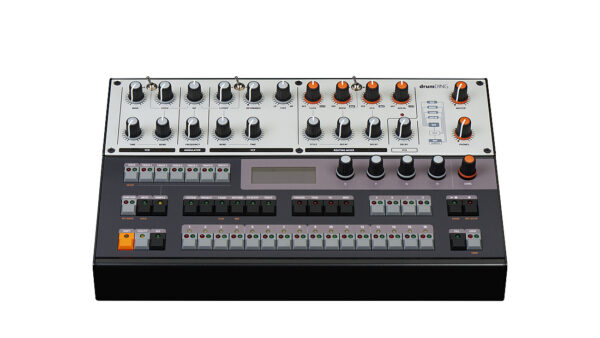
Vermona is a brand with a long and storied history that reaches back to Soviet-era East Germany. The company’s latest release, drumDING, is an innovative hybrid drum machine, combining analog drum synthesis, sample manipulation, and deep sequencing for complex and performative control over your drums.
At the heart of the machine is a single analogue voice designed to generate a broad range of percussion sounds, from kicks, toms and snares through to hats and tuned percussion. It does so through a combination of a wide-range VCO, noise generator and ‘click’ impulse generator, all of which can be combined in the internal mixer and fed through a multi-mode filter. The synth voice also includes a variety of modulation tools including an LFO and snappy decay envelopes.
drumDING then lets users quickly capture sounds created with this voice and turn them into samples that can be sequenced and processed with digital effects.
“Press a button, and your analogue sound becomes a sample – ready to be shaped further and layered with effects on the digital side,” Vermona says. “From there, drumDING’s sequencer makes it easy to turn those sounds into driving, distinctive beats. Then the cycle begins again: a new sound, a new sample, a new idea.”
As well as sampling its own internal voice, drumDING is also designed to sample via its external input, which allows users to patch in a synth or modular system.
Once captured, samples can be turned into patterns using the versatile step sequencer. This features six tracks with up-to 64 steps per track. The sequencer tracks can be set to individual lengths in order to create polymetric patterns and also includes features such as ratchets, micro-timing, parameter locks and probability. There is also a per-track LFO and pitch, envelope and reverse playback capabilities for sample manipulation.
On the effect front, drumDING has two delay sends and one reverb send. It can also make use of per-track insert effects offering drive, bit reduction and amplitude modulation.
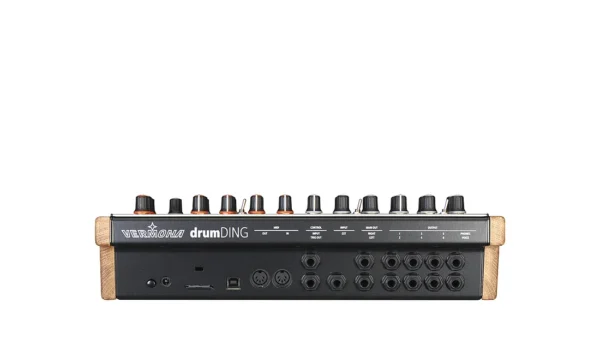
The hardware includes individual outputs for each of its six tracks along with a main output and separate output for the synth voice. It has MIDI, USB and CV connectivity for interfacing with other gear.
Features:
Hybrid analog/digital resampling drum machine
Sculpt analog drum sounds, then sample and sequence them
Analog drum voice using Vermona’s analog drum architecture
64-step sequencer with two flavors of parameter locks
Built-in FX including bitcrush, ring modulation, drive, reverb, and two delays
Save up to 32 samples per project
Aux input for sampling external sounds or resampling any internal sounds
Four-channel mixer with dry or filtered routing
Two noise modes and transient shaper
Internal modulation routing
Large OLED with corresponding parameter encoders
Preview Vermona drumDING from musician and YouTuber OoraMusic:
The drumDING allows you to sculpt your sounds from start to finish, perfect for use in the studio or for live improvisation. Suffice to say, the drumDING is just the thing for you.
All told, drumDING looks like a powerful and excitingly original drum machine. While the exact release date is still TBA, the instrument is now available for pre-order priced at $1,529.00 USD