Sine Machine, New Synth Designed To Make Additive Synthesis Friendly


Melatonin has introduced Sine Machine, an additive software synthesizer for Linux, macOS and Windows that’s designed to make additive synthesis visual and user-friendly.

Sine Machine uses 20 voices of 511 time-domain oscillators per voice, with sound design centered on direct manipulation of harmonic amplitudes, envelopes, pitch, and modulation. All filtering, reverb, and other timbral processing are implemented within the additive engine itself by manipulating harmonic content.
Features:

  • The synthesizer uses 20 voices of 511 time-domain oscillators per voice
  • More than 10,000 oscillators and over 20,000 LFOs are active within the synthesis engine
  • The instrument generates sound entirely from sine waves
  • The synthesis engine does not use FFT or inverse FFT resynthesis
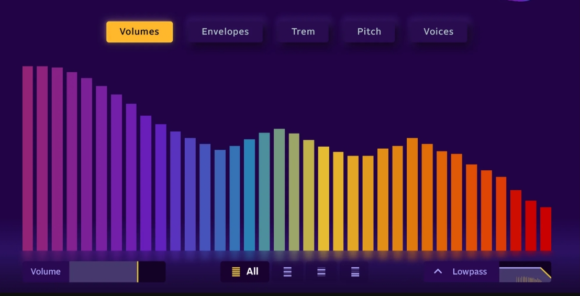
  • Per-harmonic volume editing is provided
  • Per-harmonic envelope editing is supported
  • Per-harmonic pitch modulation is available
  • Bulk editing tools allow simultaneous editing of multiple harmonics
  • Additive filters include brickwall and Gaussian band-pass modes
  • Additive reverb is generated from approximately 1,000 sine waves
  • Per-harmonic Gaussian pitch noise is available
  • Envelope Slop introduces variation between voices
  • Microtuning is supported
  • MPE performance control is supported
  • More than 140 factory presets are included
  • Visualizers display harmonic and spectral behavior during editing
  • macOS, Windows, and Linux compatibility

Video Demos:

Sine Machine is available now for $75 USD.


EMW VPOLY-6X Virtual Analog Synthesizer Sneak Preview


Electronic Music Works (EMW) shared this sneak preview of the VPOLY-6X, a new virtual analog synthesizer module that they say is “designed to deliver inspiring sound with an intuitive workflow.”


Details are still to come at their site, but they say that the VPOLY-6X offers a clean and practical interface and powerful analog-style sound.


Bob Moog Foundation Expands Archive With Rare Model 351 Tube Theremin


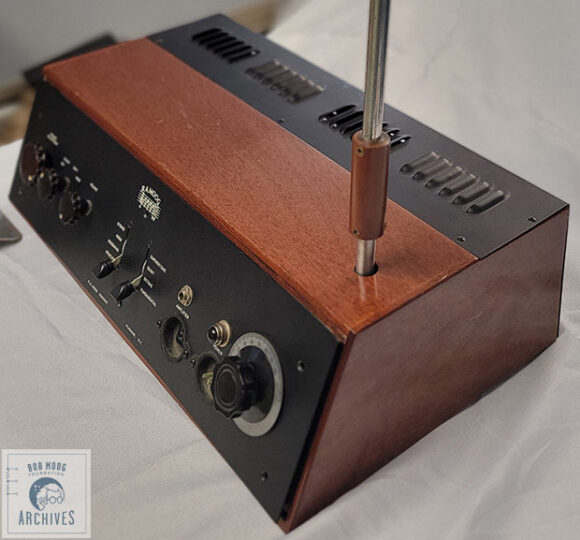
The Bob Moog Foundation is expanding its archives with the addition of one of the very first R.A. Moog theremins, the Model 351, built in 1954. Bob Moog was only 20 years old when the company made this model available.

Supporters Tammy and Phil Niemeyer donated the instrument, appraised with a value of $25,000.

Tammy’s grandfather, James Gray Everhart, purchased the theremin in Sherman, Texas, around 1955. He regularly played it for his family members and friends.

“We are thrilled to have this extremely rare R.A. Moog Model 351 theremin as part of the Bob Moog Foundation Archives,” said Michelle Moog-Koussa, Executive Director of the Bob Moog Foundation. “This stunning historical instrument helps us trace the evolution of Bob’s design ethic, while sharing the growth of his fledgling company.”

The Model 351 theremin is a five-octave, vacuum tube-based instrument, hand-assembled by Bob Moog. His father, George, assisted him with his own woodworking and engineering skills while they worked together in their basement workshop.

The 351 has a small mahogany cabinet with the standard theremin volume control plate and pitch-control antenna attached. Its silk-screened front panel features a generous number of tone-control knobs, including three separate volume knobs.

In the middle of the panel, there are two four-position switches, affecting what Moog called “Synthetic Format”. Mixing and matching the switch positions created a modest palette of tone possibilities.

The first switch could be set at “Principal,” which was the same default tone of the Model 305, or to “Woodwind,” “Horn,” or “String.” The second switch was essentially a pitch-transposing selector, with settings for “Fundamental,” “Octave,” “Quint,” and “Superoctave.” The far-right “Pitch Adjustment” knob enabled more refined pitch control.

The Model 351 is the latest in a long line of rare Moog instruments added to the Bob Moog Foundation Archives, including Bob’s very first electronic instrument, The Rensitron, an original R.A. Moog Model 201 theremin, two Moog modular synthesizers from 1967, Herb Deutsch’s Melodia theremin from 1961 and his R.A. Moog Co. Minimoog from 1971 (serial #1094), a Musonics Minimoog, Gary Wright’s Moog Liberation keytar, the Moog Apollo Polymoog prototype, the first Minimoog Voyager ever sold and more.

The Bob Moog Foundation is an independent non-profit organization, dedicated to the preservation of Bob Moog’s legacy. Key projects include the Moogseum, a STEAM program for kids focusing on the science of sound, and preserving Moog’s archives.