Behringer Unveils Two Compact MIDI Controllers And Sequencers, Jam & Jam Play
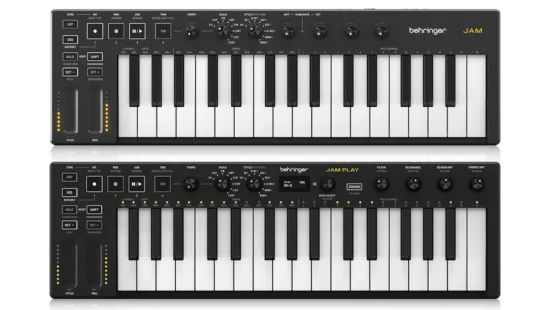

Following a leak in May that briefly revealed listings for 14 unreleased products, Behringer has officially unveiled Jam and Jam Play, two compact MIDI controller keyboards and sequencers that serve as an upgrade to the Swing.

Whereas the eyebrow-raising Swing looked remarkably familiar to Arturia KeyStep 32, Jam and Jam Play move in a more original direction, switching up the layout and introducing additional features and connectivity.

Both Jam and Jam Play are 32-key USB MIDI keyboards with velocity and channel aftertouch. On the front you also have dual touch-strips for pitch and modulation, along with four assignable rotaries and transport controls.

Both controllers are equipped with a 64-step, four-channel polyphonic sequencer with rest, tie and legato note entry, ratcheting, swing and gate randomization. There’s also a multimode arpeggiator onboard and a Chord Play mode that can remember chords of up to 16 notes.

In addition to the USB and MIDI connectivity, Jam and Jam Play send out CV/gate over three 3.5mm outputs, so you can use them to sequence modular gear or analogue synths. You also get analogue sync in/out over 3.5mm, 5-pin MIDI In and Out, a 1/4″ sustain pedal input and two USB-C connections.

Jam is a controller and sequencer, but Jam Play is also a standalone instrument, equipped with 128 instrument voices, 10 drum kits and several effects, controlled via the four rotaries. Jam Play also features a small display for switching presets and navigating parameters, along with a 1/4″ audio output. Check out a demo of Jam Play’s onboard sounds below.

“The best ideas hit when you’re not expecting them. Jam is built so you’re always ready,” reads a statement on Behringer’s website.

“Thirty-two compact velocity- and aftertouch-sensitive keys, a 64-step sequencer with 8-note polyphony, and a feature set that punches far above its weight — all in a controller you can throw in a backpack and take anywhere your music wants to go.”

Though product pages for Jam and Jam Play have popped up on Behringer website, but pricing and availability are still to be announced.

Find out more about Jam and Jam Play on Behringer website.

Jean-Michel Jarre Announces 50th Anniversary Edition Of Oxygene


Electronic music pioneer Jean-Michel Jarre is celebrating the 50th anniversary of Oxygene, the landmark electronic album he composed and recorded in his Paris home studio in 1976, using an eight-track tape machine, homemade mixing desk and a small collection of synths and drum machines, that went on to be the best-selling instrumental electronic music album of all time, and turned him into a global electronic music superstar.

The anniversary edition is bolstered by a stereo remaster, along with a Dolby Atmos version for the first time, that was mixed by David Kosten, Steven Wilson and Jarre himself.

Originally released in France in 1976, and in the rest of the world a year later in 1977, Oxygene helped establish Jarre as a major figure in electronic music.

“When I created Oxygene, I was working directly with analogue instruments and tape, and the sound had a particular depth, movement and life of its own. “For this anniversary edition, we returned to the original tapes with the aim of preserving that character rather than changing it.

“Of all the masters of OXYGENE that have been produced over the years, I believe this new remaster is the most true to what I originally created in 1976.”

The Oxygene 50th Anniversary Edition is scheduled for release on November 20, 2026. It’s available to pre-order via Amazon, and limited-edition versions are available via Jarre’s site.

And, Jarre has a book on the way, too. Machines: A History of Electronic Music will be released on 24 November via Amazon.

Prior to the album’s release, on 20 November, Jarre will appear as guest of honour at the Amsterdam Dance Event on 21 October. He’ll not only be performing there, but also speaking on the history of electronic music and its future in the age of AI.

Baby Audio Release HyperWarp Granular Multi-Effect Plugin


Described as a ‘time-bending granular effect’, Baby Audio’s latest release HyperWarp is a rhythmic multi-effect plugin designed to quickly mangle sounds and inspire new ideas.

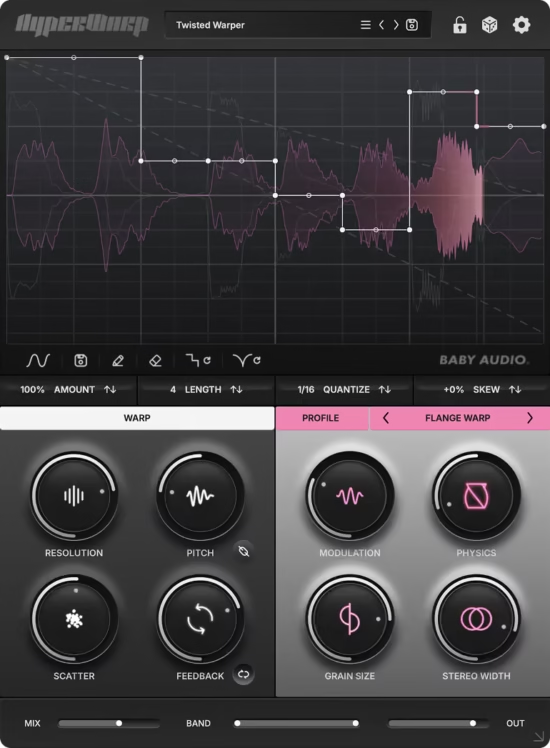
The plugin’s UI combines a customisable graph-style time manipulator with macro-controlled effects, aiming to allow users to quickly warp sounds while also providing precise control over rhythmic manipulation, glitches and stutter effects.

The heart of the plugin is Baby Audio’s granular processing engine. This breaks incoming audio down into micro samples that are then played back in a manner dictated by its controls, which allow users to alter the resolution, pitch and distribution of the grains, as well as dialling in a feedback loop.

HyperWarp also has a range of seven different profiles that apply further effects to the granular engine. Clean Warp provides the most straightforward granular processing with independent control over pitch and time. Flange Warp, meanwhile, is said to produce “tight grains, squeaky effects.” These are joined by Degrade Warp, which combines lo-fi processing and filtering.

Filter Spam is designed to apply randomised per-grain motion-controlled filtering. Harmo-Nicer creates dense harmonic effects using pitch-shifted grain. Fauxcode is a ‘resonant harmonic generator’ said to create sounds akin to a classic vocoder. Finally, Lo-Fizzly combines granular processing with digital downsampling.

Where these effects become really interesting, however, is when paired with the time manipulation graph at the top of the interface. This allows users to draw a looping, complex LFO-like curve that controls the playback of the audio coming from the engine – almost like manipulating the playback of an old fashioned tape deck.

This allows users to create any combination of stutters – by causing the playback to jump backwards – slow down and speed up effects, reversed playback or granular ‘freeze’ effects, where the plugin holds the audio output at a specific point in the loop.

The shape, movement and rhythm of these effects are controlled using the graph, which allows users to input steps based around a tempo-synced grid, freely draw curves, import or export rhythmic patterns or randomise various elements of the grid.

Those randomisation tools come in two flavours: Steppy and Curvy. According to Baby Audio, “the Steppy randomiser generates patterns that emphasise glitched-out stutters while the Curvy randomiser focuses on swing effects, record scratches and other changes in speed over time.”

According to Baby Audio: “By combining graphical time manipulation with granular processing, HyperWarp gives producers the power to reimagine their audio into glitchy rhythmic chops, or use any input as raw material for granular sound design.”

For those in search of quick inspiration, HyperWarp comes stocked with 190 presets designed to warp and manipulate sounds of all varieties.

HyperWarp is out now priced at $106.92, but it’s currently available for an introductory price of $52.92. A rent-to-own option is also available. Visit the Baby Audio site for more information.