TIDAL Will Label AI-Generated Music, Block It From Earning Royalties


Streaming service TIDAL has announced a new AI policy, saying that it will label AI-generated tracks for transparency, and that not pay royalties on these tracks.

Beginning July 15, listeners will see an AI label on tracks that TIDAL determines are entirely AI-generated. The company says it plans to expand those labels to substantially AI-generated music as detection technology improves.

The policy defines AI-generated music as music that is wholly or substantially created using generative AI, while acknowledging that AI-assisted tools have become a common part of music production.

TIDAL says artists should be free to use AI creatively, but argues that listeners should also be able to identify AI-generated content and that royalty payments should prioritize works “directly produced, written, and performed by people.”

Under the new rules, TIDAL also says it will remove or block AI-generated music associated with fraudulent activity, including content that impersonates artists, exploits a person’s name or likeness, attempts to deceive listeners, or is linked to suspicious upload or streaming behavior.

The company will also require distributors to identify AI-generated music before it reaches the platform, and the same standards will apply to releases distributed through TIDAL Upload.

Artists who believe their music has been incorrectly identified as AI-generated can request a review through TIDAL Support.

 

Vintage Synth Demo Of The Rare Moog Minitmoog


The latest Synthpro video takes a look at the rare, vintage Moog Minitmoog synthesizer keyboard.

“In this video, I take you through the Minitmoog synthesizer. from my understanding this was a one year only model with only a few hundred manufactured,” they note.

The Minitmoog was introduced in 1975, and is a basic, 2-VCO monosynth. It has presets for sounds like Trumpet, Oboe, Clarinet and Violin – but limited tweakability.

It was only made through 1976 and few were made, so much of its interest and value comes from its rarity.

View the video and share your thoughts on the Moog Minitmoog in the comments!

Free Audio Damage Delay Effect Now Available For Linux, Mac + Windows


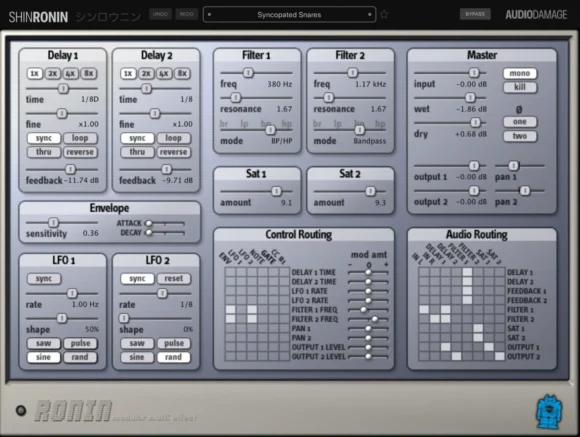
Audio Damage has introduced ShinRonin, a free delay effect for Linux, Mac and Windows.

Here’s what they have to say about it:

“Two independent delay lines, each with tempo sync, reverse, looping, and feedback, feed a pair of morphing multimode filters that sweep continuously from notch through lowpass, bandpass, and highpass. There is saturation, two LFOs, and an envelope follower.

Everything connects through two on-board matrices: a signal matrix that routes any audio source to any destination, and a modulation matrix that wires the LFOs, envelope, and incoming MIDI to nearly any parameter. It is happy doing clean stereo delays and gentle filtering, but the real fun starts when you patch a feedback loop and let it misbehave.”

ShinRonin is available now as a free download.