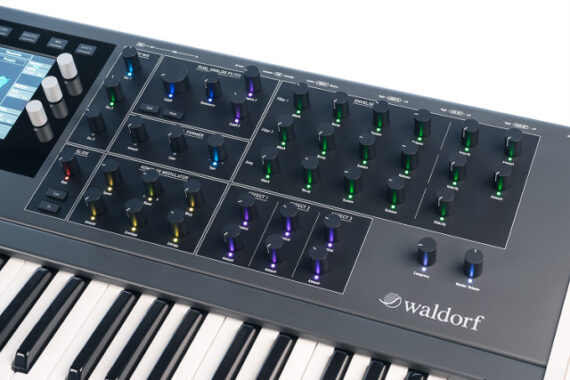
Waldorf has released OS Update 3.3.0 its Quantum & Iridium synthesizers, an update that adds MIDI 2.0 compatibility and more.
The update is compatible with all Quantum and Iridium variants, including Quantum (original & MK2), Iridium Desktop, Iridium Keyboard and Iridium Core.
New in OS Update 3.3.0:
MIDI 2.0 compatibility with high-resolution data support
Improved MPE polyphonic pitch-bend
Expanded favorite sets & authors
Release velocity as a modulation source
Additional macros and other refinements
The update is available now as a free download via the Waldorf site.
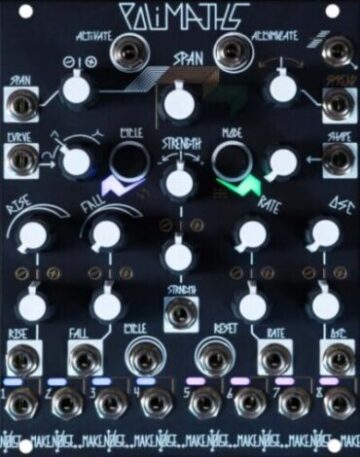
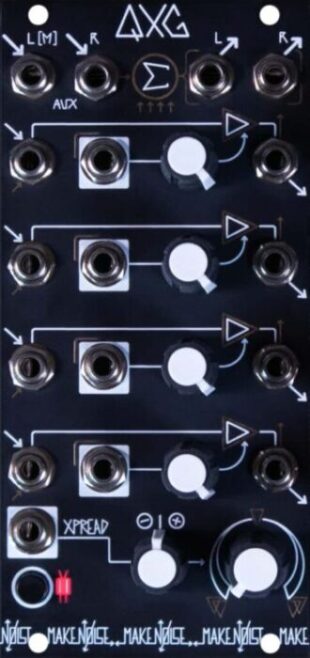
Make Noise has officially introduced two new Eurorack modules, PoliMATHS and QXG.
Here are the details:
PoliMATHS is an eight-channel CV and Audio event generator for the New Universal Synthesizer System or any Eurorack modular synthesizer.
It uses a single set of controls to generate complex functions at eight independent channel outputs. PoliMATHS’ functions are made up of two components:
First, the well-known Rise-Fall envelope with variable Curve (familiar from the original MATHS and Function and 0-Coast Slope); and
A variable-Shape Oscillation whose amplitude is controlled over time by the Rise-Fall envelopes. This oscillation can be either low frequency for the creation of complex control functions, or audio frequency for native generation of audio events/notes with optional tuned pitch control via 1v/oct control voltage.
PoliMATHS also includes output headers for creating pre-patched connections to the control inputs of QXG.
Features:
Part of the New Universal Synthesizer System
Eight channel function generator with a single set of controls
Create simple or complex functions
Activate channels in many possible patterns using Channel Index, Round, and Parallel Modes
Modulate parameters across channels with Spread or Modulation Dissemination
Designed to work with MultiMod and QXG and future NUSS modules
Chain to QXG for immediate eight channel amplitude control
The Quad Stereo Gate (QXG) music synthesizer module is a Four Channel Stereo Low Pass Gate and Mixer.
Like the DXG before it, the QXG utilizes a new low pass gate circuit that does not use vactrols. This circuit is 100% analog and its response was arrived at after many months tailoring it to meet or exceed the expectations that have been set by all the vactrol low pass gates that Make Noise has created over the years.
Additionally the QXG adds a Vactrol button to select between a Slow, low-pass-gate-like response emulating the decay time of a vactrol (Vactrol button ON), and a Fast precision response that still maintains the gentle filtering characteristic (Vactrol button OFF). Fast response can be especially useful when patching QXG with complex and quickly-changing functions such as those generated by PoliMATHS with the OSC circuit in use.
The QXG also includes a Stereo Sum Output with voltage controllable Stereo Spread to quickly route all four channels across the stereo field. Each channel also has an individual output that removes the channel from the Sum when patched.
In addition, QXG includes signal and control input headers for creating pre-patched connections from the outputs of PoliMATHS and MultiMod.
Features:
Part of the New Universal Synthesizer System
Four channel low pass gate
Vactrol-free design for classic Low Pass Gate sounds
Vactrol button to select Fast or Slow response
Xpread parameter for spreading the four channels across the stereo field
Summing stage with Stereo AUXiliary IN allows for chaining of multiple units, creating larger mixes
Individual channels can be removed from Sum by patching to their respective outputs
Designed to work with MultiMod and PoliMaths
Chain two QXG units to a PoliMaths for immediate eight channel amplitude control
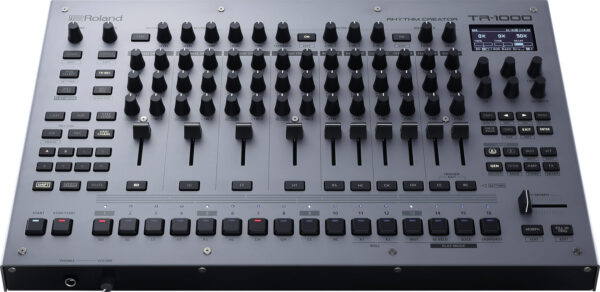
The TR-1000 builds on Roland’s drum machine legacy, combining the analog capabilities of the classic TR-808 and TR-909, digital synthesis, sampling and more.
The hour+ video digs into the TR-1000’s sound engines, the user interface, build quality, sampling, sequencing and more.
Eliraz cites the Roland TR-1000’s cost and massive size as potential cons. On the pros side, he calls the TR-1000 “The most performance-oriented, versatile and feature-rich drum machine I’ve ever used.”
Topics covered:
0:00 Intro
1:40 Overview
2:35 Generators
4:25 Project scope
6:05 Instrument
7:10 Kit scope
8:30 Workflow
10:05 Knobs, macros
12:25 Play modes
14:50 Morph
16:10 I/O
17:15 Build
17:35 TR-1000 app
18:20 Analog 808s
23:25 Analog 909s
26:50 Other ACB
27:15 FM
27:55 VA
28:25 PCM
29:10 Sampling
32:05 Timestretch
35:25 Slicing
36:50 Layer filter
37:25 Layer amp
38:00 Inst FX
39:00 Inst presets
39:35 Send FX
41:55 Master FX
43:25 Analog FX
45:15 Sidechain
46:40 Sequencing
50:55 Performance
52:00 Pros & cons
54:45 Factory patterns
Watch the Roland TR-1000 drum machine review, and share your thoughts on it in the comments!