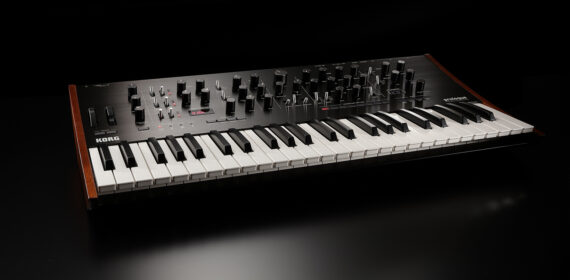
The Korg Prologue is a synthesizer that was arguably under-appreciated when it was introduced, as early discussion seemed to focus more on the instrument’s limitations than on its strengths.
Since the Prologue was discontinued, though, it seems like appreciation of the analog flagship synth has been growing steadily, as musicians have discovered its great analog sound, solid build and ease of use.
This set of videos, via synthesist Panu M Savolainen, offers ‘shut up and play’ style demos of the Prologue, showcasing the range of the instruments’ native synth engine. Only internal FX and factory presets were used.
The videos do a good job of showcasing the range of sonic possibilities that the Prologue is capable of.
What do you think of the sound of the Korg Prologue? Watch the videos, and share your thoughts in the comments!
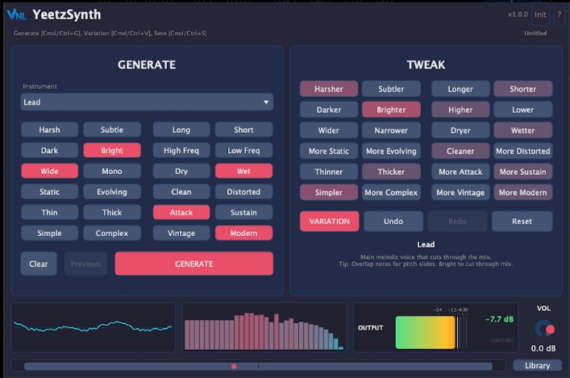
VNL Works has introduced YeetzSynth, a new software synth for Mac + Windows that’s designed to streamline patch creation.
Instead of tweaking knobs, you describe what you want:
Pick an instrument type (Bass, Lead, Pad, Wobble…)
Select style pairs (Dark/Bright, Wide/Mono, Clean/Distorted…) or leave them blank
Select ‘Generate’, and YeetzSynth builds an original patch for you.
Under the hood, YeetzSynth offers three synth engines:
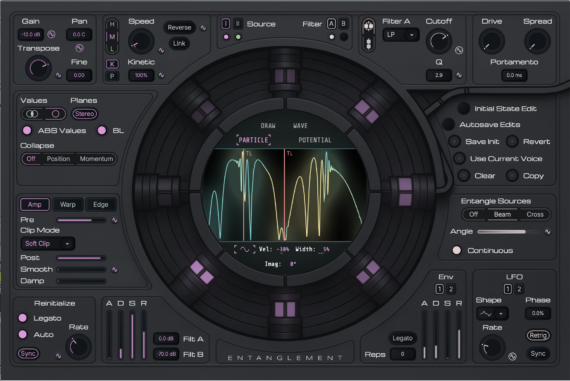
Developer Dillon Bastan has introduced Entanglement, a new software synthesizer that uses a 1D quantum wave function (Schrödinger equation) to produce evolving waveforms for use in a dual polyphonic wavetable synthesizer.
Why does this matter? Here’s what they have to say about it:
“You can add energy to the simulation in various different ways (wave packets/quantum particles, free draw, and waveform files) and those waveforms will evolve and transform based on the equation and your settings. You can also add environmental factors (potentials) to transform the energy/waveforms in different ways. Additionally you are able to manipulate the resulting waveform in different ways (stretching, warping, quantizing, smoothing, FM etc).
You can derive your waveform from the wave function with many different equations and value options, each of which offers a different sound.
Each oscillator has its own independent wave function, energies, potentials and settings. Both oscillators can also be entangled adding a rich and complex modulation of the waveforms. That coupled with an internal modulation system makes this device a powerhouse for insane sound design!”
Official intro video:
Features:
Two oscillator sources per voice each with independent:
1D Quantum wavefunction (Schrödinger equation) simulation to produce a waveform oscillator from
Interactive display of the wavefunction and manipulations of the resulting waveform
Two waveform value type modes from the wavefunction: Combined planes or Single plane
Various combined plane equation modes
For single plane mode ability to hard plane each plane (real and imaginary) in stereo for a wide sound
For single plane mode ability to select which plane to use
Able to use absolute values for the waveform which adds more body
Optional bandlimiting of the wave playback allowing for more ringy/aliased sounds when desired
Simulation speed control with a reverse option, framerate quality option (low, mid, hi), and sync to tempo option
Rhythmic Auto-reinitialize of the wavefunction option at synced and free (ms) rates
Legato reinitialize option (doesn’t reset to initial quantum state on legato voices)
Wavefunction collapse option (via position or momentum) with various shape optins for the collapse
Ability to add particles/wave packets of different shapes with velocity, width and imaginary phase offset options (More particle shapes than in the M4L version)
Ability to free draw and erase energy with options to externally free draw with a controller or automation
Ability to add envirnmental factors (potentials) to transform the energy in different ways (many more added from the M4L version)
Ability to add waveform files as energy into the simulation (internal or user files) with width and imaginary phase offset options
Various save and copy functions
Various amplitude handling/clipping options of the resulting waveform and pre/post gain for that handling