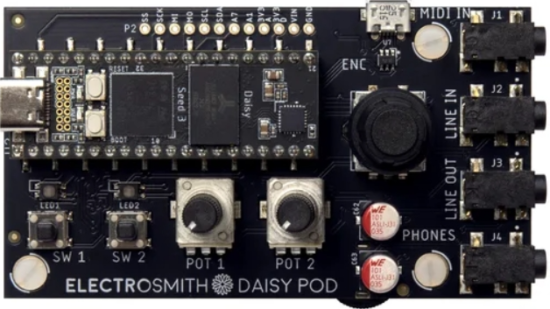
The video, via Pocket Trax, takes a look at creating custom electronic music gear using the Electrosmith Daisy Pod.
The Daisy Pod is a compact, USB-powered development board for the open-source Daisy Seed audio platform. No soldering and no breadboard needed. It has 2 knobs, 2 buttons, a clickable encoder, stereo line in/out, TRS MIDI in, and a headphone out.
You can program it with C++/Arduino or Pure Data/Max Gen, or patch visually in PlugData.
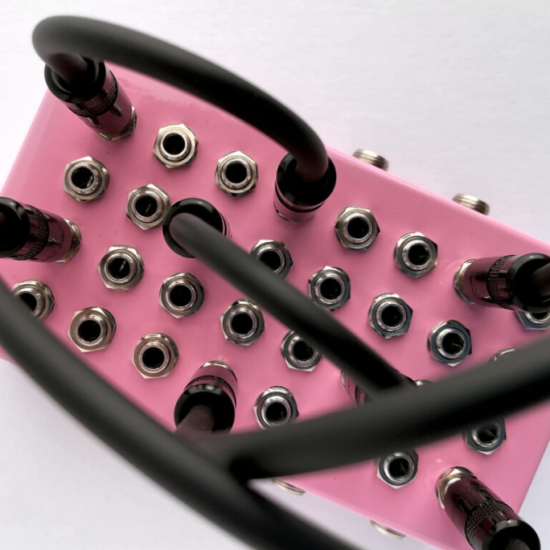
Mulch Box is a passive patch bay and signal multiplier that combines 1/4-inch and 3.5mm connections for routing audio between synthesizers, effects pedals, modular systems, and recording equipment
Go Outside Music has introduced the Mulch Box, a compact passive signal-routing device designed to simplify connections between electronic music equipment with different audio jack formats.
The hardware combines standard 1/4-inch connections with 3.5mm mini-jacks, allowing users to split, combine, and reroute signals without repeatedly disconnecting the main cables attached to their instruments and other equipment.
The Mulch Box features eight channels, each with one 1/4-inch jack and four 3.5mm jacks wired together. Its passive design requires no power supply, making it suitable for studio setups, modular synthesizer systems, effects-pedal chains, and portable electronic music rigs.
Features:
Passive Signal Routing: The Mulch Box uses a completely passive design and requires no power supply. Each channel’s five jacks are electrically connected, allowing signals to be routed between connected equipment using standard TS mono cables.
Eight Independent Channels: The unit provides eight channels, each equipped with one 1/4-inch jack and four 3.5mm jacks. This configuration accommodates standard instrument cables alongside the mini-jack connections commonly used by modular synthesizers and other electronic music devices.
Signal Splitting: Each channel can distribute a signal to multiple destinations, enabling parallel processing through effects pedals or routing a synthesizer output to multiple devices. Signal levels may decrease when an unbuffered source is split across multiple destinations.
Signal Combining: Multiple sources can be connected to the same channel to combine their signals. The resulting level and behavior depend on the connected equipment and its electrical characteristics, so combining outputs is not equivalent to using a dedicated mixer.
Mixed-Format Connectivity: The combination of 1/4-inch and 3.5mm jacks allows the Mulch Box to bridge equipment with different connector formats without requiring a separate adapter for every connection.
Synthesizer and Modular Integration: The device can connect conventional synthesizers and drum machines with Eurorack and other modular equipment. Its passive connections provide a way to experiment with routing audio between instruments and modular signal paths.
Effects and Recording Workflows: The Mulch Box can be used to route audio between effects pedals, mixers, recorders, and other studio equipment. Keeping primary input and output cables connected while changing the mini-jack patching can reduce the need to rearrange an existing setup.
Signal Interaction: Because the jacks are directly connected, splitting and combining signals can produce changes in level and tone. The manufacturer notes that signal loading can affect unbuffered sources, including guitar pickups, and recommends considering a buffer or boost device before splitting a signal when necessary.
Compact, Power-Free Design: The pedal-sized unit operates without an external power supply, making it easy to integrate into a desktop studio or portable equipment setup. Its passive design also avoids adding another powered device to a rig.
The Go Outside Music Mulch Box is available now for $175. The manufacturer produces the units in small batches, with an estimated fulfillment time of two to six weeks.
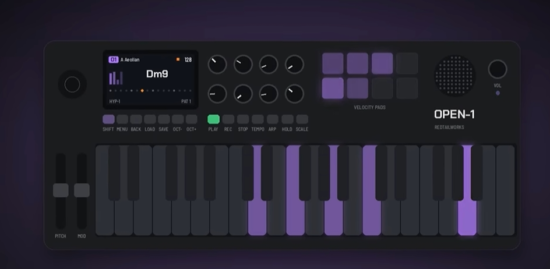
Portland electronic music producer Alexander Gaddis (RedtailWorks) shared these videos, documenting his concept designs for OPEN-1, an open, entry-level synthesizer that can run multiple firmware options.
Unlike the M-Vave FM-1, though, the OPEN-1 is designed intentionally to run multiple firmware options and would let you swap them on the fly.
In this concept video, the OPEN-1 runs a simulated HYP-1, in time with a real HYP-1 live take.
Open-1 Synthesizer Specs (preliminary):
480 MHz Cortex-M7 (STM32H750), open toolchain (the FM-1 runs at 240 MHz)
32 MB of working memory for long delays, loops and samples (the FM-1 has about 432 KB)
16 MB of firmware flash plus a microSD library: keep several firmwares installed, swap from the menu
24-bit stereo audio in AND out, so it can be an effects box too
MIDI in and out (3.5 mm TRS), USB-C device and USB-C host
37 RGB-lit silicone keys, 8 velocity pads, 8 endless encoders, a thumbstick and 2 spring levers
Wired only, no Bluetooth: lower latency, simpler to build
Target price: under $200
Open Synthesizer Design
The platform would include an open SDK and a browser emulator, so developers can build firmware before the hardware ships. Launch firmware would be ported from existing options for the FM-1 family: HYP-1, LOF-1, ECO-1 and GRAV-1.
At this point, the OPEN-1 synthesizer is just a design concept. You can learn more about it at RedtailWorks’ Youtube page.