Live Modular Performance By FreqGen, ‘Orbital Drift’


Synthesist and producer Scott David Albert (Klayton, Celldweller) shared this live modular performance, Orbital Drift, under his FreqGen project.

“I haven’t done this in a while,” notes Albert. “No softsynths. No presets. Just raw voltage, evolving sequences, and semi-controlled chaos, captured in real time.”
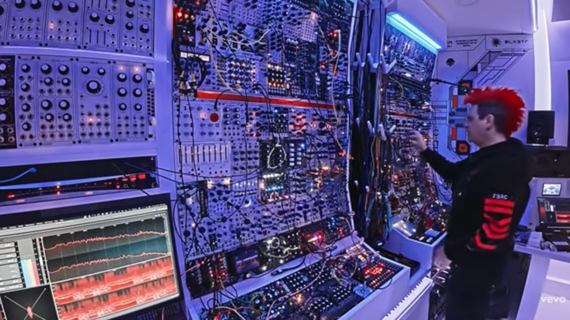
He also shared detailed modular patch notes for the performance:

“I’ve had Intellijel’s Metropolis for a long time and have used it on many songs. A family member bought me Metropolix as a gift and it was time for me to wrap my head around all the upgrades and new features, so that was the impetus for this track and the foundation it was built on.

Intellijel Metropolix to Livewire AFG. Modulating pulse width and harmonic animation with Ornament & Crime. That’s run through one of my fav filters of all time, the Cwejman MMF-2 modulated by the Tip Top Z4000 EG for a bit of snap but mostly as seen in the vid, manual modulation of the cutoff. Hands are handy.

Drums are sequenced by the Erica Synths Drum Sequencer with kick, hats and percussion all in random mode. The Drum Sequencer is controlling the VPME QD & QEX which I loaded up with my own selection of drum samples.

I used Make Noise Pressure Points/Brains for the main played lead, controlling pitch of the XAOC Devices Odessa. Gates fired from PP/Brains trigger another Z4000 EG which mults through a Synthrotek mult to a Pittsburgh Modular VCA and the Roland 521 VCF (The thing I keep looking up at, hoping it would wave or say hi. It never did, but it did an amazing job at filtering the Odessa.)

The little arp I added at the last minute. It lives on another rack which contains all my 5U stuff. Sadly it’s not in the video bc I didn’t know I was going to utilize it when I set up the cameras. Next time. The arp uses all Synthesizers.Com modules, sequenced by the Q119 and filtered by the Q150 Transistor Ladder filter.

Delays and reverbs from multiple Tip Top Z-DSPs. Some EQ & compression and maybe a delay in Cubase which mainly acted as my tape machine to record the performance. As I normally do when I patch, it’s all synced to Cubase clock using Expert Sleepers modules & Silent Way software.”

Orbital Drift is available as a single via the FreqGen Bandcamp page.

 

Why Native Instruments Is In Bankruptcy Court


The news that Native Instruments has filed for Preliminary Insolvency shook the music industry, because the company’s tools have been used by so many, for so long.

Many have speculated about what led to the company’s decline, but the best take we’ve seen comes from Music Trades Editor Brian T. Majeski, who calls Native Instruments as “the industry’s latest private equity casualty”.

In his newsletter, he shared his analysis of the company’s decline after it was acquired by private equity firm Francisco Partners:

“After five years under the stewardship of Francisco Partners, the company that pioneered computer-centric music systems filed for bankruptcy protection in the Berlin courts on January 27.

The catalyst for the filing was a steep decline in sales, cumulative losses of €288 million ($339 million) accrued in 2023 and 2024, and looming maturities on approximately €262 million ($309 million) in debt.

The bankruptcy court has a mandate to keep Native Instrument intact as a viable business and they are likely to succeed. The company retains a valuable product portfolio that is used on 80% of the Top Ten Billboard tracks and has over 1.5 million registered users. However, there will be serious post-bankruptcy challenges.

Despite assurances from management that “business will carry on as usual,” consumers are understandably wary. Many are deferring or cancelling planned purchases out concern that the restructured company many not honor existing software licenses or provide product support.”

Recent moves left many Native Instruments customers puzzled:

  • In 2022, Native Instruments and iZotope announced ‘Soundwide’ as the new name of their parent company, and welcomed several new members to the Soundwide group of brands, including audio plugin platform Plugin Alliance and audio software company Brainworx. The goal was to provide end-to-end solutions, but the companies seem to have struggled to find synergy.
  • Just a year later, they announced dumping the Soundwide brand, and that iZotope, Brainworx, and Plugin Alliance would become part of Native Instruments.
  • The company also frustrated long-time customers by neglecting or retiring loved products. In 2022, the company retired Absynth – one of its oldest and most powerful software synths. In late 2025, though, the company introduced Absynth 6. It was a welcome return, but also left many questioning Native’s strategy for its software synths and virtual instruments.

“The failure of Native Instruments is a complicated story, worthy of a full-length case study,” notes Majeski, adding that “Misplaced growth expectations, poor product development, and a healthy dose of hubris surely contributed.

You can read more analysis and editorials by Majeski at the Music Trades site.

Have your own take on what created Native Instruments’ predicament? Share your thoughts in the comments!


New Software Synths Take Inspiration From Buchla, ARP 2500


Developer Giorgio Sancristoforo shared these sneak previews of a pair of new software synths.

Sancristoforo has previously released a wide range of creative synths, including Gleetchlab, No-Fi Tape Loop Music Studio, Ongaku and Berna 3.

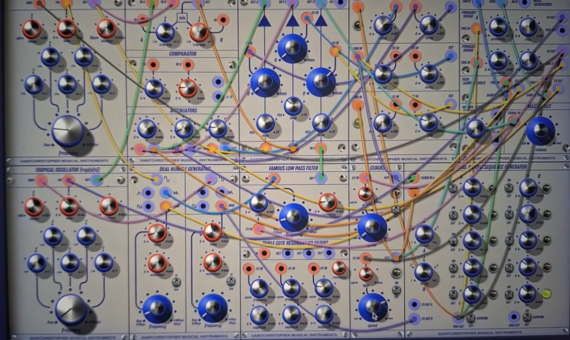
The first new software synth, Eye of Horus, takes inspiration from Buchla synths. We’ve embedded the preview above.

The second new synth, SONDA, takes inspiration from the ARP 2500 and the work of electronic music pioneer Eliane Radigue:

Details on the two new synths are still to come at Sancristoforo’s site.