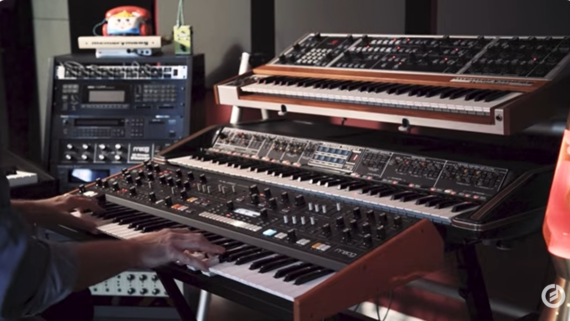
Today, Moog Music releases the Memorymoog Preset Collection for the Moog Muse synthesizer.
The free collection was created by synthesist and sound designer Eric Frampton, and recreates all 100 original Memorymoog factory presets.
The demo video, embedded above, offers a head-to-head comparison between the original Memorymoog and Muse versions.
Using Muse’s modern architecture, each sound goes beyond the original, adding velocity, aftertouch, macro controls, effects, and expanded modulation, while preserving the three-oscillator design of the original Memorymoog patches.
The Memorymoog Preset Collection is available now as a free download.
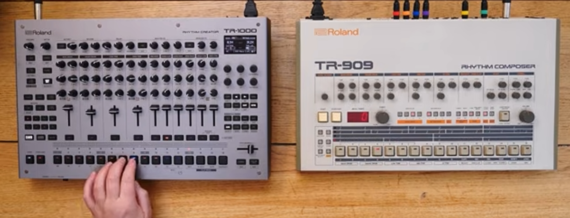
Synthesist Starsky Carr – in his latest video – shares a head-to-head comparison between the classic Roland TR-909 and the new TR-1000 drum machine.
“I put the Roland TR-1000 head-to-head with my original Roland TR-909 to see how close we can actually get”, notes Carr, “and more importantly, where the differences really matter.”
Topics covered:
Kick, snare, clap, rim & tom comparisons
Analogue voices vs ACB models (and why that’s ironic…)
The real difference between main outputs and individual outs
Why the 909 sounds more “band-limited” and less hi-fi
Frequency analysis & Match EQ deep dive in Logic
The exact EQ curve to give your 909 samples that crusty main-out character
Why obsessing over 1:1 matching might be missing the point
Carr argues that the key to recreating the classic 909 sound isn’t tweaking the TR-1000, but band-limiting the output. He demonstrates to how to recreate this, using Logic’s Match EQ.
Is the Roland TR-1000 close enough to replace the TR-909? Check out the comparison and share your thoughts in the comments!
Gingoduino is a free, open source music theory engine for Arduino and other embedded systems.
It brings notes, intervals, chords, scales, harmonic fields, fretboard engine, musical events, and sequences to Arduino, ESP32, Teensy, Daisy Seed, Raspberry Pi Pico, and other platforms.
Features:
12-note chromatic system with enharmonic equivalents
42 chord formulas with reverse lookup (identify)
40+ scale types and modes with signature, brightness, relative/parallel
Harmonic field analysis with T/S/D functions and roles
Fretboard engine: violao, cavaquinho, bandolim, ukulele with fingering scoring
Musical events (note, chord, rest) and sequences with tempo/time signature