Moog Minimoog Model D App is now compatible with All Major macOS DAWs

 

Moog Music has announced that its Minimoog Model D app – originally released for iOS – is now available in a version compatible with all major macOS DAWs.

Free to all current Model D iOS app owners, or available at limited-time introductory pricing for new users of the instrument, the update makes the legendary sound of the Minimoog available directly in your DAW.

 

New Features & Integrations


The major update allows for seamless integration with Logic, GarageBand, MainStage, Reaper, and – through a free VST wrapper – in Ableton Live and Cubase. Minimoog Model D can also be used as a standalone instrument or effect.

In addition, Minimoog Model D App incorporates a number of features not found in the original hardware. This includes the ability to play chords with up to four-note polyphony, an easy-to-use arpeggiator for rhythmic pattern creation, a real-time looping recorder with unlimited overdubbing capacity, a tempo-synchronizable stereo ping-pong delay module, and the Bender—a wide-range stereo time modulation effect module.

The latest update also includes a redesigned preset management system for quicker navigation and adds a random preset generator function.


Key Features:

  • Ships with over 160 presets (hundreds more available in the Minimoog Model D App Store)
  • Up to 4-notes of polyphony
  • Share presets and audio recordings with friends
  • Arpeggiator module with note-hold and chord latch capability
  • Stereo ping-pong delay effect
  • Bender time modulation effect
  • Real-time looping recorder with overdub and immediate sharing
  • Selectable envelope shapes and triggering behaviour
  • Effortless MIDI CC mapping
  • Backup presets to iCloud
  • Play mode for easier panel and keyboard interaction
  • A new take on the classic feedback/overload path


The Minimoog Model D App for macOS is available individually for $24.9, or in a bundle with the Model 15 Modular Synthesizer App for $39.99.
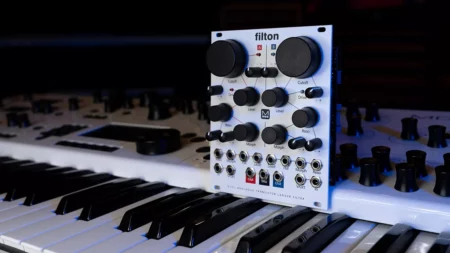

Modal Electronics Filton, a Eurorack Dual Analogue Ladder Filter


Modal Electronics tests the Eurorack waters with Filton, a 20HP dual analogue transistor ladder filter module – a Moog-style dual analogue ladder filter.


New 20HP module is a Kickstarter exclusive. It is based on the design of the classic Moog ladder filter. Filton promises to deliver saturated transistor overdrive, resonant harmonic peaks and warm analogue timbres. It also features the ‘polesweeping’ that Modal introduced in its 002 synth, which enables seamless filter morphing from four-pole through bandpass to one-pole 6db per octave, and everything in between.


In fact, Filton is based on the same circuitry as the 002’s filter, though the design has been altered to improve stability and sound. Additionally, the dual architecture means that you get two filters, which enable you to process two sounds independently or a single sound using both filters in series or parallel.


Each of these filters has an audio output, four analogue CVs with attenuvertor controls for FM, Resonance, Morph and Level, pitch tracking provided by the 1V/Oct input, an audio output and a mixed output.


All CV inputs on Filter A have been ‘normalled’ to Filter B, meaning any CV signal plugged into Filter A is automatically sent to Filter B if nothing is plugged into the corresponding input.

Filton is available exclusively on Kickstarter priced at £299. As such, it’ll only be released if the £50,000 funding target is reached.

iZotope launches RX10 and Ozone 10, Audio Repair software and Mastering suite.


iZotope has unveiled RX10 and Ozone 10, promising cutting-edge audio repair and mastering technologies. The latest versions of its flagship are said to be more ‘intelligent’ than ever before, with AI doing an increased amount of heavy lifting if you want it to, though there’s still plenty of scope to personalise the results.


RX 10 features a rebuilt Repair Assistant plugin. RX 10 is dedicated to cleaning up audio in both music and post production situations. This will automatically identify problems and propose fixes, which you can modify as you wish.


In addition, there is a new dynamic adaptive mode in the De-Hum module, which promises to remove unwanted interference automatically, while upgraded spectral recovery is here to add life to thin-sounding audio that you may have captured on your mobile phone or other lower-end recording device.


Other highlights include selection feathering for smoother edits and support for Macs with Apple silicon chips.


Ozone 10 marks the arrival of the Stabilizer module – an intelligent and adaptive mastering EQ. It’s designed to give your mix a “clear, natural tone,” while also taming problem resonances, removing harshness and smoothing transients.


If you want to add space and punch, you can try the Impact module – a ‘microdynamic’ controller that offers four sliders that work across different frequency bands. Additionally, there is an improved Master Assistant, which makes it easier than ever to match your mix to a trusted reference file or hit song, while the Magnify Soft Clip setting in the Maximizer module is designed to boost loudness while maintaining audio quality.


The Recover Sides feature is new to the Imager module, this promises to maintain stereo information in mono and preserve depth and power when narrowing a problem frequency.

Includes Apple silicon support, and a refreshed look and feel for the GUI.

RX 10 is available now in Advanced, Standard and Elements formats for the introductory prices of $799, $299 and $99 respectively (these prices will rise to $1,199, $399 and $129 after 11 October). Ozone 10 Advanced and Standard will be released on 13 September for the introductory prices of $299 and $199 (prices of $499 and $249 will apply after 20 October). Find out more on the iZotope website.