Free Update for Mutable Instruments Plaits adds DX7-Compatible 6-Operator FM Synth and More
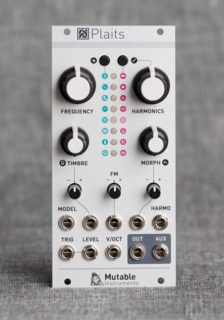
 

Mutable Instruments has released a free firmware update for its Plaits that adds a DX7-compatible 6-Operator FM synth and 7 more synthesis models.


New in the updated Plaits firmware:

  • Fixed a spurious retriggering of the internal envelope when entering/leaving the speech synthesis model.
  • Reduced the amount of software filtering on the TIMBRE and MORPH knobs, to increase their responsiveness.
  • Reduced the amount of hysteresis in the quantizer responsible for converting a voltage into discrete settings (for example, for model selection with the MODEL CV input, or chord selection with the HARMONICS knob and CV input). This makes the relationship between a voltage and a specific setting more consistent when controlled by a sequencer.
  • The filters used for band-limited wavetable synthesis have been improved, eliminating the amplitude drop observed for the highest notes.
  • The frequency range selector has a new mode: octaves. In this mode, the right button and FREQUENCY knob combo adjusts the root note, then the FREQUENCY knob transposes this root note up or down.
  • Pressing both buttons simultaneously for a short time enables or disables an alternative way of selecting a synthesis model: the first button selects the previous model, the second button the next one.


This new -/+ control scheme gives access to an orange bank of synthesis models for pitched sounds:

  • Classic waveshapes with filter (HARMO: resonance and filter character – gentle 24dB/octave CCW, harsh 12dB/octave CW, TIMBRE: filter cutoff, MORPH: waveform and sub level, OUT: LP output, AUX: 12dB/octave HP output)\
  • Phase distortion and modulation (HARMO: distortion frequency, TIMBRE: distortion amount, MORPH: distortion asymmetry, OUT: carrier is sync’ed (phase distortion), AUX: carrier is free-running (phase modulation)).
  • 3, 4, 5) 2-voice, 6-operator FM synth with 32 presets (HARMO: preset selection, TIMBRE: modulator(s) level, MORPH: envelope and modulation stretching/time-travel). The two voices are alternatively triggered whenever a trigger is received on the TRIG input. When the TRIG input is not patched, a single voice plays as a drone, and the MORPH knob allows time-travel along the envelopes and modulations. The LEVEL input is repurposed as a velocity control – controlling loudness or timbre depending on how each preset is programmed. Each model corresponds to a different bank of 32 presets among basses/synths, keyboards/ plucked strings/ percussions, organs/pads/strings/brass.
  • 6) Wave terrain synthesis with continuous interpolation between eight 2D terrains (HARMO: terrain, TIMBRE: path radius, MORPH: path offset, OUT: Direct terrain height (z), AUX: Terrain height interpreted as phase distortion (sin(y+z)).
  • 7) String machine emulation with stereo filter and chorus (HARMO: chord, TIMBRE: chorus/filter amount, MORPH: waveform, OUT: voices 1&3 predominantly, AUX: voices 2&4 predominantly).
  • 8) Four variable square voices for chords or arpeggios (HARMO: chord, TIMBRE: arpeggio type or chord inversion, MORPH: PW/Sync, OUT: square wave voices, AUX: NES triangle voice, TIMBRE attenuverter: envelope shape). Plug a trigger input to clock the arpeggiator.


The module can also now receive audio data on its TIMBRE input to load custom data into a synthesis model (only one synthesis model can be altered at a time). This new feature is available for the following models:

  • 6-operator FM: transfer of 32 custom patches in DX7 SysEx format. They will replace one of the built-in banks.
  • Wave terrain synthesis: transfer of a custom wave terrain.
  • Wavetable synthesis: transfer of 15 custom waveforms and customization of bank 4’s wave map.

The update is available now at the Mutable Instruments website.
 

Behringer Pro-800 is “the world’s first analogue 8-voice polysynth that is affordable for everyone” (Sneak Preview)


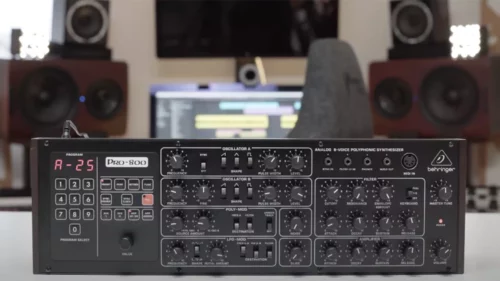
Behringer has officially introduced the Behringer PRO-800, an 8-voice polysynth module – a reinvigorated reboot of the Sequential Circuits Prophet-600, and Behringer says that its new Prophet-inspired Pro-800 is “the world’s first analogue 8-voice polysynth that is affordable for everyone” – have a price and release date.

It was teased in 2020 and said to be “almost there” early in 2021, the Pro-800 has two more voices than the synth that inspired it, with each voice offering two VCOs.

The Pro-800 has been created with the help of synth designer GliGli, who specialises in modding the Prophet-600, and his improvements are present and correct here. There’s also a non-standard noise generator that was only found on the rare Japanese editions of the Prophet-600, full MIDI CC control, USB MIDI, a dual polyphonic sequencer, a dedicated LFO with six waveshapes and VCA overdrive.

The Behringer version also cuts manufacturing costs, compared to the original design, by eliminating the keyboard, shrinking the interface to fit the Eurorack format and using modern mass-production build techniques.

Some may question Behringer’s decision to retain the worst aspects of the original’s interface, the membrane switch control and limited LED display. But, by retaining these elements, the Behringer PRO-800 copies the look of the original, which will increase the perceived value of the synth for some, compared to similarly priced synths that have much more powerful synth engines, like Behringer’s own Deepmind 6, the ASM Hydrasynth Explorer or the Korg Modwave. You can get an overview of the Pro-800 in the video above. The Behringer PRO-800 synthesizer is expected to be available in April 2023, priced at $599.


ESI introduces Affordable Desktop Audio Interfaces, Neva Uno and Neva Duo


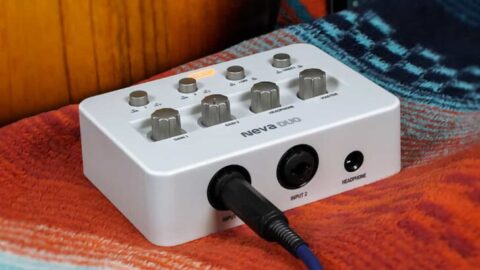
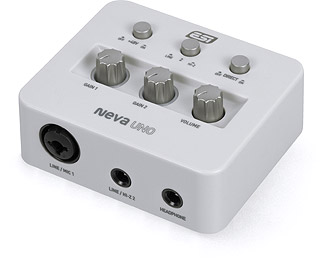
ESI has introduced a pair of affordable audio interfaces, the Neva Uno and Neva Duo.

The Neva Uno features a single XLR combo microphone preamp, while the Neva Duo features 2x XLR microphone preamps.

“We decided that it is time to provide basic professional features, like ultra-low-latency ASIO drivers and decent 24-bit / 192kHz support, at a cost anyone can afford.”, says ESI CEO Claus Riethmüller.

Neva Uno Features:

  • 2 input / 2 output 24-bit / 192kHz USB 3.1 audio interface with USB-C connector
  • XLR combo microphone preamp with +48V phantom power support
  • Hi-Z instrument input with 1/4″ connector
  • USB bus powered (no additional power adapter needed)
  • line output with unbalanced RCA connectors
  • headphone output with 1/4″ connector
  • ADC with 97dB(a) dynamic range
  • DAC with 107dB(a) dynamic range
  • zero latency hardware direct input monitoring activated by switch
  • master output volume control
  • supports Windows 10, Windows 11 with ASIO 2.0, MME, WDM and DirectSound
  • supports macOS via the native CoreAudio USB audio driver from Apple
  • stereo hardware loopback channel for internal recording


Neva Duo Features:

  • 2 input / 2 output 24-bit / 192kHz USB 3.1 audio interface with USB-C connector
  • 2x XLR microphone preamp with +48V phantom power support
  • 2x Hi-Z inputs with 1/4″ connector
  • USB bus powered (no additional power adapter needed)
  • line output with balanced/unbalanced 1/4″ TRS connectors
  • headphone output with 1/4″ Stereo connector and separate volume control
  • ADC with 97dB(a) dynamic range
  • DAC with 107dB(a) dynamic range
  • zero latency hardware direct input monitoring activated by switch
  • master output volume control o supports Windows 10, Windows 11 with ASIO 2.0, MME, WDM and DirectSound
  • supports macOS via the native CoreAudio USB audio driver from Apple
  • stereo hardware loopback channel for internal recording


ESI expects the Neva Uno and Neva Duo to be available in Europe in December, priced at € 69 and € 85 respectively, and globally early next year. Find out more on the ESI website.