Adobe Podcast Make Trash Audio Sound Like Studio Recording


Can Adobe’s free online tool make your low-quality spoken word recordings sound like they were made in a pro studio?

Adobe has pre-launched Adobe Podcast (previously known as Project Shasta), a new set of online tools for audio processing. Currently free to those who request and are granted access, at the moment this offers two usable elements: an AI-powered speech enhancer that automatically cleans up your audio, and a Mic Check feature that tells you how well you have your recording rig set up.

It is the Enhance Speech tool that’s generating the most interest, as it promises to make voices sound as if they were “recorded in a professional studio,” even if the audio that you give it was captured using a cheap mic or less-than-ideal environment.

The process is similar to the one used by many AI auto-mastering platforms – simply drag an audio file onto the web page and Enhance Speech will go to work.


PiXimperfect provides a good overview of the kinds of results you can expect from Enhance Speech in the video above, and we have to say that they are rather impressive. Adobe’s technology appears to do a good job of removing audio artefacts, harshness and background noise, and makes a reasonable fist of cutting mic handling, plosive and sibilant sounds, as well. Speech Enhance is a tool that’s mainly used when recordings are particularly bad.

The other usable Adobe Podcast tool is Mic Check, which will analyse a sample recording from your mic and tell you how well it scores for proximity, gain, background noise and echo.

Other options in the pipeline include the ability to edit spoken audio from an automatically generated transcript, a Remote Recording feature that captures group discussions made in multiple locations and then assembles them in the cloud, and project templates to speed up your workflow.

It is worth emphasising that Adobe Podcast is specifically designed to handle speech at the moment, and so, as its name suggests, will likely be of most use to podcasters and creators of other content that features spoken words. However, there may well be scope to use it on recordings of sung vocals in the future, as well.

You can find out more about Adobe Podcast and request access on the Adobe website.
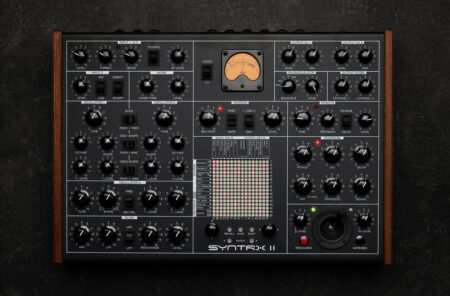
 

Erica Synths SYNTRX II Available Now


Erica Synths has announced the availability of their SYNTRX II.

Introduced at Superbooth 2022, the Syntrx II is an update to their Syntrx synth that takes the EMS Synthi AKS concept into the future.

While the Syntrx II is inspired by the classic EMS Synthi AKS design, it features stable oscillators, new synthesis options, a digital patch matrix, patch recall, a built-in sequencer, effects and more.


An in-depth overview from Loopop‘s Ziv Eliraz:


Features:

  • Two stable main oscillators with CV controlled waveforms
  • Modulation oscillator with variable waveforms
  • Highpass and Lowpass filters in series
  • Free running or gate synced sample and hold circuit
  • Multi-colour noise generator
  • DC coupled instrument inputs with signal inversion and envelope follower
  • Ringmodulator of unique design
  • Looping trapezoid envelope generator and VCA
  • Two output VCAs
  • Signal meter with a dedicated audio/CV output
  • FX section with great sounding Delay and Reverb
  • Recordable Joystick Analogue patch matrix with 3 attenuation levels in each patch point
  • 254 patch memory
  • Piano roll sequencer
  • Two CV inputs
  • Gate input
  • DIN5 MIDI Input (CV and Gate) and MIDI Thru
  • Two assignable outputs
  • Headphone output


Erica Synths Syntrx II available now, priced at € 1800.00 (VAT excl.)/ $2179.


Free Arturia’s Filter MS-20 plugin could be the end-of-year treat you have been waiting for


The filter section on the Korg MS-20  synth is legendary in music production circles, with its filthy sound and screaming resonance. Now, thanks to Filter MS-20, Arturia’s new free plugin, you have the opportunity to have it in your DAW for free.

As on the original you get both high- and low-pass filters, both of which feature those much-loved Peak (resonance) controls. In addition, there’s a distortion section for additional filth.

Arturia has also taken the opportunity to add some modern enhancements to Filter MS-20. You can “modulate and animate the virtual circuitry”, reroute the filter and distortion sections and add stereo width.

The plugin is tweakable; it has a knob-per-function main interface, macro-style controls for easy edits, and an Advanced panel that gives you access to the envelope follower, step sequencer and function generator.


This means that Filter MS-20 is flexible – capable of creating everything from filtered and distorted sounds to stereo phasing, pumping sidechain and auto-wah effects, in fact.

Its launch follows the release of Arturia’s emulation of the MS-20 synth earlier this year. This is included in its V Collection 9  bundle.

You’ll note that the font for the Filter MS-20’s logo nods to the one used by Daft Punk – the French duo are believed to have been fans of Korg’s synth. Other famous MS-20 lovers include The Chemical Brothers and Aphex Twin.

It runs on PC and Mac in VST/AU/AAX formats.

The regular price of Filter MS-20 will be €99, but it can be downloaded for free until 2 January 2023. and you can download it now from the Arturia website.