Tone2 Updates Electra3 Synthesizer with ‘A Massive Number Of New Features’
Tone2 Audiosoftware has released Electra 3.0, “a giant update with a massive number of new features and sounds.”
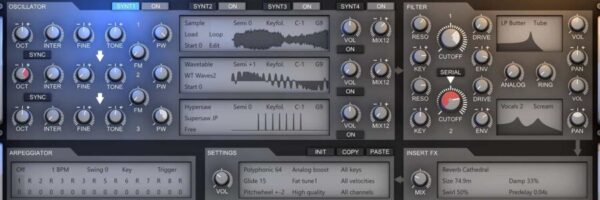
Electra 3.0 features a scalable interface, with support for displays up to 8K; a deeper synth engine with new oscillator types, modulation types and more; improved effects; more efficient CPU usage; and more.
What’s new:
New features – interface:
- GUI with 16 different sizes (with and without editor / effects).
- Native support for WQHD, 4K, 5K and 8K UHD displays.
- GUI can be scaled from 50% up to 300% by clicking in the lower right corner.
- Smoother animations and more responisve controls.
- Support for hardware-acceleration.
- Ultrasharp graphics with enhanced HiDpi and Retina Display support.
- The SYNTH button flashes when a layer plays a note.This makes it easier to work with several arpeggiators.
- Automatic detection of the ideal GUI size.
- A check-mark shows the last loaded custom-waveform.
- Online help with tutorial videos.
New features – synthesis:
- 118 additional patches that make use of the new features. The synth ships with 1439 patches now.
- The 8Bit noise oscillator can create lo-fi fx sounds from the past.The sound can be changed with PW and the key.
- Major and minor chords are available as additional key modes for the arpeggiator.
- The new ‘Transient shaper’ adds punch and presence to the sounds. It can be accessed in the ‘sound mode’ selector.
- The new ‘Transient + Bass’ mode adds presence and dynamic bass pressure to the sounds.It can be accessed in the ‘sound mode’ selector.
- New analog pulse oscillator types : Pulse 1/2, Pulse 2/5, Pulse 1/3, Pulse 1/4, Pulse 1/5, Pulse 1/6, Pulse 1/8.
- New analog oscillator types with inverted phase : Saw invert, Pulse invert.
- New analog oscillator types : Impulse, Sine Flip, Comb 2, Comb 3.
- New reverb-types : Cold, Theater and Hangar.
- 40 new waveforms for the custom-wave/wavetable oscillators.
- New bipolar modulation source : “Step LFO/Envelope +-“.
- Monophonic LFOs that re-trigger only with the first pressed key (set the LFO mode to ‘Mono’).
- Monophonic STEP LFOs (set the trigger mode to ‘Mono loop’).
Enhancements – synthesis:
- The audio-engine now uses 64-bit precision instead of 32-bit, which results in a higher sound-quality.
- CPU useage has been lowered.
- Maximum Delay-time has been extended.
- Enhanced sound of the automatic micro-tuning : A wide range of chords are detected.
- Replaced ‘Reverb Hall’ with a better sounding algorithm.
- Slightly enhanced sound of the Reverb types ‘Cathedral’, ‘Room’, ‘Infinity’, ‘Big’, ‘Glass’, ‘Plate’.
- The arpeggiator’s Stack-mode has been enhanced and can handle polyphonic input and duplicate notes.
- Enhanced sound of Unison.
- Unused matrix slots are cleaned-up automatically after saving patches.
New Multistep-Envelope / LFO (available for each one of the 4 synth-layers):
- The STEP LFO has been completely rewritten.
- It can be used as a Multistep Envelope by changing trigger-mode to Envelope.
- The modulation capabilities of the synth have been extended drastically.
- Editing and sound-design is more intuitive.
- A realtime-display visualizes the current shape.
- The current play-position is shown.
- Unused parts of the LFO are faded-out.
- The STEP LFO shape and values are not longer only updated after NoteOn.
- It offers higher precision timing.
- It is able to interpolate and sounds a lot smoother.
New Multistep-Envelope / LFO waveforms:
- Linear to left : Interpoles smoothly to the step located to the left.
- Cubic to left : Interpolates with a cubic spline.
- Analog slow : Analog envelope smoothing with low cutoff.
- Analog medium : Analog envelope smoothing with medium cutoff.
- Analog fast : Analog envelope smoothing with high cutoff.
- Analog reverse : Inverted analog envelope.
- Saw down : The step ramp downwards.
- Saw up : The step ramps upwards.
- Triangle : The step ramps upwards and downwards.
- Triangle 25 % : Sloped triangle.
- Triangle 75 % : Sloped triangle.
- Pulse 0 % : The second part of the step is 0.
- Pulse 50 % : The first part of the step is 0.
- Decay 1 : Slow analog decay envelope.
- Decay 2 : Fast analog decay envelope.
- Attack 1 : Slow analog attack envelope.
- Attack 2 : Fast analog attack envelope.
- Sine / 2 : Sine with half frequency.
- Cosine / 2 : Cosing with half frequency.
- Sine + -: Bipolar sine.
- FM Sine : The FM modulated sine is useful for wobbles.
- FM Square : FM modulated square-wave.
- FM Saw down : The FM modulated saw is useful for wobbles.
- FM Saw up : The FM modulated saw is useful for wobbles.
- Noise : A step with noise.
- Diffusion : Noisy diffusion between steps
Enhancements – interface:
- Completely rewritten GUI code.
- More beautiful graphics for the LCD displays.
- The animations of the filter, LFO, waveform and envelope-displays are drastically faster and smoother.
- More contrast for the knob-handles.
- Reworked many graphics.
- LFO waveform display is bigger.
- Keyboard in patch browser is hidden when editor or effects are hidden.
- Fine-tuned many coordinates in the interface.
- Fine-tuned some colors.
- More immediate control of filter cutoff and parameters.
- More tooltips with better descriptions.
- Layers are initialized with a smoothed gate shape.
- Patch browser can now also be opened by clicking on ‘BROWSER’ or the display on the upper left.
- A finger is shown when hovering over ‘BROWSER’ to indicate that the control is click – able.
- The interface gets a blue shading when drag & drop modulation is used.
- When a patch uses the STEP Lfo it is show automatically after loading.
- The user is warned if he / she selects a GUI size that is too large for the screen.
Enhancements – synthesis:
- Enhanced sound quality.
- More precise pitch calculation.
- Higher precision timing of the LFOs.
- Enhanced sound of white noise.
- Enhanced sound of pink noise.
- Analog oscillators are more in-tune and have more beautiful noise.
- Step LFO shape and values are not longer updated only on NoteOn.
- Step LFO is able to interpolate and sounds smoother.
Other enhancements:
- Enhanced DAW compatibility and stability.
- Performance optimizations.
- Smarter detection of the installation path on PC to avoid duplicate installations.
- All links are now https.
- A huge number of small enhancements.
Electra 3.0 is available now, with an intro price of $169.