Elektron Digitakt v1.50 adds Sample Playback Machines and More


Elektron has released Digitakt firmware v1.50, a free update for the 8-voice digital drum computer and sampler that adds four different Machines, each with their own flavor:

  • Repitch for automatic classic beat-matching;
  • Werp for a little quirky old-school way of time warping;
  • Slice – to chop up your audio and placing the pieces back in any order you like; and
  • Oneshot, the default Machine for playing your sample forward, backward or looped.


In addition, the update adds a new way to record your samples. You can now set a fixed number of steps for your recording. And, Sample Rate Reduction that can be inserted before or after the filter.


What’s new in Digitakt 1.50:

  • Added sample playback enhancements by implementing sample playback machines that add features such as warping and sample slicing.
  • Added Sample Rate Reduction functionality that can be routed either post- or pre-filter.
  • Decreased the encoder sensitivity when changing MIDI parameters.
  • Improved the filter type switching to reduce the amount of unwanted audio artifacts that could occur.
  • Added the functionality to record loops based on the current BPM when sampling or re-sampling.
  • Previewing a sample or a recording while on a MIDI track is now possible by letting it be previewed on the neighbouring audio track.


Find out more Digitakt 1.50 on the Elektron website and share your thoughts on the update in the comments!

Update: Here’s a deep dive into the updated OS via Dave Mech:
 

Doctor Mix AI Synth Available Now as a Free download


ChatGPT built the world’s first AI-coded synthesizer and you can download the plugin for free.

ChatGPT has been making headlines in every corner of the technological landscape this year, and the music tech world has been no exception. Since it launched, we’ve seen the AI-powered chatbot construct chord sequences, write lyrics, make playlists, and even produce code for effects plugins.

YouTuber Doctor Mix has added to this list of achievements by creating the first VST synthesizer from code authored by artificial intelligence. In a video posted on February 28, the YouTuber used ChatGPT to develop a synth plugin that he’s (rather unimaginatively) named Doctor Mix AI Synth, and released to the public as a free download.

Though ChatGPT generated code used in the plugin, the process wasn’t quite as simple as it sounds: after first asking the chatbot if it could code a synth, Doctor Mix received a negative response: “I’m sorry, but as a language model, I do not have the capability to code a VST synthesizer”, ChatGPT responded.

With some cajoling, however, the chatbot was able to generate code for a simple sine wave synth to be deployed within the open-source C++ framework WDL-OL. Doctor Mix then attempted to use ChatGPT to guide himself through the process of transforming this code into a useable plugin, but shortly hit a brick wall.

After heading to Amsterdam to seek some assistance from plugin developers Martinic – and getting distracted by a few choice bits of vintage gear in the process – Doctor Mix was able to integrate the code generated by ChatGPT with some additional code written by Martinic’s developers.

This process produced a working software synthesizer capable of receiving MIDI input. Martinic’s team then added some extra features, including a filter and an amplitude envelope, compiled this code into a VST/AU/CLAP plugin, complete with a somewhat questionable GUI, and released it for free via their GitHub website.

While it’s far from the most powerful free VST synth plugin we’ve ever come across, it’s certainly the first to be co-developed by AI, and for that it deserves some recognition.

Find out more on Martinic website or subscribe to Doctor Mix on YouTube.


Experimental Groovetube Plasma Synthesizer Available Now via Kickstarter


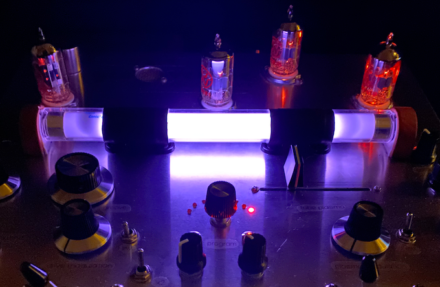
Developer Tom Hardiment has launched a Kickstarter project to fund production of the Groovetube plasma synth.


Audio is generated by a plasma instability inside a fluorescent tube, which you can control and shape with a magnet.


Tom Hardiment says “It’s a bit like a theremin crossed with a 303, dunked in a bucket of drippy/splintery plasma…”


What they say about the Groovetube:

“We are releasing this first-generation machine for people to try out a new way to make noise. It is a sort of proto-instrument – an experimental machine to be experimented with!

Having machines out in the world will help explore what is possible, as there is a lot of unexplored territory here – we don’t have much audio equipment, and have tried a dozen or so tubes. By making these machines available now, we hope to not only fund further development but also let collective experimentation inform its direction.”


The Groovetube is available to project backers for £699 (about $840).

*Note that crowdfunded projects involve risk. See the project website for details.