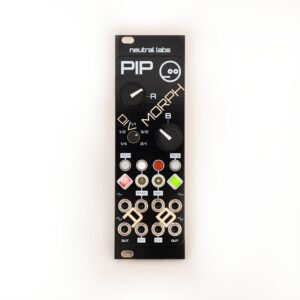
Neutral Labs introduces 2 New Eurorack Modules, PIP and NIJEL, available Assembled & as DIY Kits

Neutral Labs has introduced 2 new Eurorack modules:

  • PIP, a dual clocked CV generator/recorder; and
  • Nijel, a 4 HP distortion module.

PIP is a dual clocked CV generator/recorder. It offers two morphable CV generators/complex LFOs in 8 HP that can be synced to each other in predefined ratios, unsynced or phase-shifted between each other.

You can choose from a large variety of preset waveforms or random waves. The module also allows you to record, morph and time-stretch your own external CV or knob movements.

Pip is available now as an assembled module or full DIY kit from retailers.

NIJEL is a 4 HP distortion module that enables you change its character by plugging in components like diodes, capacitors or resistors directly to the front panel. Assembled modules and DIY kits come with a set of small components for experimentation. A set of preset cartridges is also available, which gives you instant access to a variety of sounds. The preset cards are also compatible with the Neutral Labs Scrat customisable multimode filter.

Nijel is available now as an assembled module or full DIY kit from retailers. The set of 4 preset cards called Nuts (Acorn, Almond, Cashew and Pecan) is recommended, but not necessary to operate the module and so it is sold separately.
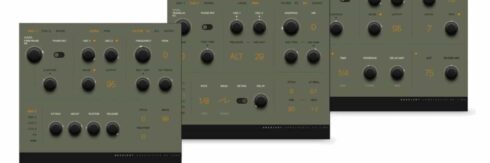
Constructs Of Time introduces Gradient Synthesizer for Kontakt Player


New software synthesizer maker Constructs of Time has introduced Gradient, a polyphonic synthesizer for Kontakt Player that they say “captures the raw and organic sound of analogue.”

The sound of Gradient starts with a Eurorack modular system and a modified ARP Avatar that are deeply multi-sampled, to create tube-saturated sine waves, chorused saw waves, noisy pulse width modulation and powerful ring modulation. Gradient’s filters, modulation sources and effects further shape the sound.

Features:

  • Works with Native Instruments’ free Kontakt Player
  • NKS compatible
  • 190+ production-ready presets
  • 2 oscillators (83 waves) & 1 noise generator (21 waves)
  • 3 panning modes (alternate, key tracking, random)
  • Lowpass and highpass filters
  • 4 shapers (overdrive, grit, crush, tape)
  • 2 envelopes & 2 syncable LFOs with multiple destinations
  • Delay & reverb

Gradient is available now for €75 (excl. VAT)

Roland introduces “premier” GP Digital Grand Piano range.

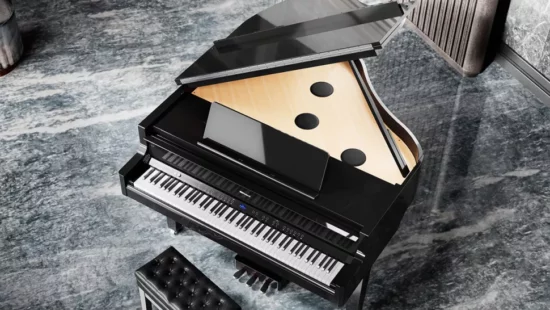
Roland’s “premier” GP digital grand piano range includes a $19,000 self-playing model, but there are cheaper options, as well.

The GP-6, GP-9 and GP-9M join the super-compact GP-3

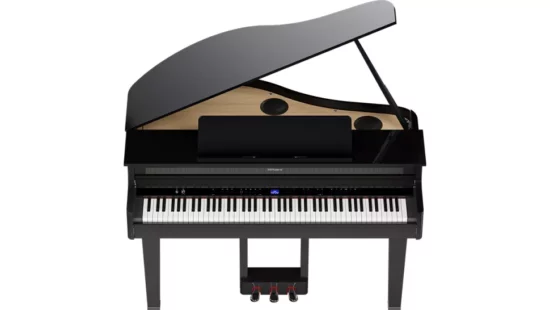
Roland Corporation today has introduced its full line-up of flagship GP digital grand pianos, which are designed to look as good as they sound. We’d already seen the ultra-compact GP-3, and this has now been joined by the GP-6, GP-9 and GP-9M.

The GP-9 and GP-9M sit at the top of the range, coming in large cabinets that are finished in either high-gloss ebony or polished white, features the ‘Piano Reality Concert modelling’ represents Roland’s latest technology and is designed to emulate every element of an acoustic piano – from the soundboard material and frame to the strings, hammers and more.

GP-9 and GP-9M offer unlimited polyphony, notes and resonances, a progressive hammer action keyboard with escapement, hybrid wood/moulded key construction with Ivory Feel, and advanced acceleration sensing technology for accurate detection of the subtlest playing nuances.

You even get haptic feedback from the keys that’s designed to emulate the physical resonances of an acoustic piano’s body, along with “high-performance” sustain, soft and sostenuto pedals with a weighted feel and damper modelling.

Careful attention has also been paid to the sound system, which promises multi-channel amplification, premium audio circuitry and advanced sonic processing to create an immersive, surround experience.

The guts of the GP-9 and GP-9M are the same, but the latter model is notable for its self-playing key function. It also comes with pro-level audio outputs and a mic input that enables you to sing along through the onboard speaker system.

The GP-6 is the mid-level piano in the range but, you still get the Piano Reality Premium modelling sound engine and keyboard and unlimited polyphony, and even though the cabinet is smaller, we’re still promised amazing sound.

GP-6 and GP-9 will be available this month priced at $6,300 and $11,000 respectively. The GP-9M will be available in May priced at $19,000, while at the other end of the scale, the GP-3 is available now at $4,000.

Find out more on the Roland website.