Aqusmatiq Audio intros Dedalus Delay VST Granular Looping & Layering Device

Aqusmatiq Audio has introduced Dedalus Delay, a real-time audio “delay mangler.”

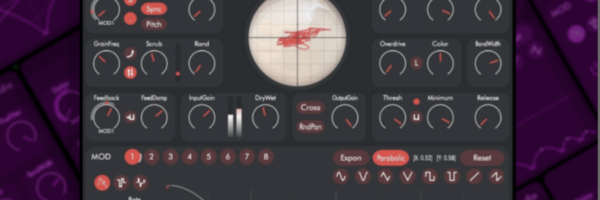
A network of delay lines is granulated and modulated, producing a labyrinth of echoes, which are further processed by filters, dynamic processors, and saturation modules.

Dedalus can create a wide variety of effects, from reverb-like ambiences to evolving resonations to pure noise.
Features:

  • The delay can be set in rhythmic values, in seconds and also ad MIDI note pitches (resonances)
  • The delay time can be continuously varied and granulated.
  • The feedback can be set up to 200% to create infinite ever-changing resonances. A limiter within the feedback circuit prevents the uncontrolled increase in sound volume.
  • Two cascaded fourth-order filters (low-pass and high-pass) allow shaping of the sound spectrum within the feedback loop.
  • The overdrive module creates a warm distortion that gives depth to the sound.
  • The duck/gate dynamics processor allows the sound produced by the delay to “breathe” along with the rhythmic accents of the incoming sound.
  • The plugin has 8 modulators that can be used to vary all parameters. One modulator can modulate another modulator and even modulate itself. You can draw the waveform of the modulator, use a step sequencer or a random waveform generator.

Aqusmatiq Audio is a new company founded by three experienced audio software developers: Diego Capoccitti, Maurizio Giri, and Alessandro Petrolati. Capoccitti is an electronic composer and expert in Juce and C++. Giri, also an electronic composer, has written a series of books on Max MSP and many devices under his Amazing Noises brand. Petrolati is a classical pianist and an electronic composer, and with his brand apeSoft has created several iOS apps and Max for Live devices.

Dedalus Delay is available now with an intro price of about $19 till March 31, 2023 (will be $49).

Behringer teases Roland Juno-60 Knockoff, the ‘Neptune-80’

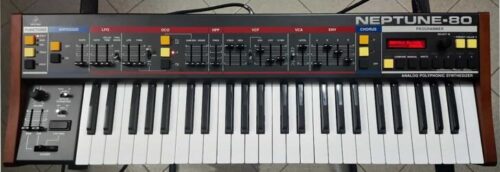
Behringer has announced a Roland Juno-60 knockoff, the ‘Neptune-80’.

Behringer Neptune-80 copies the synth architecture and look of the Juno-6/60, but reduces the size of the control panel and uses a 4-octave keyboard, instead of the 5-octave keyboard of the original. It appears that Behringer may be basing the Neptune-80 dimensions on the Deepmind 12’s form factor.

The original Juno-6/60 has a simple voice architecture, with a single Digitally Controlled Oscillator (DCO) per voice. But, while its voice architecture is basic, the synth is very well designed, sounds great and has an extremely user-friendly interface.

It looks like the Neptune-80 will retain much of what has made the original popular, while adding MIDI and upping polyphony to 8 voices.

What Behringer say about the Neptune-80:

“So, for years you guys have been urging us to build one of the most sought after synths. We managed to resist for a long time, but we finally gave in;-)

Here is the fully working prototype of our Neptune-80, an 8-voice polyphonic synth with original analog matrix, BBD chorus and modern user interface such as LCD Display, USB/Midi etc.

We modeled it after the best sounding 6/60 version and we absolutely love the sound.”

Behringer Neptune-80 pricing and availability details are still to be announced. The synthesizer in the teaser images is an engineering prototype, and manufacturing is dependent on Behringer being able to obtain parts in production quantities.

Check out the images and let us know what you think of the Behringer Neptune-80 in the comments!


Free Kick Drum Synthesizer by muted.io


Are you looking for a quick, easy and free way to generate a new kick drum sound?

Get your kicks for free with this effortless online bass drum generator. Heads on to muted.io website, the answer could be awaiting you over at muted.io.

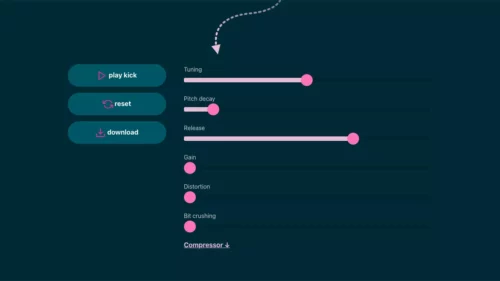
The Kick Drum Generator does exactly what its name suggests. Tweak the tuning, pitch decay, release, distortion, bitcrushing gain and compression parameters and you will hear previews of your sound as you go.

A built-in limiter should prevent any clipping, but if things start to get out of control simply click the reset button to return to the default settings. You can also reset parameters individually by double-clicking them.

Once you are satisfied and happy with your sound, clicking the download button immediately generates and saves a WAV file that you can take into your DAW, sampler or any other application or piece of hardware in your studio.

This is just one of many musical tools available on the muted.io website. Others include music theory charts and guide, a simple sequencer, a beat maker, a mini music machine and a chord player.