RYK Modular shared this video demo of the M175 Triple Resonator, a new module for the classic Roland System 100m modular synthesizer.
Consisting of three resonant Band Pass Filters arranged in parallel, the M175 is great for “adding some shape and character to a sound”. You can use the triple peaks to add acoustic style resonant spikes, or modulate them to create dramatic phaser style swooshes and sweeps. Additionally, you can tune the center frequencies to create formant-style vocal noises from waveforms with high harmonic content, such as pulse waves.
The M175 contains three dual Vactrols to control the center frequency of each resonator, which add a small amount of slew to the frequency modulation, famously associated with classic Buchla modules.
Features:
Three Vactrol controlled Band Pass Filters arranged in normalized parallel, or can be used as three separate filters.
Audio input signal is normalized to all three resonators, but can be overridden by inserting a jack into the resonators 1st inputs allow them to be used separately.
A mix output is available that sums the output of all three resonators, by inserting a jack into a resonators individual output overrides its output from the mix output.
Keyboard CV is supplied via the standard System 100m DIN connector, to the 1st modulation input of each resonator.
The 2nd input of the first resonator is normalized to each of the other two resonators
Authentic reproduction of Roland System 100m panel, with 100m grey paint finish and 70’s off white screen print.
STG Soundlabs has introduced an updated version of its Pulse Matrix, a comparator and divider network configured for audio applications in MU format.
It is designed so that it can be used independently as a comparator and suboctave generator, and it also can be connected directly to the STG Soundlabs Oscillator, so that the oscillator is normalized to the Pulse Matrix input.
What they say about it:
“Think of it as an elaborate version of the PWM and Suboctave of the SH-101. If you’re not familiar with the SH-101, think of it as a little box you can put any waveform into and get a pulse wave and 4 varieties of suboctave from.
The signal input is where you would put whatever you want to turn into a pulse wave into.
The threshold control sets the “flip” point of the comparator, and has a range of approximately negative five volts to positive five volts. think of it as a pulse width control.
The control input has a dedicated attenuator and is summed with the manual control, and allows for external modulation of the threshold point. Think of it as a pulse width modulation input.
Next are five outputs. They are all ten volt peak-to-peak signal to play nice with other audio modules. This is unlike the sh-101, where the suboctave had a dc offset which made its bass frequencies not as strong as they could have been.
The first is the direct output of the comparator. In “pulse width” terms this is zero to one hundred percent.
The second output is a 50 percent duty cycle wave one octave lower than the main output.
The third output is a variable output, from one to forty-nine percent duty cycle, one octave lower than the main output.
The fourth output is a 50 percent duty cycle wave two octaves lower than the main output.
The fifth output is a 25 percent duty cycle wave two octaves lower than the main output.
There is a rear panel header to connect to the STG Soundlabs Oscillator so the sawtooth wave is normaled to the input of the module. Cable is included.”
The Pulse Matrix is available to order for $250. STG Soundlabs says that there’s a lead time for orders of about 2 weeks.
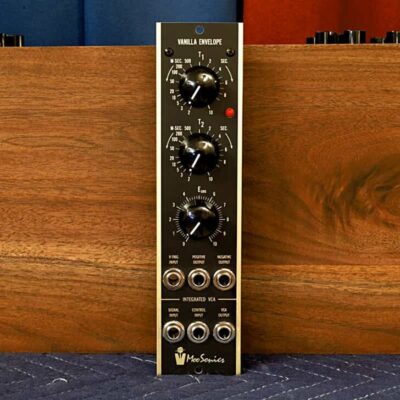
MooSonics – the recently resurrected modular synth maker, now led by Suit & Tie Guy (Knobcon, STG Soundlabs) – has introduced the Vanilla Envelope, a new envelope generator + VCA design that they say takes inspiration from “a certain American two voice synthesizer from the 1970s”.
The Vanilla Envelope provides two functions in one module: an envelope generator and VCA. The integrated functions can be used completely independently, if desired.
Suit notes that the MooSonics Vanilla Envelope adds a negative EG output; the VCA is ‘tweaked out’ to be a bit hotter on the input, so if you want to push it into distortion you can; and the input-output signal levels are updated to modern MU standards, as set by Roger Arrick 23 years ago with the Synthesizers.com line.
The top knob is attack time, second knob is decay and release time, and the third knob is the sustain level. The LED indicates output of the EG.
The VCA provides approximately unity gain, at a 5V control voltage or maximum EG sustain level.
MooSonics is initially making the Vanilla Envelope available as a kit. An assembled version may follow.
*Note: The PCB is labeled with all component values. It will ship with paper BOM and schematic. There is an assumption that buyers have some experience in building electronic devices. If you have no experience, you will need to do some research on basic assembly techniques.
The MooSonics Vanilla Envelope Kit will be available in April, priced at $150