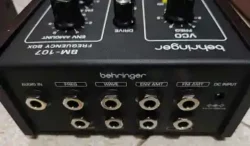
Behringer Previews Entire Line of ‘Boogerfooger’ Knockoffs
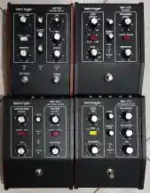
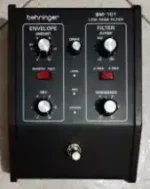
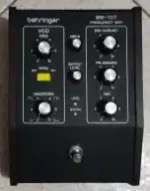
Behringer has shared teaser images of an entire line of hardware effects modules that appear to be fairly straight knockoffs of classic Big Briar/Moog Music Moogerfooger effects.

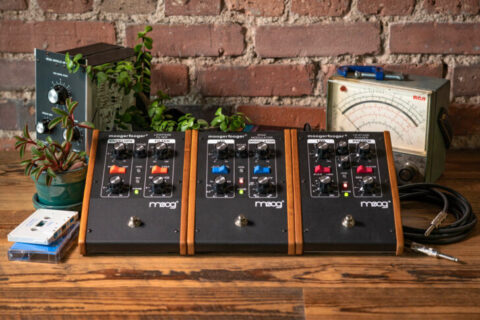
The images, above, show four ‘Boogerfooger’ effects:

  • The Behringer BM-101 Low Pass Filter copies the Moog MF-101 Lowpass Filter.
  • The Behringer BM-103 Phaser copies the Moog MF-103 12-Stage Phaser.
  • The Behringer AD-104 Analog Delay copies the Moog MF-104M Analog Delay.
  • The Behringer BM-107 Frequency Box copies the Moog MF-107 Freqbox.

The company originally announced its intentions to copy Moogerfooger effects about a year ago, with a preview of their AD104 Analog Delay. At that time, Behringer tagged the AD104 as #hardvaporware, indicating that they were not putting it into production yet, because of limited parts availability.

Behringer is not announcing pricing or availability for these effects yet, but says that their design is complete and that they are “now moving them all to beta testing.”

They have not said yet if they plan to make copies of the other members of the Moogerfooger line:

  • MF-102S Ring Modulator
  • MF-105S MuRF
  • MF-108S Cluster Flux

The Original Moog Moogerfoogers

Moog retired the Moogerfooger line in 2018, after making Moogerfooger hardware effects for about 20 years. Since then, used prices for Moogerfooger have increased, because of the popularity of the line and their limited quantities.

Last year, they introduced a full line of Moogerfooger plugins.

What about the MF-106?
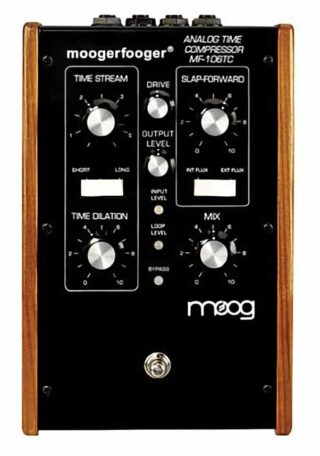
Some readers may have noticed a gap in the Moogerfooger numbering scheme between the MF-105S MuRF and the MF-107 Freqbox.

The Moog MF-106TC Analog Time Compressor, right, was announced April 1st, 2009, but has never been released. According to the company, the effect was the result of a happy accident:

“We accidentally reversed the clock phasing in the time generation on our MF-104Z Analog Delay, and discovered that it can actually work in reverse, compressing the time stream instead of expanding it. Much to our amazement and delight we began hearing sounds up to 1000 milliseconds before we played them,” said Amos Gaynes, Moog Temporal Engineer.

Gaynes said that the Analog Time Compressor circuit on the MF-106TC can eliminate digital latency in real time, or sound like you’re playing faster than you really are. The Analog Time Compressor’s unique Slap-Forward delay effect sounds even better than Slap-Back, according to Gaynes.

“The MF-106TC has hundreds of unique applications,” said Moog Marketing Manager Chris Stack. “Used on the Pitch Preview output of our new Etherwave Plus Theremin, you not only hear your note before the audience does; you actually hear it before you play it.”
Haxophone is A DIY Hackable Saxophone

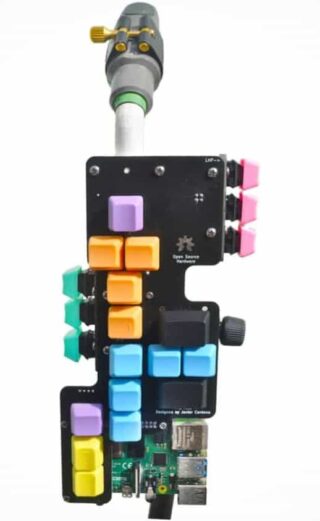
Haxophone is an inexpensive open source ‘hackable saxophone’, based on a Raspberry Pi HAT.

The mechanical keys and custom ergonomics are designed to give Haxophone a satisfying feel. The design is fully open source, hackable and OSHWA certified. This means that you can make Haxophone entirely your own, from changing the type of key switches to making your own note and instrument mappings.

The developer says that the Haxophone is a good fit for musicians who are also hackers, or for hackers looking for a fun musical project that won’t break the bank.

The Haxophone has been designed to utilize standard mechanical key switches as fingering keys. These are cheaper, more reliable and more repairable than the custom molded keys that you find on digital saxophones.

Haxophone is designed as a HAT (Hardware Attached on Top) for the Raspberry Pi family of single-board computers. The HAT includes an audio amplifier, so Haxophone does not need to rely on the amplifier built into the Raspberry Pi 3 and 4. This means the HAT will work with the least expensive of the Pi family, the Raspberry Pi Zero.

In order to keep costs down, the Haxophone PCB (printed circuit board) is an integral part of the physical structure of the Haxophone. Meaning that the key switches, thumb rests, mouthpiece and Raspberry Pi are all attached directly to the PCB. The side keys (left palm and right knuckle keys) are mounted on smaller PCBs and attached to the main PCB via right angle metal brackets. These smaller PCBs are manufactured as detachable panels, bringing down the manufacturing cost. Haxophone is an open source DIY project. See the project website for details.

Features:

  • Custom Raspberry Pi HAT PCB
  • Software:
    • haxo-rs: This is the driver that detects key presses, breath and converts it into notes. It’s written in Rust, and compiled on the Raspberry Pi into a native application
    • fluidsynth: This is the synthesizer software that will convert notes into sounds
  • Tactile-feedback 5-pin mechanical switches
  • Mechanical keycaps
  • Breath pressure sensor
  • Built-in audio amplifier (works with no-audio Raspberry Pi’s like the Zero and the Zero W) with 3.5mm audio out mini-jack
  • Serial console for hacking


Grp Synthesizer A1 works Standalone or as a Eurorack Synth Voice

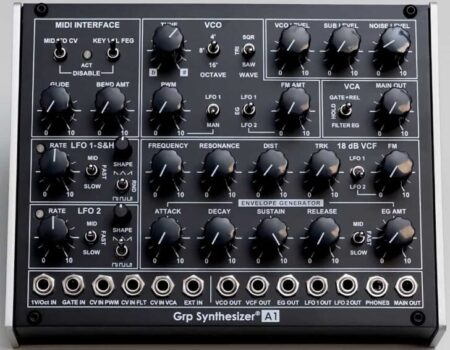
Italian synth maker GRP Synthesizer has introduced a new compact analog synth, the GRP A1.

The GRP A1 is an analog desktop instrument that can be used as a compact tabletop synth or as part of a Eurorack modular system. Features include a MIDI-CV interface, dual LFOs, VCO, suboscillator, noise, an 18dB VCF and ADSR EG. 11 patch points mean that you can use GRP A1 to process external signals, or integrate it with other Eurorack gear.

What they say about it:

“The Grp A1 monophonic synthesizer can be used as a stand-alone musical instrument or can be used to filter external signals through the Low Pass 18dB VCF resonant circuit. The presence of three internal signals (VCO, SUB and NOISE) ensures timbral power and ease of use. With the two Low Frequency Oscillators – LFOs (the first, integrates a Sample & Hold S&H) and the Envelope Generator ADSR, you can sculpt cyclic or transient modulation behavior.

The instrument can be powered via a USB type C cable connected to any USB 2.5A power supply.

It can also be taken out of its cabinet to be easily installed in any EuroRack modular system; it can be powered using the normal flat cables supplied with EuroRack systems.”

GRP A1 demo video, via SchneidersLaden:

Grp Synthesizer A1 is available now for € 491 plus VAT. via Dave Makoun