Korg microKORG Crystal Celebrates 20 Year Anniversary of a Classic Synth


The Korg microKorg Crystal makes it clear that the iconic synth is celebrating its 20th anniversary. A transparent attempt to give the microKorg a slick new look.

20 years ago, Korg’s microKorg helped to kickstart a trend for affordable, portable synths, and its built-in vocoder gave it an additional layer of hipster cool. To celebrate this double-decade anniversary, a new semi-translucent version – microKorg Crystal – has been released, giving you the opportunity to see what’s going on inside.

Korg today introduced microKorg Crystal, a new 20th anniversary variant of the microKORG.

What they say about it:

“Two decades ago, the portable, battery-powered microKORG was born with a radical new micro-keybed, a powerful Vocoder and ready-to-use sounds.

This compact sound monster introduced synthesis to a vast number of non-keyboard playing musicians and created a way of making music we now take for granted: a small keyboard resting unassumingly atop a larger one onstage, made for use by hobbyists and pros alike and finding itself front and center of studios worldwide from the smallest bedroom to the largest pro recording facility.

To celebrate the 20th anniversary of its release, the special edition microKORG Crystal offers a unique and stunningly stylish take on this beloved synth – now a classic in its own right.”
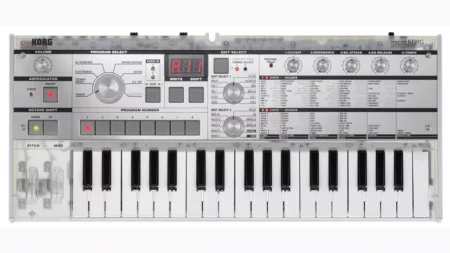
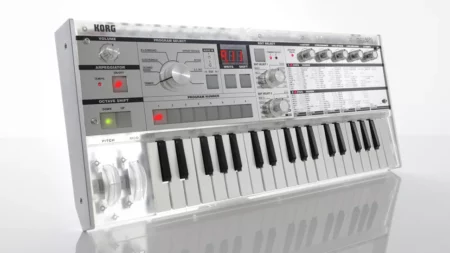
20th Anniversary Model

The microKORG Crystal features a new take on the structure of the microKORG, with a semi-translucent chassis that lets you see the electronics and internals. Even the controllers are semi-transparent, including the knobs, dials and wheels.

The microKORG Crystal features a stainless mirror-finish front panel that is designed to coordinate with the semi-translucent knobs and dials. And, while the original microKORG featured wooden side panels that suggested a retro feel, the new microKORG features aluminum side panels.

The microKORG Crystal is available to pre-order for $529.99.
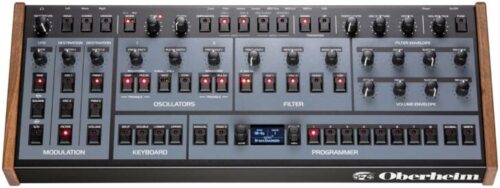
Oberheim OB-X8 Desktop Module Coming at Superbooth 2023

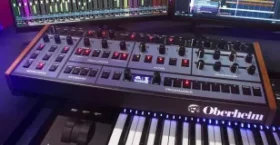
At Superbooth 2023, being held in Berlin May 11-13, Oberheim is introducing the OB-X8 Desktop synthesizer.

The Oberheim OB-X8 keyboard, introduced at last year’s Superbooth, combines the three different voice architectures of the classic OB-X, OB-Xa, and OB-8 synths into a single instrument. The individual filter types and other unique characteristics of each model have been faithfully reproduced, along with a 100% analog signal path. Since then, it’s earned a reputation as a worthy successor to Oberheim’s classic synths.

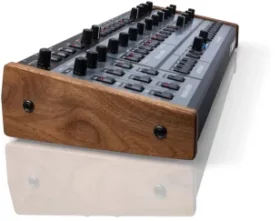
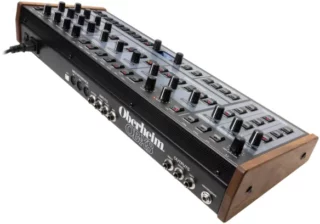
The new OB-X8 desktop version has the same features as the keyboard version, without the 61-note Fatar keybed and pitch/mod levers. The OB-X8 desktop module boasts an identical sound engine to the keyboard version, featuring an all-analog signal path with discrete VCOs, VCAs, and filters.

The desktop version also features the same knob-per-function sound design experience, with immediate access to virtually all the synth’s parameters.


Page 2022

OB users know that the myriad of “Page 2″ functions unlocked the hidden power of the original OB-8.

The OB-X8 includes all of the classic Page 2 parameters, along with new ones, giving you direct access to 40+ controls, including additional SEM filter modes, per-voice panning, LFO keyboard tracking, Mod delay time and envelope inversion, independent pulse width control and more.

Features:

  • 8-voice analog polyphony
  • Two discrete OB-X/SEM-lineage VCOs per voice deliver classic punchy Oberheim tone
  • Discrete SEM-lineage VCFs deliver authentic OB-X-style tone and presence
  • Genuine Curtis filters add bold OB-Xa/OB-8 character
  • Meticulously modeled envelope responses match each OB model: OB-X, Ob-Xa, and OB-8
  • Bi-timbral capability allows two presets simultaneously for splits and doubles
  • 400-plus factory programs, including the full set of factory sounds for the OB-X, OB-SX, Ob-Xa, and OB-8
  • Integral fan-less, heatsink-free power supply
  • Walnut end cheeks
  • High-resolution OLED display enables patch management and easy access to advanced features

Enhancements:

  • Additional SEM filter modes add high-pass, band-pass, and notch functions to the classic OB-X filter
  • Vintage knob allows variable amounts of voice-to-voice variability to emulate the behavior of vintage instruments
  • Velocity response adds expressiveness to volume and filter
  • Channel Aftertouch response adds real-time performance-based modulation
  • Enhanced unison allows variable voice stacking from 1-8 voices
  • Programmable per-voice pan allows wider stereo presence
  • Variable oscillator and noise levels
  • Variable triangle wave cross-modulation
  • Over 600 user-programmable preset locations

Details on pricing and availability are to be announced. Find out more on the Oberheim website.

Doepfer introduces 4 New Eurorack Modules

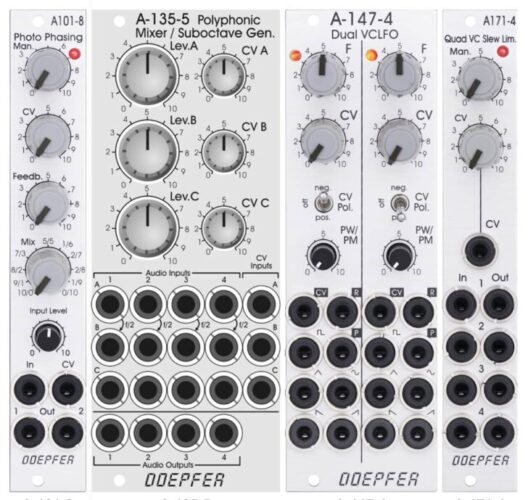
Ahead of Superbooth 2023, being held in Berlin May 11-13, Eurorack pioneer Doepfer Musikelektronik has announced four new modules:

  • A-101-8 Photo Phaser;
  • A-135-5 Polyphonic Mixer with Suboctave-Option;
  • A-147-4 Dual LFO with PW/PWM; and
  • A-171-4 Quad VC Slew Limiter.


What they shared about the details for each module:

  • Module A-101-8 is a 8-stage phase shifter which uses light-sensitive resistors (LDR) and is a replica of the Compact Phasing A manufactured by the company Schulte in the seventies. The actual phasing circuit is identical to the historic model. Only the illumination control of the LDRs is different: the A-101-8 uses LEDs to illuminate the LDRs, the historic model used incandescent miniature lamps. And the A-101-8 has no built-in LFO but can be controlled by any external control voltage source (e.g. LFO, ADSR, random, Theremin, ribbon controller, sequencer, midi). The phasing offset (i.e. the base value for the phase shifting) and the modulation depth of the external control signal can be adjusted separately. The Compact Phasing A had no offset control but only a depth control for the built-in LFO. Feedback and mixing ratio of the output signal are set by two controls. The audio input is equipped with an attenuator. The module has two audio outputs available (same as the historic model) and a visual display of the phase shifting.
  • Module A-135-5 is a combination of a voltage controlled polyphonic mixer and a polyphonic suboctave generator. It is made of 12 voltage controlled amplifiers (VCAs) which are arranged in form of a 4×3 matrix. Herewith up to three four-voice polyphonic signals (e.g. the outputs of three polyphonic VCOs A-111-4) can be mixed. The level of each of the three polyphonic channels (A, B, C) with four voices each can be controlled manually or by means of an external control voltage with associated attenuators.
  • Module A-147-4 is a dual voltage controlled LFO (Low Frequency Oscillator). Each LFO has the five waveforms triangle, sine, rising and falling sawtooth, as well as rectangle available. The rectangle output features manually adjustable pulsewidth and pulsewidth modulation by means of an external control voltage. The core waveform is triangle. The other waveforms are derived from triangle by means of waveform converters. The frequency of each LFO can be adjusted manually and modulated by means of an external control voltage with associated attenuator and polarity switch. By means of a jumper the basic frequency range of each LFO can selected: about 0.02 Hz (~ 50 seconds) … 2.5kHz or about 0.0017 Hz(~ 600 seconds) … 220Hz. That way each LFO can be used also as a VCO with a max. frequency of about 2.5kHz. Each LFO features a reset input which can be used to reset the triangle signal.
  • Module A-171-4 is a fourfold voltage controlled slew limiter. It’s intended purpose is polyphonic portamento but can be used also for other applications where several slew limiters are required. The common slew time can be adjusted manually and in addition controlled by an external control voltage. The module uses light-sensitive resistors (LDR). Therefore the slew times are not exactly the same for all units due to the tolerances of the LDRs and the LEDs, which are used to illuminate the LDRs. Inputs and outputs of the slew limiters are buffered to avoid voltage drops. This is especially important for polyphonic portamento applications. Each output can drive several VCOs without the need of exernal buffers. In addition the slew limiter inputs and outputs are available at internal pin headers for internal pre-wiring of polyphonic patches. As the switching contacts of the sockets are used for the internal pre-patching the internal patch can be overridden by using the sockets at the front panel.

Find out more on the Doepfer website.